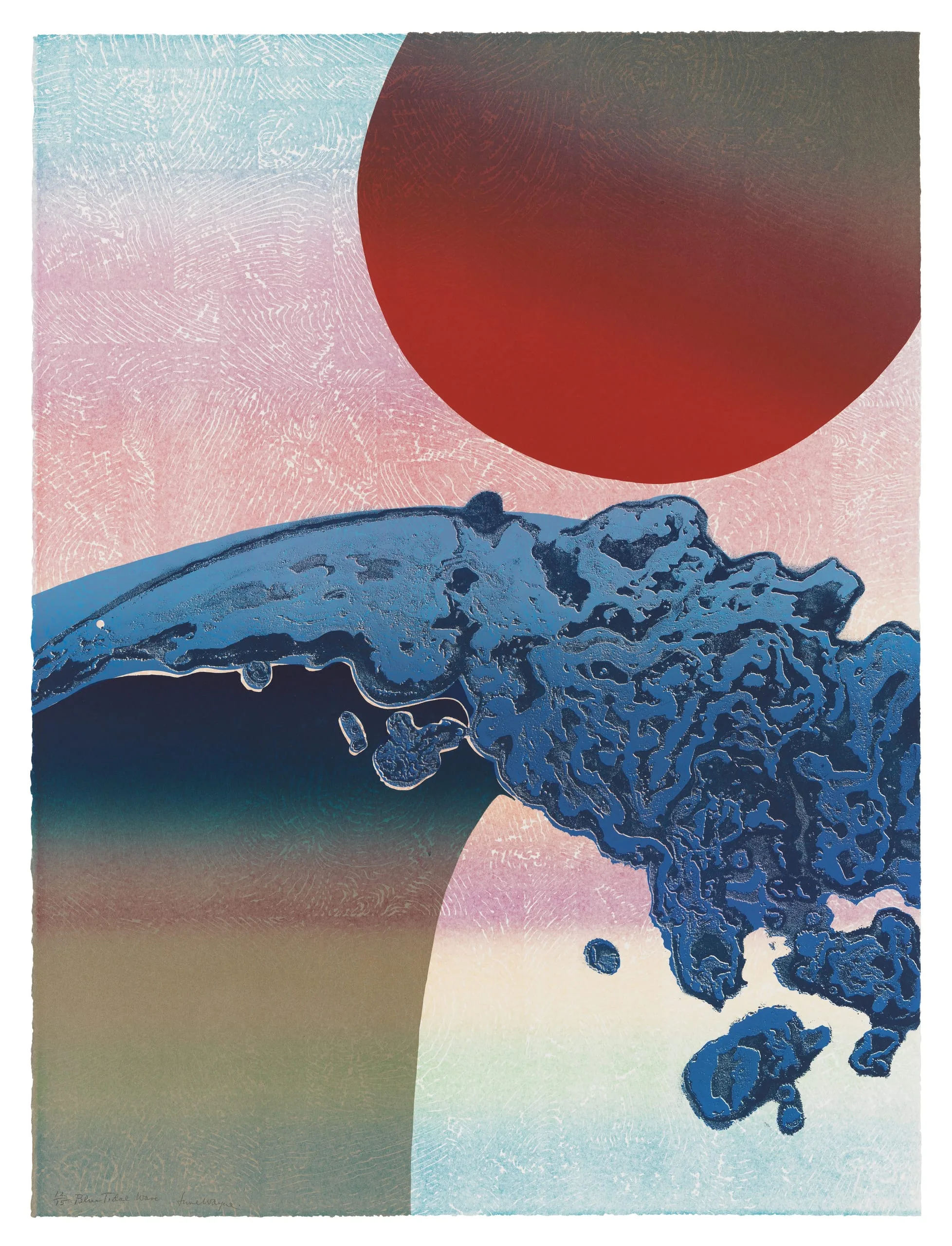
Blue Tidal Wave was realized in three different mediums—lithography, painting, and tapestry—in varying scales. The lithograph (here) is 29 1/2 inches in height, the painting 72 inches, and the tapestry 86 inches. Wayne believed that the effect of scale impacted the image itself, and that the range of smaller and larger scales became more dynamic in juxtaposition than a life-size image alone would be. In describing the lithograph, she noted, “What’s very interesting about this image is that the background, the pink-blue sky, has been blotted off. It was printed and then quickly run through the press again with a clean sheet of paper to pull off some of the ink. You get a quite different quality on the surface than when the ink is left untouched. You also get a more fragile coat of ink in terms of light fastness, because it’s a much thinner layer, but it does have a wonderful otherworldly quality, like a ghost of itself” (Conway 2007: 211).
Wayne’s commitment to feminism and her deep interest in scientific subjects such as DNA, quantum physics, and the cosmos were expressed in a multifaceted visual practice that encompassed painting, printmaking, and tapestry design. Her bold depictions of planetary forces merged art and science, utilizing formal abstraction and often vibrant color, and presenting viewers with original ways of seeing the world. Inspired by her training with printmakers in Paris in the 1950s, Wayne championed the resurgence of lithography as a fine-art form in the United States. In 1960, she established the Tamarind Workshop for Lithography in Los Angeles; the workshop relocated to the University of New Mexico at Albuquerque in 1970 and is still thriving.
Claudine Dixon
2025
Selected Bibliography
Conway, Robert P. June Wayne: The Art of Everything: A Catalogue Raisonné 1936−2006. Rutgers University Press, 2007.