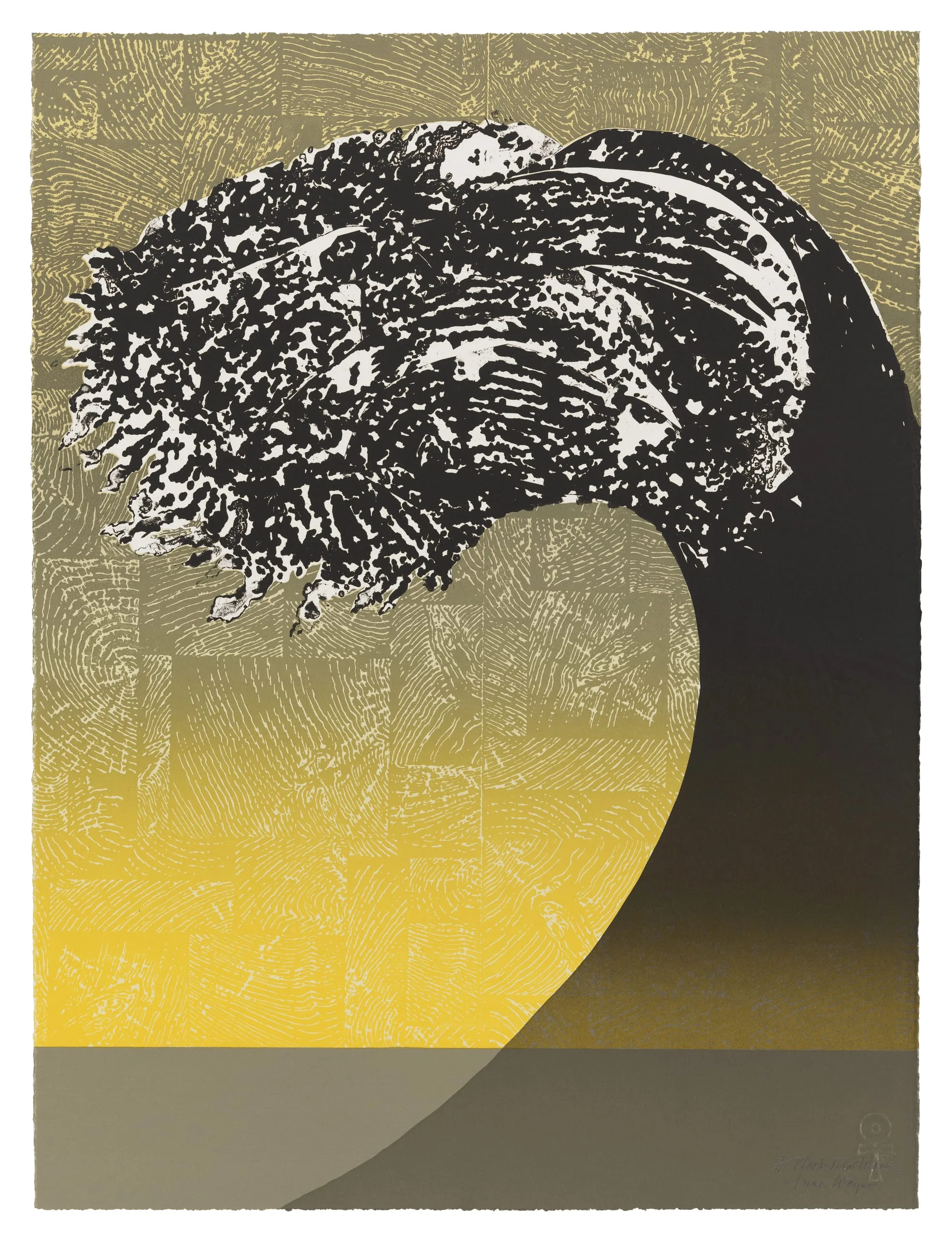
In her Tidal Wave lithographs, created in the 1970s, June Wayne explained that she “wanted to suggest the enormous scale of that kind of water manifestation. How do you do that, especially when a wave is so insistent upon simply falling away? For it to become aggressive it had to be almost like a person—rear up like some sort of creature. And that was the aesthetic device which animated these large prints” (Wayne 2009). The patterning of Black Tidal Wave suggests an engraving or woodcut, a look Wayne arrived at by incorporating the texture of wood from her studio flooring into the image: “It was amusing to use the rubbing of my parquet floor as the first run of all these wave images. Only thirty by twenty-two inches, but they feel much bigger” (Conway 2007: 228). The artist’s obsession with tidal waves harkened back to her childhood in Chicago: “My mother used to take me to the lakefront, Lake Michigan, with the waves, to me, huge, breaking on the cement blocks that constituted the foundation of the breakwater. A wave goes on endlessly and then sort of peters out and doesn’t look important at all. How do I make a wave that . . . is really tearing up a city with a 30-foot surge? What does that feel like standing there with 30 feet of water rushing toward you?” (Belloli 2009: 23).
Wayne’s commitment to feminism and her deep interest in scientific subjects such as DNA, quantum physics, and the cosmos were expressed in a multifaceted visual practice that encompassed painting, printmaking, and tapestry design. Her bold depictions of planetary forces merged art and science, utilizing formal abstraction and often vibrant color, and presenting viewers with original ways of seeing the world. Inspired by her training with printmakers in Paris in the 1950s, Wayne championed the resurgence of lithography as a fine-art form in the United States. In 1960, she established the Tamarind Workshop for Lithography in Los Angeles; the workshop relocated to the University of New Mexico at Albuquerque in 1970 and is still thriving.
Claudine Dixon
2025
Selected Bibliography
Belloli, Jay. “A Conversation with June Wayne.” In Impact: The Big Print. OCC Arts Pavilion Press and the Los Angeles Printmaking Society, 2009.
Conway, Robert P. June Wayne: The Art of Everything: A Catalogue Raisonné 1936−2006. Rutgers University Press, 2007.
Wayne, June. Video conversation with June Wayne in her Tamarind/Hollywood studio, 2009, https://www.mbabram.com/black-tidal-wave.