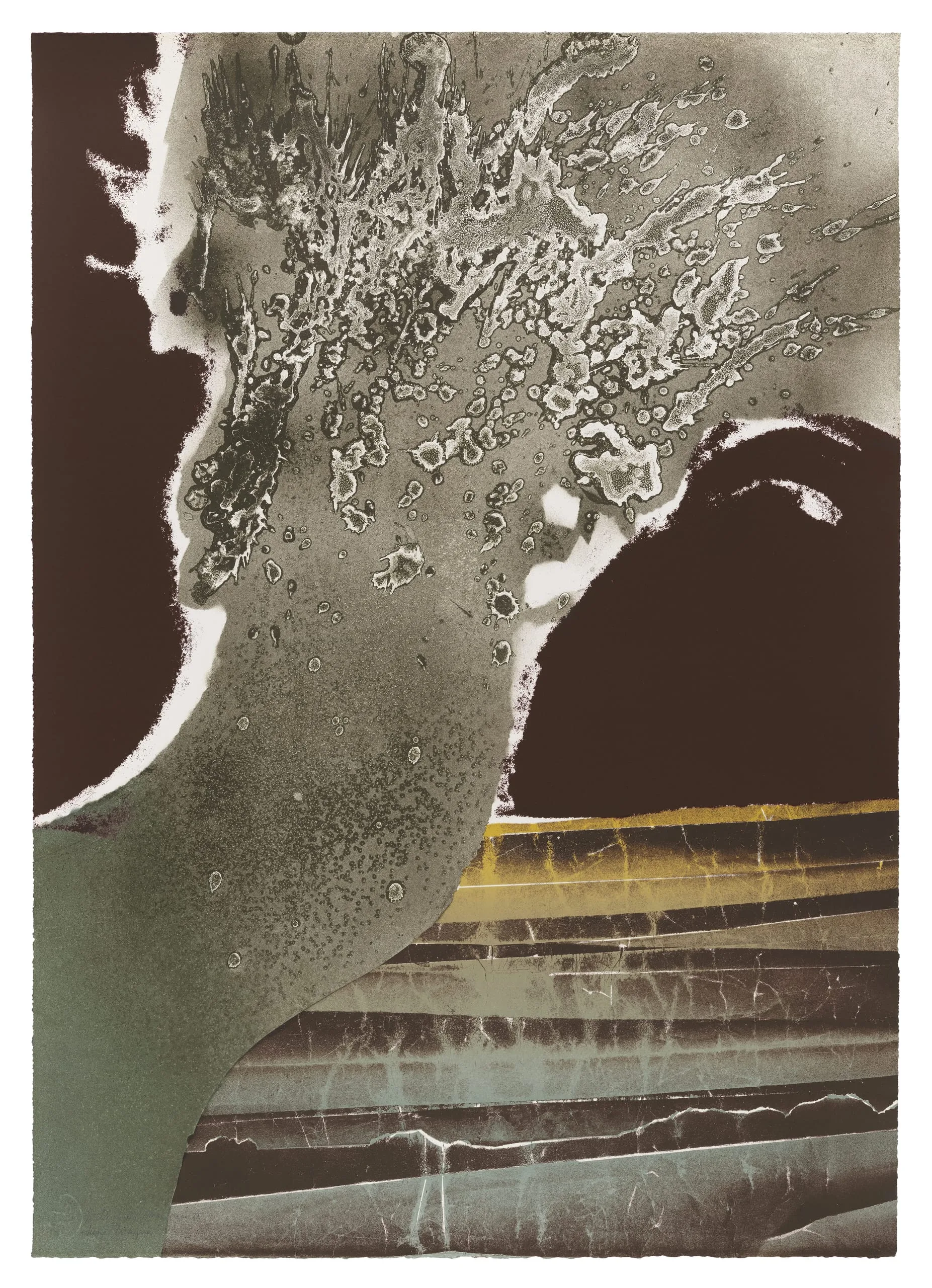
June Wayne noted the variation in form developed in Demented Tidal Wave I (printed in black and transparent black inks) and Demented Tidal Wave II (printed in seven colors, including black) that set them apart from her other wave works: “Although [the wave] is rearing up like the other waves, this is not a curling wave like the others. It’s not listening to your opinion. It’s there. It’s aggressive. It’s tall. It is so wild I call it demented” (Conway 2007: 214). Wayne’s obsession with tidal waves harkened back to her childhood in Chicago, where the enormity of Lake Michigan and its frequently stormy waters left an indelible impression upon her psyche. Her ongoing fascination with the random intensities of water and its destructive potential was also prescient—made in the 1970s, the Tidal Wave series of lithographs predates three of the most deadly earthquake-induced tsunamis in the last century, in the Indian Ocean (2004), Japan (2011), and Indonesia (2018).
Wayne’s commitment to feminism and her deep interest in scientific subjects such as DNA, quantum physics, and the cosmos were expressed in a multifaceted visual practice that encompassed painting, printmaking, and tapestry design. Her bold depictions of planetary forces merged art and science, utilizing formal abstraction and often vibrant color, and presenting viewers with original ways of seeing the world. Inspired by her training with printmakers in Paris in the 1950s, Wayne championed the resurgence of lithography as a fine-art form in the United States. In 1960, she established the Tamarind Workshop for Lithography in Los Angeles; the workshop relocated to the University of New Mexico at Albuquerque in 1970 and is still thriving.
Claudine Dixon
2025
Selected Bibliography
Conway, Robert P. June Wayne: The Art of Everything: A Catalogue Raisonné 1936−2006. Rutgers University Press, 2007.