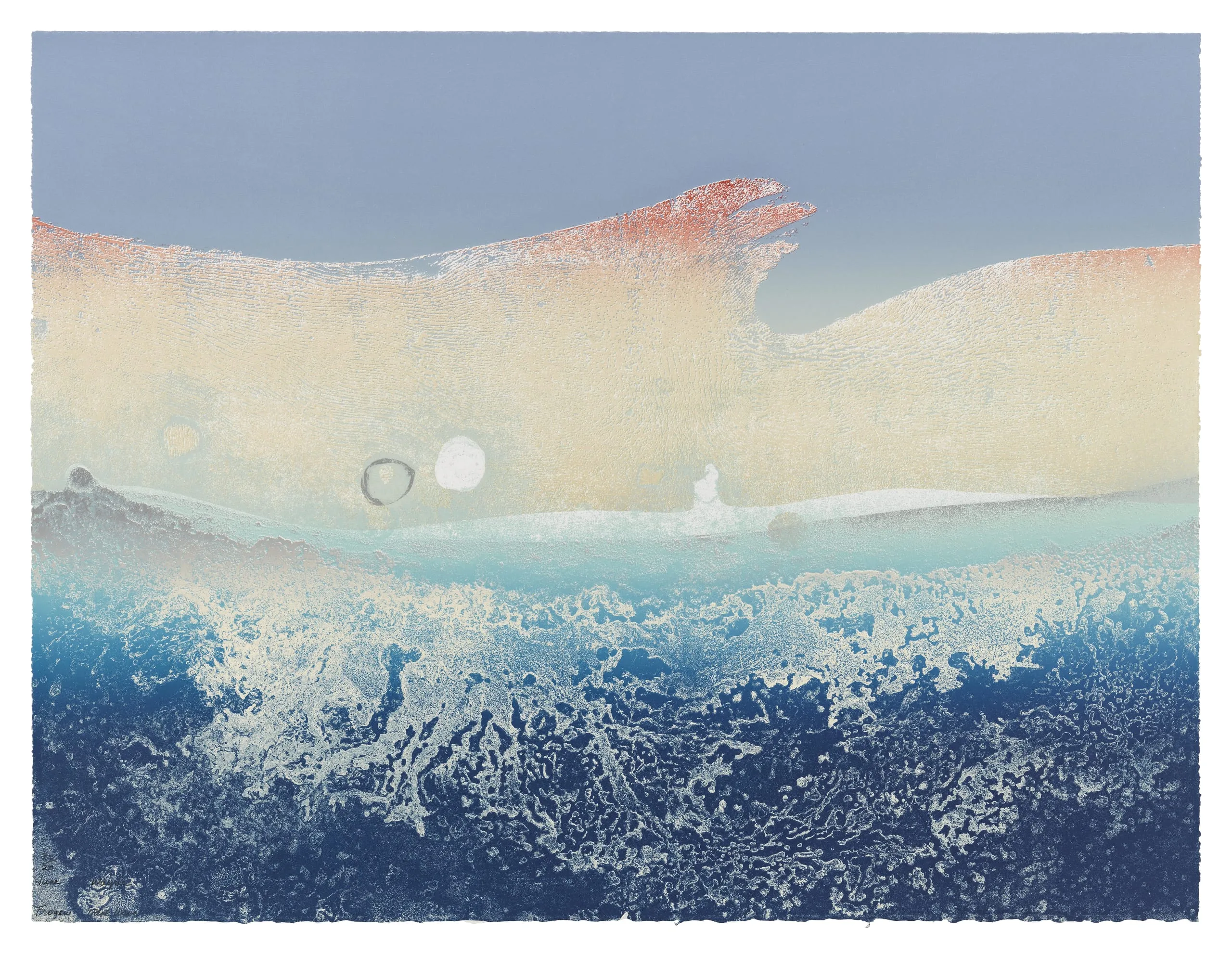
The colors in Frozen Tidal Wave were inspired by a research trip June Wayne made to Alaska in the summer of 1974 for W. MacNeil (“Mac”) Lowry, vice president of the Ford Foundation. The foundation was investigating the Indigenous creative environment and the supply of materials, such as papers, brushes, wood, and other essential equipment, available to local artists, many of whom were Inuit and Yupik tribal peoples. “Mac was considering a grant to improve creative conditions for Alaskan artists,” Wayne explained. “Would a special building of private studios be best, or would communal workshops be better? I was there during the summer, when it was daylight all the time. I was greatly energized by the light. I stayed in a room at the Captain Cook Hotel that straddled the huge fissure of the great earthquake of [1964]. It was quite exhilarating” (Conway 2007: 237). Here, the wave’s form becomes anthropomorphic, “like sculpture, like some arctic bird” (Wayne 2009).
Wayne’s commitment to feminism and her deep interest in scientific subjects such as DNA, quantum physics, and the cosmos were expressed in a multifaceted visual practice that encompassed painting, printmaking, and tapestry design. Her bold depictions of planetary forces merged art and science, utilizing formal abstraction and often vibrant color, and presenting viewers with original ways of seeing the world. Inspired by her training with printmakers in Paris in the 1950s, Wayne championed the resurgence of lithography as a fine-art form in the United States. In 1960, she established the Tamarind Workshop for Lithography in Los Angeles; the workshop relocated to the University of New Mexico at Albuquerque in 1970 and is still thriving.
Claudine Dixon
2025
Selected Bibliography
Conway, Robert P. June Wayne: The Art of Everything: A Catalogue Raisonné 1936−2006. Rutgers University Press, 2007.
Wayne, June. Video conversation with June Wayne in her Tamarind/Hollywood studio, 2009,
https://www.mbabram.com/frozen-wave.