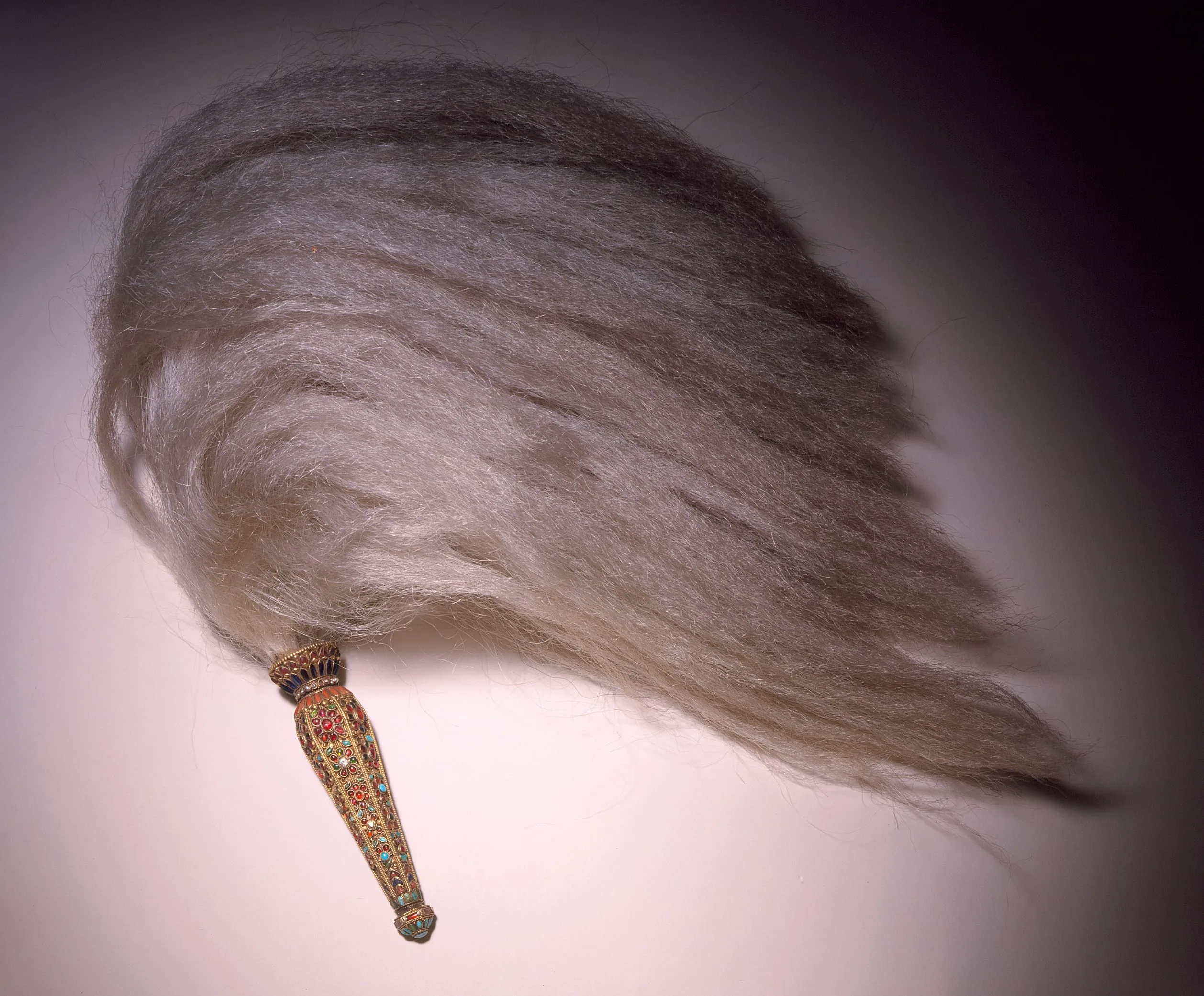
Known as a chowri (from Hindi cauri and Sanskrit camara), the honorific fly whisk is an ancient pan-Asian accouterment of both earthly and divine sovereignty. Chowris (typically held by attendants) are a ubiquitous insignia found in royal portraits (for example, see M.83.105.21 and M.2003.214.3). The Mughal Emperors Shah Jahan (r. 1628-1658) and Aurangzeb (r. 1658-1707) are also occasionally represented holding a small flywhisk with dark tail-hairs that is symbolic of their spiritual devotion (see AC1994.59.2). Fly whisks are also used to venerate images of Hindu, Buddhist, and Jain divinities (for a Jain example, see M.86.83). The whisk is generally made from the white tail-hairs of a yak, as in this example, or from the tail-hairs of a horse. They can also be made with peacock feathers and used as an extended fan; in which case the whisk is called a morchal (see M.78.128a-b and M.91.349.4.1-.57 frontispiece).
The exquisite gold filigree embellishing the surface of this gilt copper alloy whisk handle suggests it was made by a Newar artist, a member of the chief historical and cultural ethnicity in Nepal that was renowned for its fine filigree metalworking. The gemstones inset into the tapering shaft and lotus bud pommel include foil-backed rubies, emeralds, and diamonds, as well as pearls, turquoise, lapis lazuli, and coral.