LACMA

ShopMembershipMyLACMATickets
LACMA
Los Angeles County Museum of Art
5905 Wilshire Blvd.
Los Angeles, CA 90036
info@lacma.org
(323) 857-6000
Sign up to receive emails
Subscribe
© Museum Associates 2025

Museum Hours

Monday

11 am–6 pm

Tuesday

11 am–6 pm

Wednesday

Closed

Thursday

11 am–6 pm

Friday

11 am–8 pm

Saturday

10 am–7 pm

Sunday

10 am–7 pm


  • About LACMA
  • Jobs
  • Building LACMA
  • Host An Event
  • Unframed
  • Press
  • FAQs
  • Log in to MyLACMA
  • Privacy Policy
© Museum Associates 2025
Collections

Unknown
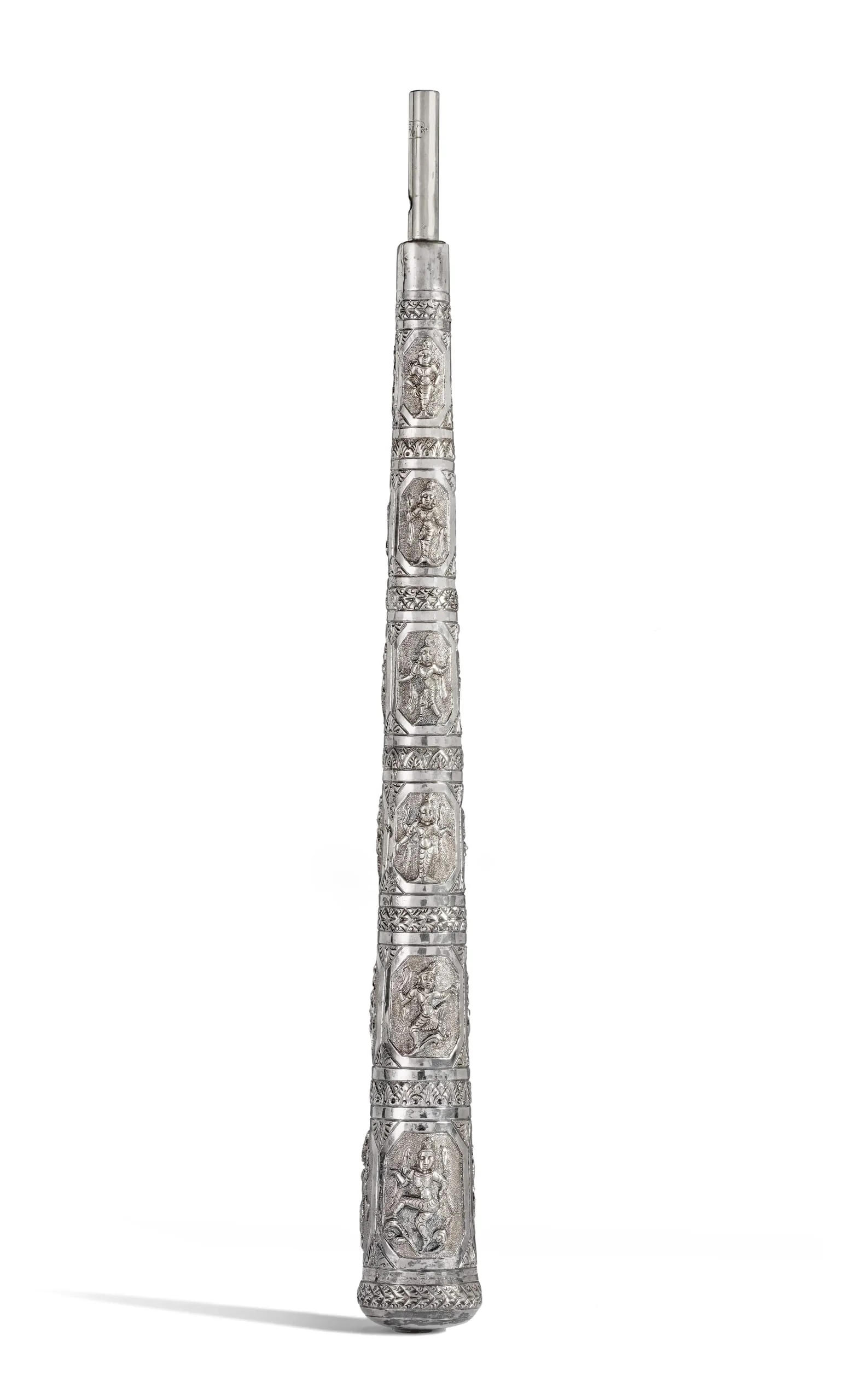
Parasol Handle with Deities and Dancerscirca 1875-1900

Not on view
Silver metal horn or trumpet tapering from a narrow mouthpiece to a wide bell, covered in horizontal bands of low-relief figural cartouches
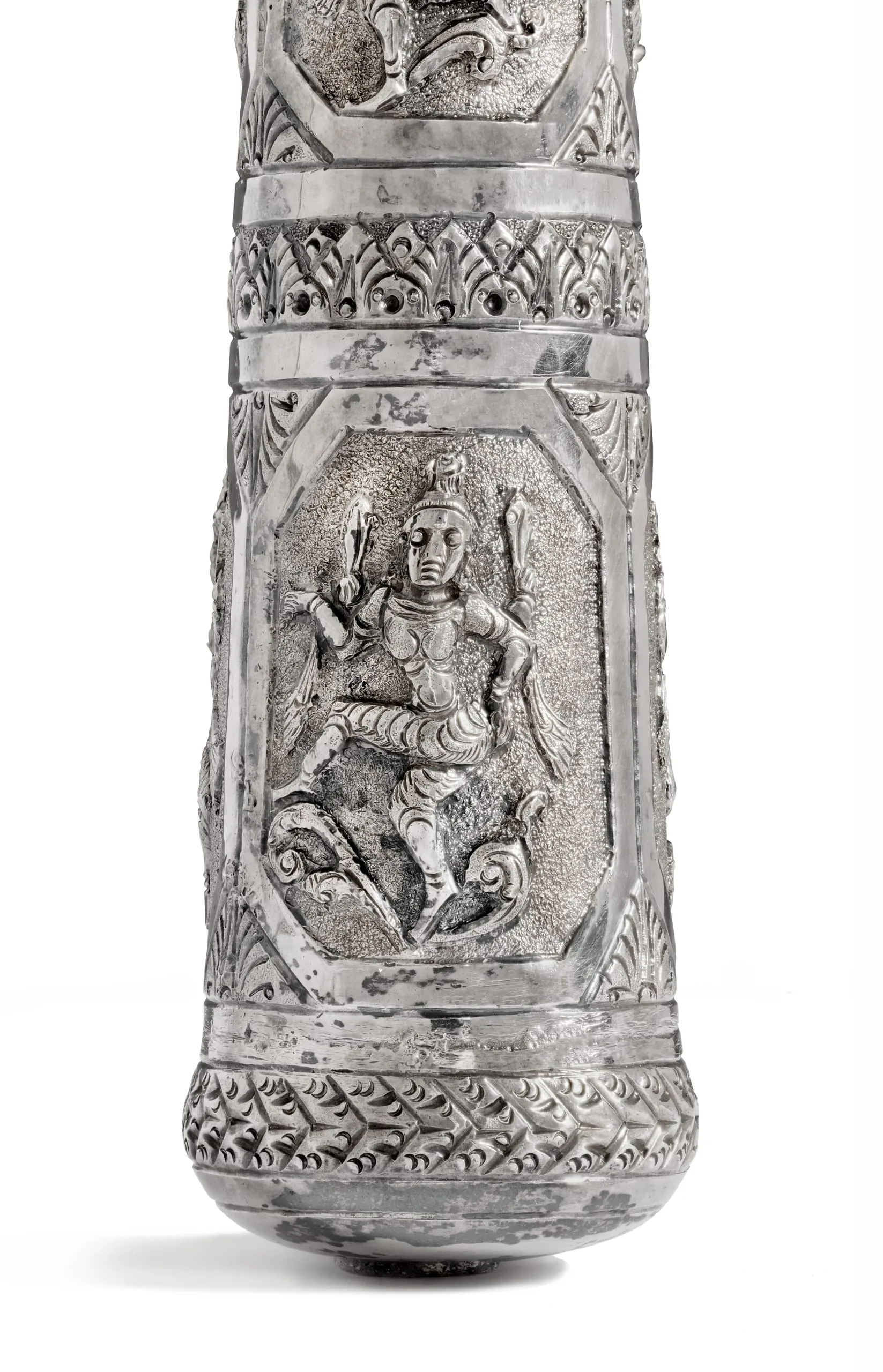
Silver repoussé vessel, partially shown, with an octagonal cartouche depicting a multi-armed deity in dynamic pose; surrounded by bands of foliate scrollwork, scale patterns, and flame-like borders in high relief.
Artist or Maker
Unknown
Title
Parasol Handle with Deities and Dancers
Place Made
India, Tamil Nadu, Chennai (Madras)
Date Made
circa 1875-1900
Medium
Silver-plated copper alloy repoussé
Dimensions
14 1/8 x 1 3/8 in. (35.87 x 3.49 cm)
Credit Line
Collection of Colonel and Mrs. George J. Denis
Accession Number
41.7.5
Classification
Tools and Equipment
Collecting Area
South and Southeast Asian Art
Curatorial Notes

This is the lower section of a parasol handle made of silver-plated copper alloy repoussé. The spring release mechanism at the top bears a monogram, nRw, in a scroll cartouche.

The repoussé decoration consists of six horizontal registers with octagonal cartouches containing standing male figures. The five upper registers appear to depict mainly generic deities, apart from what may be a depiction of Matsya, the Fish Avatar (register one), and Hanuman, the Divine Monkey, carrying the mountain of medicinal herbs (register four). The generic figures are depicted with three leg positions: legs together, feet splayed; walking sideways, upper torso twisted frontally towards viewer; and dancing in jig style. The arms of the generic figures vary; some have their arms akimbo, others are extended horizontally in various positions. Long pendant sashes grace the figures and ambiguous vertical objects that may replicate iconographic attributes flank the figures by their hands. The bottom register depicts Shiva Nataraja, Vishnu Narasimha, and Krishna Venugopala.

The handle is crafted in a distinctive south Indian metalware style called "swami" work, which was produced mainly around Chennai (formerly Madras) in the modern state of Tamil Nadu during the mid-19th to early 20th centuries. It was primarily manufactured for European consumption by P. Orr and Sons, Madras. The firm specialized in jewelry and utility items, including fine tableware, commemorative trophies, and sundry containers.
Selected Bibliography
  • Markel, Stephen. Mughal and Early Modern Metalware from South Asia at LACMA: An Online Scholarly Catalogue. Los Angeles: Los Angeles County Museum of Art, 2020. https://archive.org/details/mughal-metalware (accessed September 7, 2021).