- Title
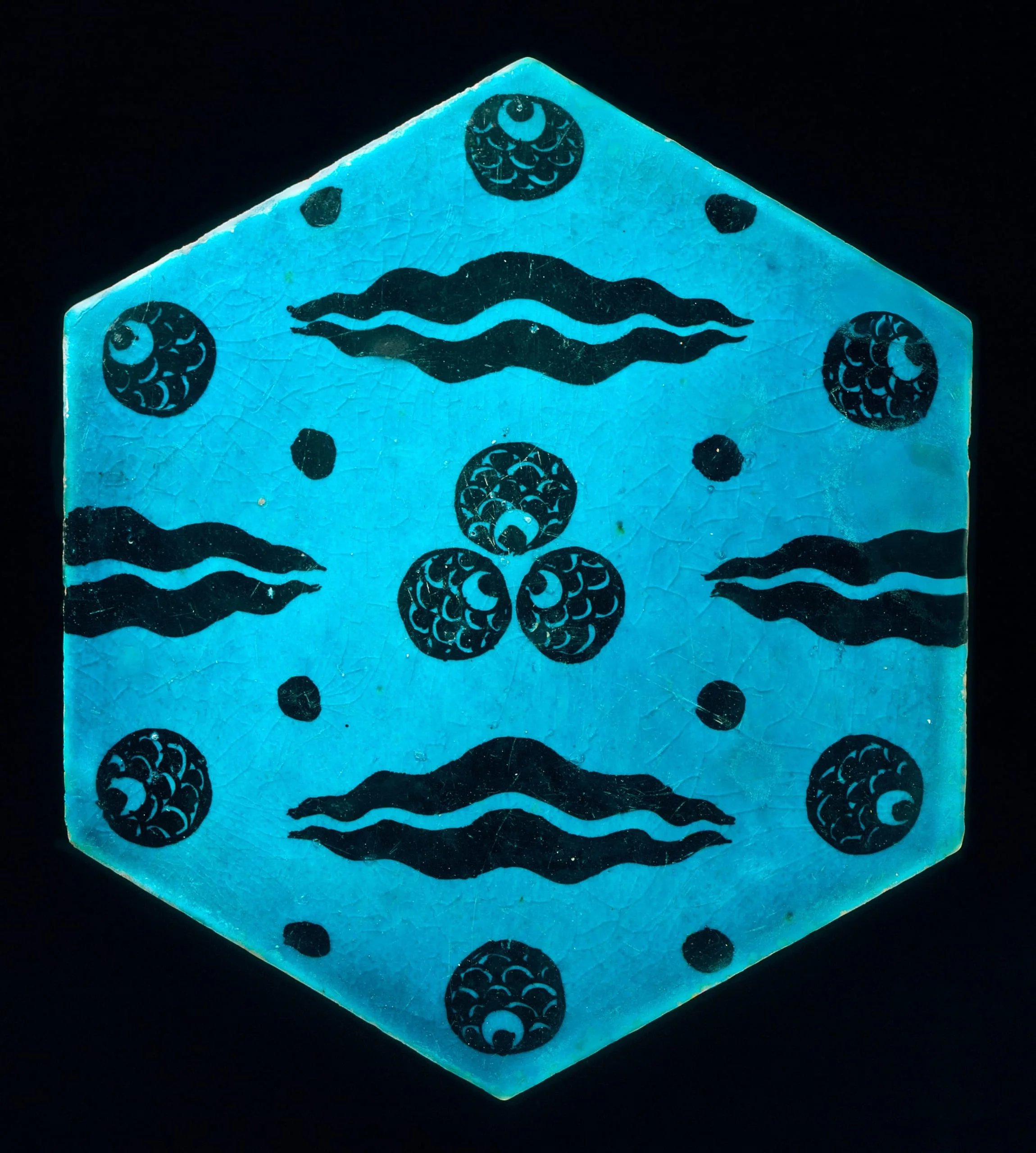
- Tile
- Date Made
- 1550-1600
- Medium
- Fritware, underglaze-painted
- Dimensions
- Width: 10 3/8 in. (26.4 cm)
- Accession Number
- M.2002.1.8
- Curatorial Notes
The striking motif of three circles combined with paired wavy lines, possibly a much abstracted version of leopard spots and tiger stripes, was repeated in a variety of Ottoman mediums, whether made for the court in Istanbul or produced in provincial centers such as Damascus. In this hexagonal tile, the Syrian artist has replicated the design but not the color scheme of red and blue on a white ground associated with classic Iznik ware (see M.2000.31). Instead, the tile is boldly decorated in turquoise and black, a color combination that typifies Syrian tiles in the Ottoman period and was likely a reflection of local taste. Arranged to form larger panels that create a repeat pattern, such hexagonal tiles were produced as multiples. A small group of tiles with the same decoration of triple circles and paired wavy lines demonstrates subtle variations in the design elements, suggesting they were made for different locations or more likely that the efficacy of the overall pattern maintained supremacy over the individual parts.