LACMA

ShopMembershipMyLACMATickets
LACMA
Los Angeles County Museum of Art
5905 Wilshire Blvd.
Los Angeles, CA 90036
info@lacma.org
(323) 857-6000
Sign up to receive emails
Subscribe
© Museum Associates 2025

Museum Hours

Monday

11 am–6 pm

Tuesday

11 am–6 pm

Wednesday

Closed

Thursday

11 am–6 pm

Friday

11 am–8 pm

Saturday

10 am–7 pm

Sunday

10 am–7 pm


  • About LACMA
  • Jobs
  • Building LACMA
  • Host An Event
  • Unframed
  • Press
  • FAQs
  • Log in to MyLACMA
  • Privacy Policy
© Museum Associates 2025
Collections

Unknown
Buddha Shakyamunicirca 8th-9th century

Not on view
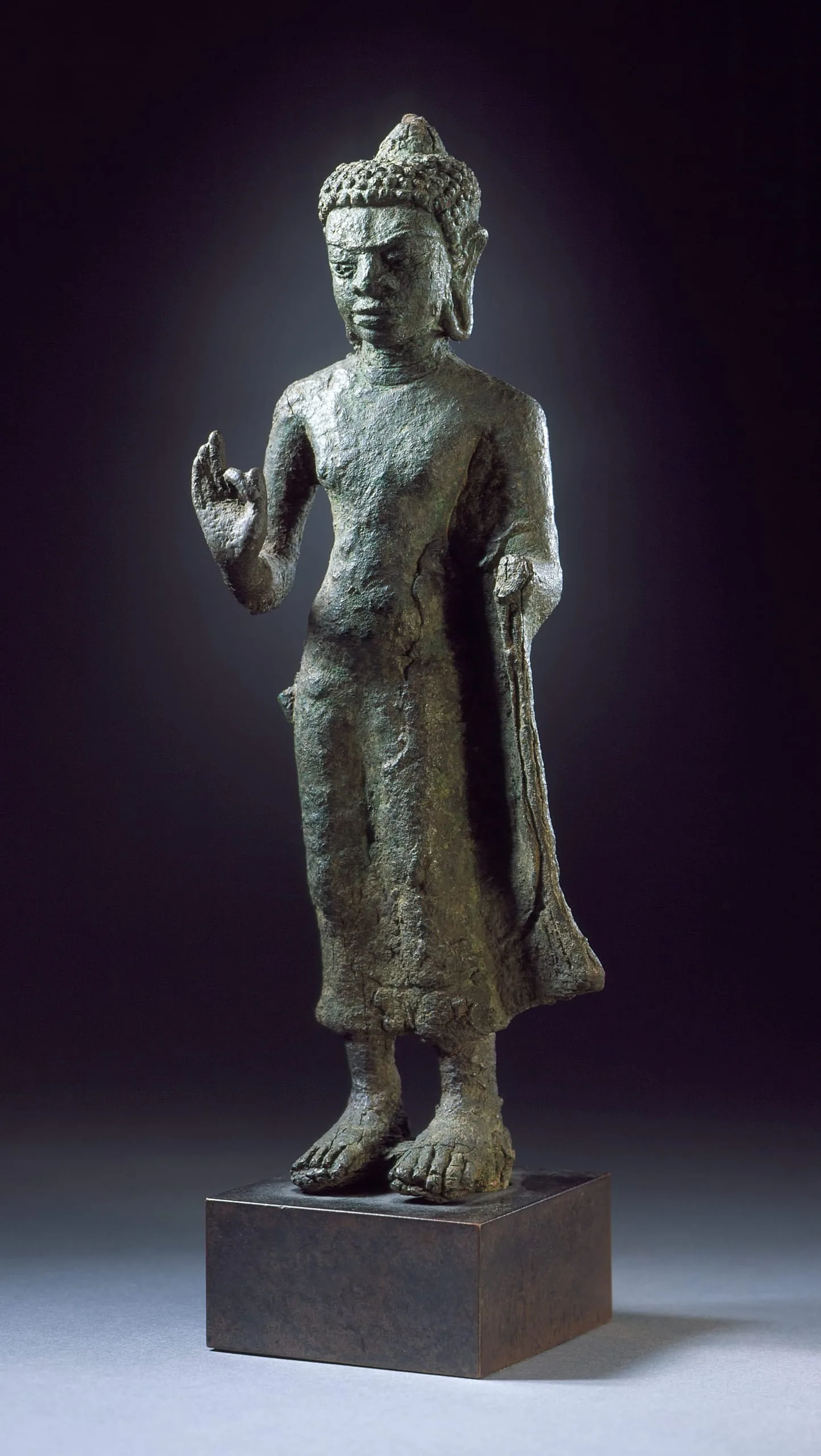
Standing bronze figure on a square pedestal, with tightly curled hair, one hand raised palm-outward, wearing a wrapped lower garment, with dark gray-green patina
Artist or Maker
Unknown
Title
Buddha Shakyamuni
Culture
Mon-Dvaravati
Place Made
Thailand, Mon-Dvaravati
Date Made
circa 8th-9th century
Medium
Copper alloy
Dimensions
9 x 3 1/8 x 2 in. (22.9 x 7.9 x 5.1 cm)
Credit Line
Gift of Michael Phillips and Juliana Maio
Accession Number
AC1997.208.1
Classification
Sculpture
Collecting Area
South and Southeast Asian Art
Curatorial Notes

This standing Buddha was likely made in the Mon-Dvaravati kingdom in north-central Thailand (7th-13th century). Mon-Dvaravati is also the name used for a related artistic style that existed somewhat earlier and continued after the actual dates of the kingdom.

The Buddha stands with a slight sway in his waist. He has a pointed cranial protuberance symbolizing his omniscience (ushnisha), snail curl hair, and distended earlobes, the latter two features symbolizing his renunciation of the princely realm when he previously had long locks and wore heavy golden ear ornaments. He stares slightly downward towards the viewer with wide open eyes. Although difficult to discern given the current surface condition of the image, his monastic robe likely covered only his left shoulder. His right hand is held in the gesture of discourse (vitarka mudra). His left hand, now missing, would have likely held the hem of his robe.

Comparable images are in the Art Institute of Chicago (2016.433) and Metropolitan Museum of Art, New York (1984.484.3, 1992.99, and 1993.387.6).