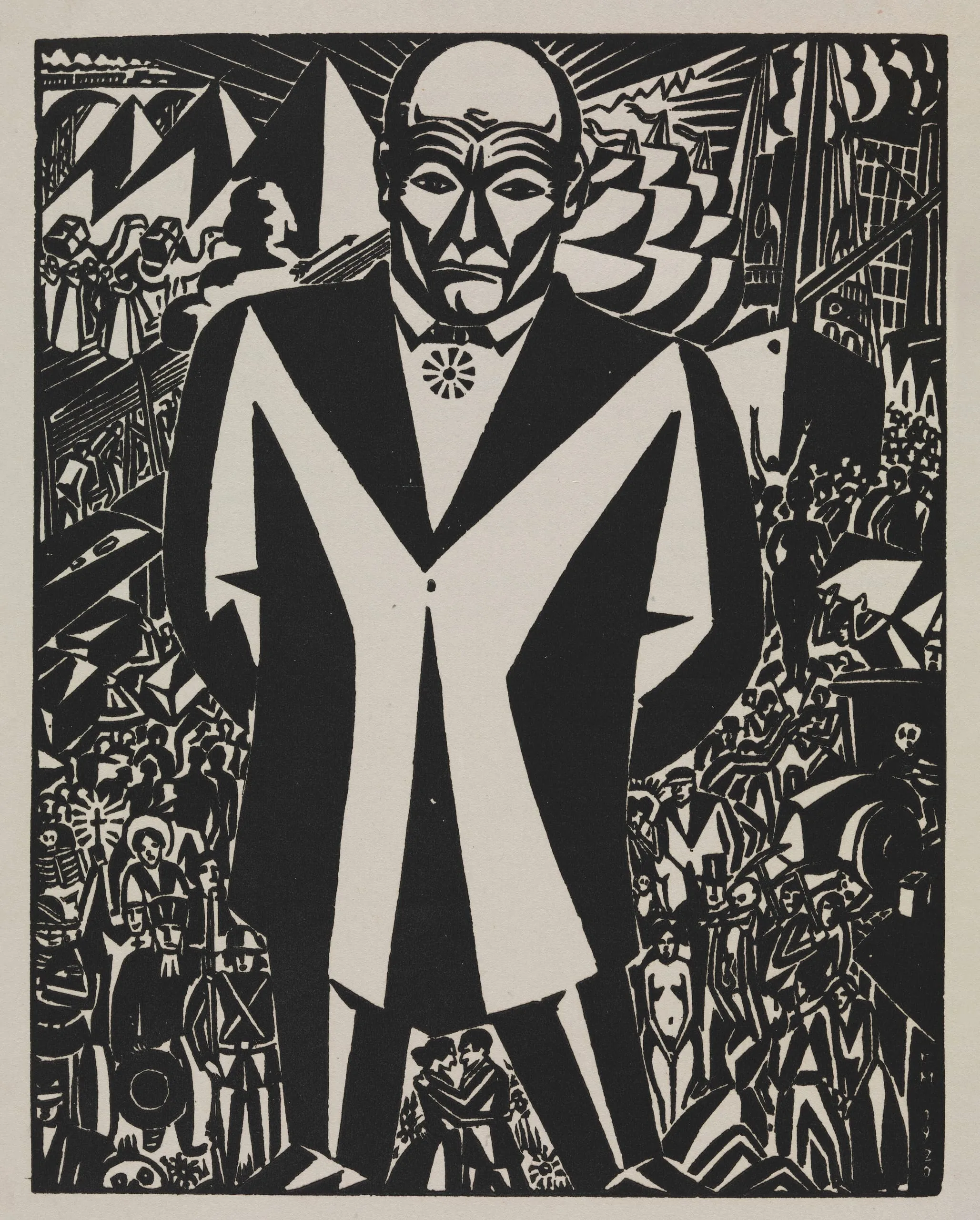
Born into a Belgian family with strong socialist convictions, Frans Masereel experienced the destruction of World War I firsthand while living in France. He soon moved to Geneva, where he found a community of expatriate artists and writers who shared his pacifism. There, he began producing illustrations for antiwar journals such as La Feuille and Les Tablettes (which he cofounded). Businessman (Geschäftsmann) shows the signature technique he developed in response to working on tight timelines: drawing with india ink and brush on a woodblock to create thick black lines and areas of tone, and the spare use of white to define form, an inversion of the typical black/white balance of woodcuts. This shorthand method of defining volume is seen here in the X shape on the man’s long suit coat. Masereel also played with scale in his woodcuts, often to suggest something about the status or power of his subjects. Here, the businessman’s dramatic size indicates that he is a literal and figurative titan of industry. His body spans the length of the printed sheet as he towers above the mass of humanity below, which includes clergy, soldiers, lovers, and laborers. He even dwarfs the pyramids on the left and the steamship on the right. Thin rays of light radiate from behind his head, projecting an ironic image of the businessman as a modern-day deity.
Due to his prolific output, large editions, and political subject matter, Masereel’s work was popular throughout Europe, especially in Germany. His prints also became internationally known. El libro negro del terror nazi en Europa (The Black Book of Nazi Terror in Europe), published in Mexico City by the Taller de Gráfica Popular, contains six of Masereel’s illustrations.
Erin Sullivan Maynes
2022 (adapted from Pressing Politics: Revolutionary Graphics from Mexico and Germany, 96)