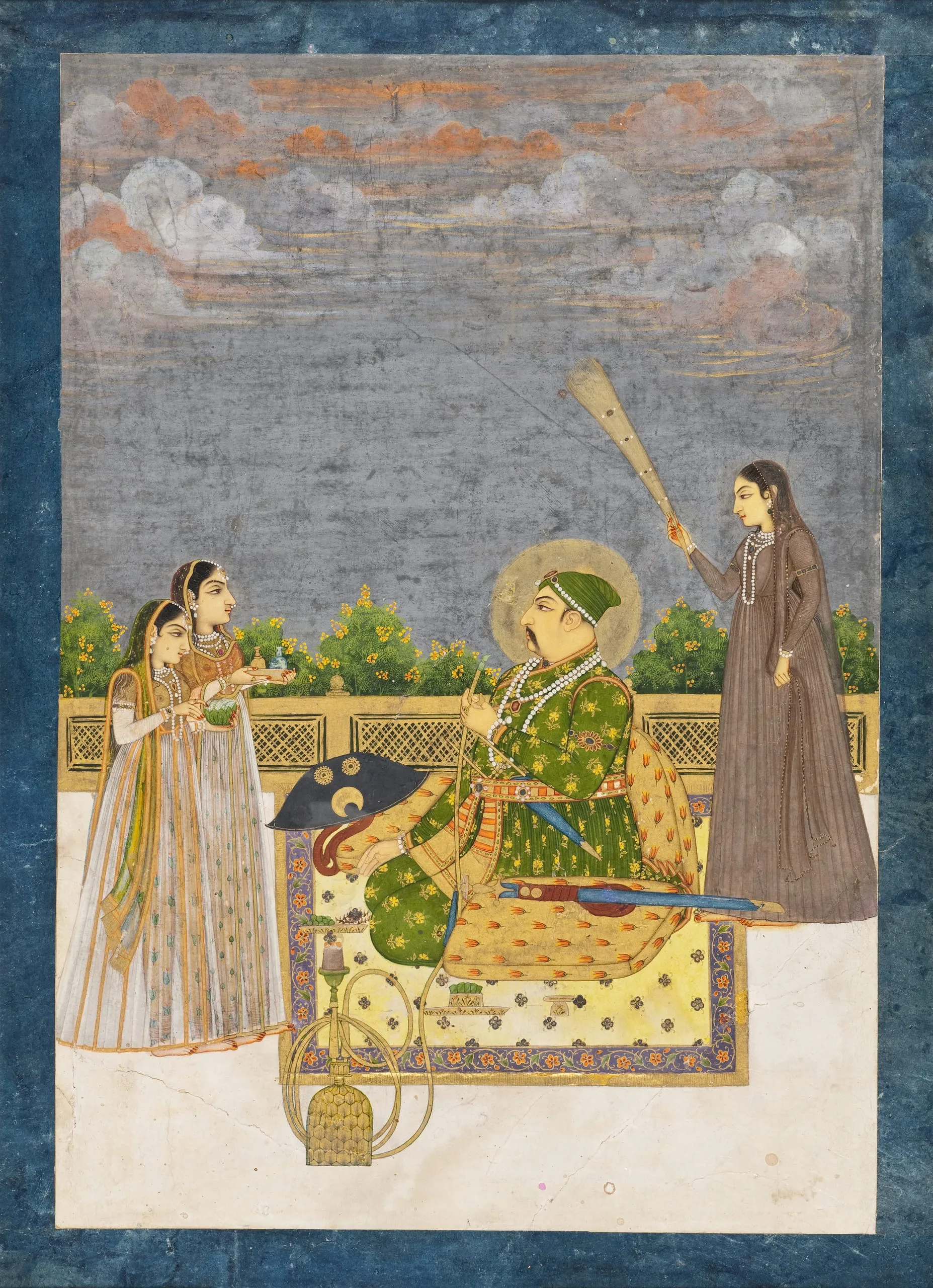
- Title
- Emperor Muhammad Shah (r. 1719-1748)
- Date Made
- circa 1735
- Medium
- Opaque watercolor, gold, and ink on paper
- Dimensions
- Sheet: 11 3/4 x 8 3/8 in. (29.85 x 21.27 cm); Image: 9 5/8 x 6 3/4 in. (24.45 x 17.15 cm)
- Accession Number
- AC1997.127.1
- Curatorial Notes
Emperor Muhammad Shah (r. 1719-1748) is identified by a Hindi inscription beneath the blue border that reads, Muhammad Shah [from] Ghazni, his birthplace and a strategically important city near Kabul, Afghanistan. He is nimbate and represented with all the customary accouterments of an Indo-Muslim monarch: his sword, shield, and dagger proclaim him a mighty warrior; the hookah and delicacies such as grapes and betel nut show that he is a man of refined tastes; and the setting--a palace terrace with serving maidens and a fly-whisk bearer--bespeaks a wealthy ruler living a luxurious life.
Muhammad Shah’s long reign of twenty-nine years is chiefly remembered for his cultural advancements, especially the so-called “Muhammad Shahi Revival” in painting. His active patronage reversed the artistic stagnation under a series of ineffectual short-reigned Mughal rulers following the empire’s highpoint in the 17th century. Due to his lack of interest in politics, his reign also suffered a series of rebellions and military attacks across India, culminating in the sack of the Imperial capital of Delhi in 1739 by the Iranian King Nadir Shah (r. 1736-1747). As a result of the raid on Delhi, and the subsequent political uncertainty, many of the Mughal court’s leading artists, poets, and intelligentsia fled to seek security and sponsorship in other kingdoms. Many went to the affluent provincial capital of Lucknow, but others emigrated to the Rajput or princely courts of Rajasthan.
- Selected Bibliography
- Vermani, Neha. "Aromas from Mughal Dining Spaces." Marg 75, no.2 (2023): 40-49.