- Title
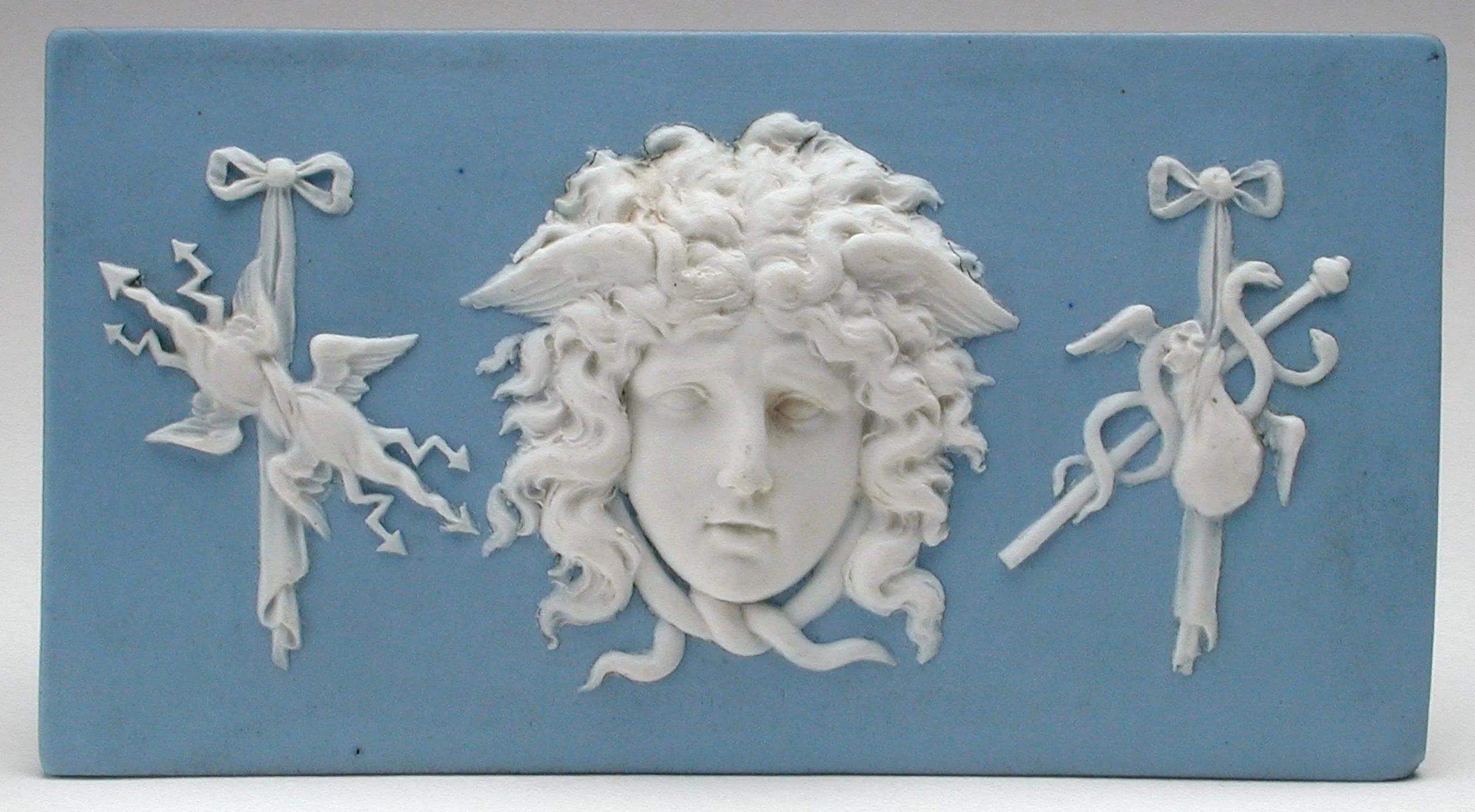
- Plaque with Apollo (Medusa) and Mercury, with Emblems of Jupiter and Mercury
- Date Made
- circa 1767-1833
- Medium
- Stoneware (solid blue jasperware with white applied relief)
- Dimensions
- 2 1/4 x 4 1/4 in. (5.72 x 10.8 cm)
- Accession Number
- AC1997.109.6
- Curatorial Notes
Jasperware is a type of high-fired stoneware invented by Josiah Wedgwood in the 1770s. Inspired by ancient ceramics and cameo glass, jasperware is characterized by an unglazed matte finish, also referred to as “biscuit” porcelain, and can be colored with metallic oxide in a range of pastel tones. This panel was made with Wedgwood’s characteristic pale blue color. The white reliefs are sprigs, separately molded low-relief decoration applied to the background before firing. At the center of this plaque is the head of Medusa, first modeled by John Flaxman, which is flanked by lightning bolts, an attribute of Jupiter, and a caduceus, a staff intertwined with snakes that represent Mercury. While Wedgwood produced several medallions with Medusa, a plaque that combines her head with godly attributes is more unusual and perhaps represents an earlier experiment in Wedgwood’s catalogue. Many of Wedgwood’s products looked to Greek and Roman antiquity for inspiration, appealing to renewed fascination with Mediterranean cultures after the rediscovery of ancient sites as well as nationalist interest in positioning the British Empire as the successor of the Roman Empire. Such rectangular plaques could either be incorporated into chimneypieces and architectural decor or framed and displayed as individual ornaments.
Cynthia Kok
2025