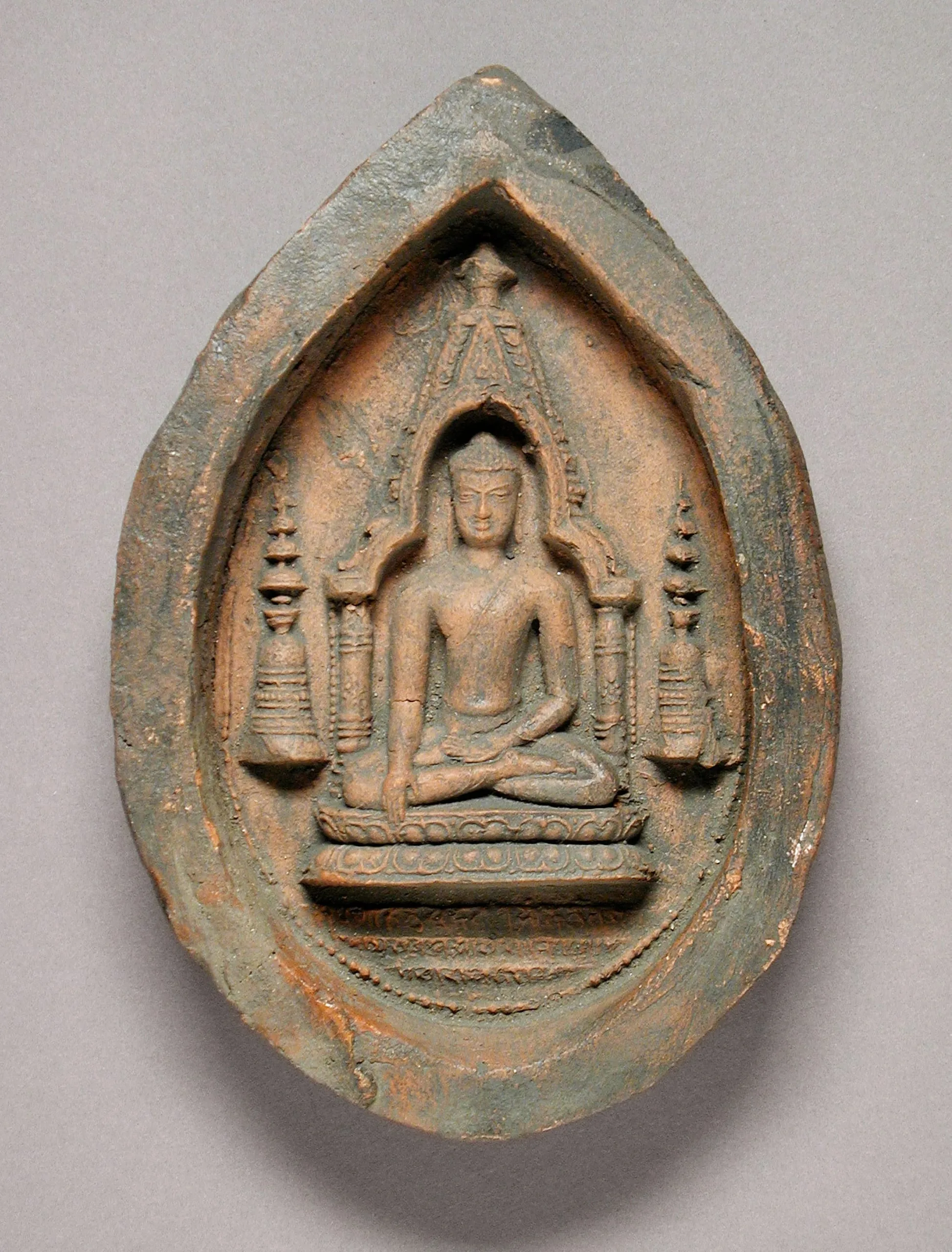
Some two centuries after the Buddha’s death, traditionally dated to 483 BCE, a shrine marking the site of his enlightenment was constructed at Bodhgaya in Bihar. Sometime prior to the 11th century, as attested by several miniature stone models that have been found in Burma, Nepal, Tibet, and India (see M.91.62), the shrine evolved into the towering structure known as the Mahabodhi Temple. Religious souvenirs from Bodhgaya¾ the most important Buddhist pilgrimage¾ site conveyed eastern Indian architectural forms and styles throughout Asia. In Burma, architecture, sculpture, and even votive plaques reveal the stylistic impact of the Pala Dynasty (750–1161) during a period of political consolidation and Buddhist resurgence in the 11th century.
Here, Buddha Shakyamuni is enthroned within the Mahabodhi Temple. His right hand is extended in the gesture of calling upon the earth to witness his right to achieve Enlightenment after his many lifetimes (bhumisparsha mudra). He is flanked by two ritual stupas (funerary mounds).