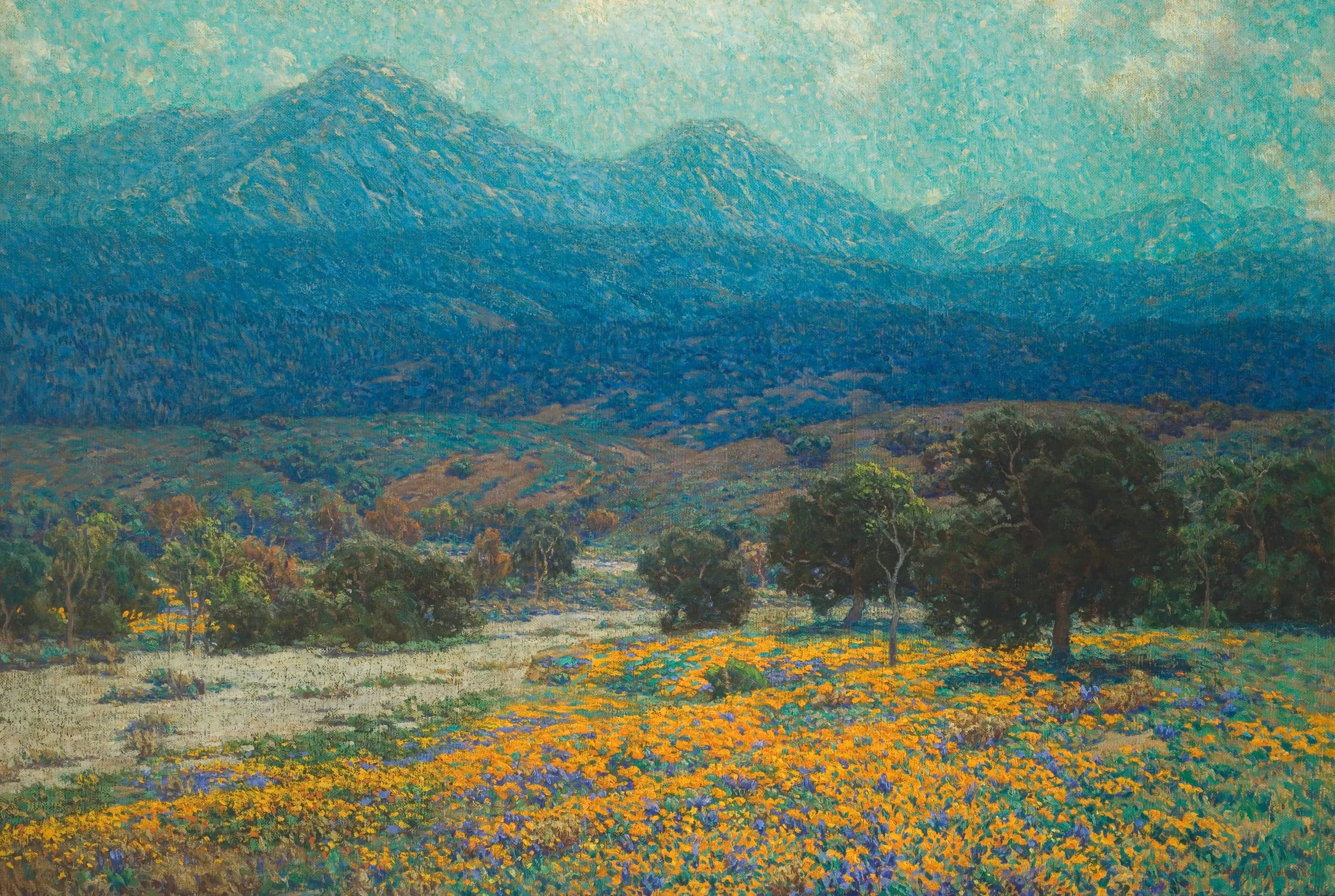
- Title
- California Poppy Field
- Date Made
- circa 1926
- Medium
- Oil on canvas
- Dimensions
- Canvas: 40 1/4 × 60 1/4 in. (102.24 × 153.04 cm)
Frame: 44 3/4 × 64 3/4 × 3 1/4 in. (113.67 × 164.47 × 8.26 cm)
- Accession Number
- 40.7
- Curatorial Notes
Among the most prominent artists working in Los Angeles at the turn of the twentieth century, Granville Redmond developed a reputation for his paintings of golden poppies—California’s state flower. In this exceptionally large example, he worked on a rough-hewn canvas to add texture to the scene. He skillfully contrasted the warm orange hues of the foreground flowers with the cool blues of the distant mountains, capturing a peak springtime bloom when wildflowers carpet Southern California’s landscape.
- Provenance
Raymond Griffith, Beverly Hills, Calif. to 1940.
Raymond Griffith (1895–1957), Beverly Hills, gifted 1940 to; LACMA.
- Selected Bibliography
- Los Angeles County Museum of Art Members' Calendar 1993, vol. 31, no. 1-11 (January-November, 1993).
- Los Angeles County Museum of Art. New York: Thames and Hudson, 2003.
Barron, Stephanie, S. Bernstein and I. S. Fort, with essays by Stephanie Barron, Sherri Bernstein, M. Dear, Howard N. Fox and Richard Rodriguez. Made in California: Art, Image, and Identity, 1900-2000. Los Angeles: Los Angeles County Museum of Art and Berkeley: University of California Press, Berkeley, 2000.
- Fort, Ilene Susan and Michael Quick. American Art: a Catalogue of the Los Angeles County Museum of Art Collection. Los Angeles: Los Angeles County Museum of Art, 1991.
- Moure, Nancy Dustin Wall. Painting and Sculpture in Los Angeles, 1900-1945. Los Angeles: Los Angeles County Museum of Art, 1980.
- LACMA: Obras Maestras 1750-1950: Pintura Estadounidense Del Museo De Arte Del Condado De Los Angeles. Mexico, D.F.: Museo Nacional de Arte, 2006.
- The California pop-up book. New York: Universe Pub. in association with the Los Angeles County Museum of Art, 2000.
- Shields, Scott A., and Mildred Albronda. Granville Redmond: the Eloquent Palette. Portland, OR: Pomegranate; Sacramento, CA: Crocker Art Museum, 2020.