- Title
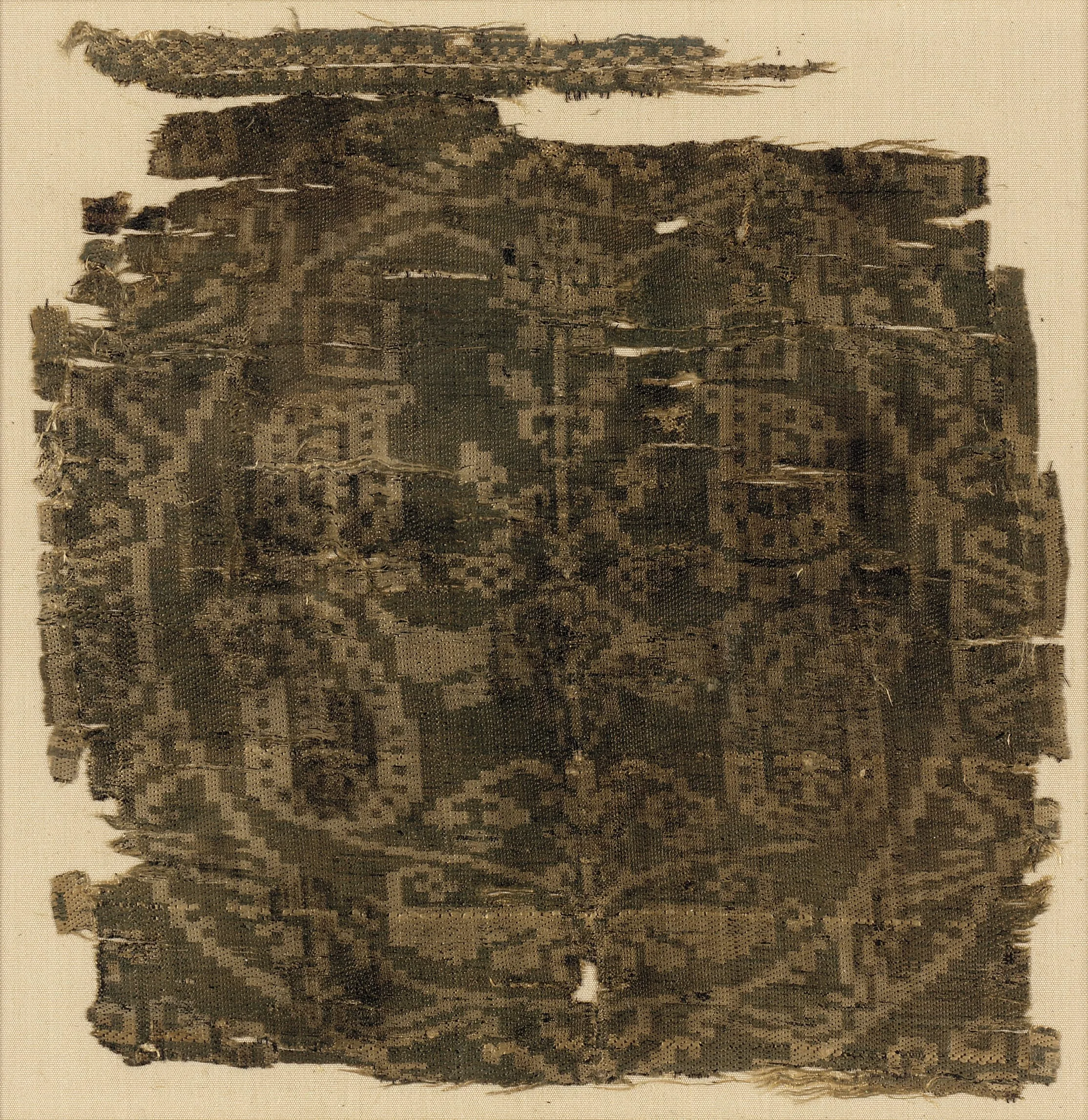
- Textile Fragment
- Date Made
- 7th-9th century
- Medium
- Silk weft-face compound twill (samite)
- Dimensions
- 6 3/4 × 6 3/4 in. (17.15 × 17.15 cm)
- Accession Number
- M.2002.1.3
- Curatorial Notes
Silk textiles were prized throughout the lands that came under Muslim control and, like their predecessors, the new leaders similarly enjoyed adorning themselves and their residences with the luxe material. Certain designs also remained popular despite the change in faith and leadership, making it difficult to date and locate many fragments. The symmetrical palmette tree featured at the center of this roundel is one such example. Carbon-dating of other palmette fragments shows that the motif, which may have derived from either Sasanian or Byzantine designs, was used for more than three centuries. While many of these textiles have been discovered at a manufacturing site in Akhmim, Egypt, they may also have been produced in Syria. Here, the slightly pixelated appearance of the design indicates that the drawloom on which the textile was made was set for quick (and perhaps cheaper) production, as curvilinear designs were more difficult to achieve and required more time to set up on the loom.
2024