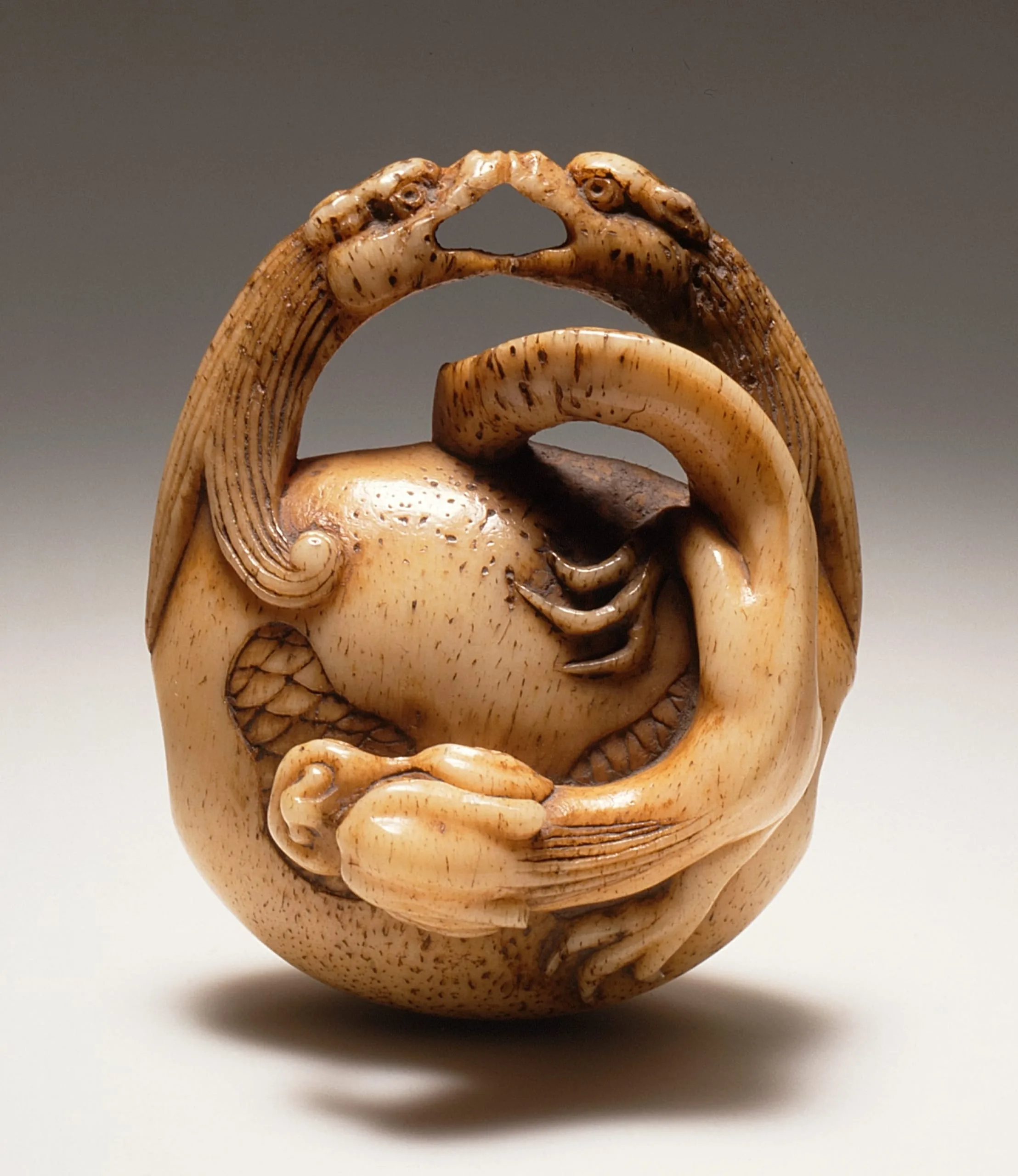
Netsuke were produced in a wide variety of materials native to Japan as well as imported and fabricated ones. Indigenous materials included numerous types of wood, marine ivory, boar tusk, and stag antler, as in this small sculpture of dragons sinuously curled around a temple gong. While abundant and inexpensive, antler has its limitations: its texture is uneven, its porous center is brittle thus difficult to carve, and its natural form limits the sculpted object’s size and shape. Many antler netsuke are consequently simple in form and decoration. This example, however, is representative of the Asakusa School of netsuke carvers, whose innovative designs made creative use of antler’s uneven coloring and surface. While other artists avoided or covered up the material’s disagreeable core or grooved outer surface, Asakusa carvers often incorporated the dark color and rough texture into their designs, giving them dramatic contrasts and accents (see AC1998.249.104). Motifs favored by these carvers included bats, dragons, and Chinese lions (see M.87.263.17). While many of these motifs were traditional ones that had appeared in netsuke for many years, they took on a fresh and distinctive look in the hands of Asakusa carvers. Typically the forms would become simplified, elongated, or exaggerated, with snouts, limbs, and manes stylized in an abundance of swirling lines and curlicues.
The Asakusa school of netsuke carvers took its name from the area within the city of Edo (present-day Tokyo) where the group’s leader, Ozaki Kokusai (1835−c. 1894), lived and worked. Kokusai was an eccentric character who broke with current trends creating unique works that influenced a number of artists. Among his preferred subjects were Buddhist themes such as reishi fungus, lotus, monkeys, and temple gongs (mokugyo). The term “school” is used loosely here, as Kokusai never actually had any students, nor does there seem to have been any direct teacher-pupil relationship among these carvers. Well-known members of the group include Ishikawa Rensai, Hōshunsai Masayuki, and Hoshino Hakusai, all of whom worked in the second half of the nineteenth century.
2024