LACMA

ShopMembershipMyLACMATickets
LACMA
Los Angeles County Museum of Art
5905 Wilshire Blvd.
Los Angeles, CA 90036
info@lacma.org
(323) 857-6000
Sign up to receive emails
Subscribe
© Museum Associates 2025

Museum Hours

Monday

11 am–6 pm

Tuesday

11 am–6 pm

Wednesday

Closed

Thursday

11 am–6 pm

Friday

11 am–8 pm

Saturday

10 am–7 pm

Sunday

10 am–7 pm


  • About LACMA
  • Jobs
  • Building LACMA
  • Host An Event
  • Unframed
  • Press
  • FAQs
  • Log in to MyLACMA
  • Privacy Policy
© Museum Associates 2025
Collections

Unknown
Design for a Powder Primer Flaskcirca 1800

Not on view
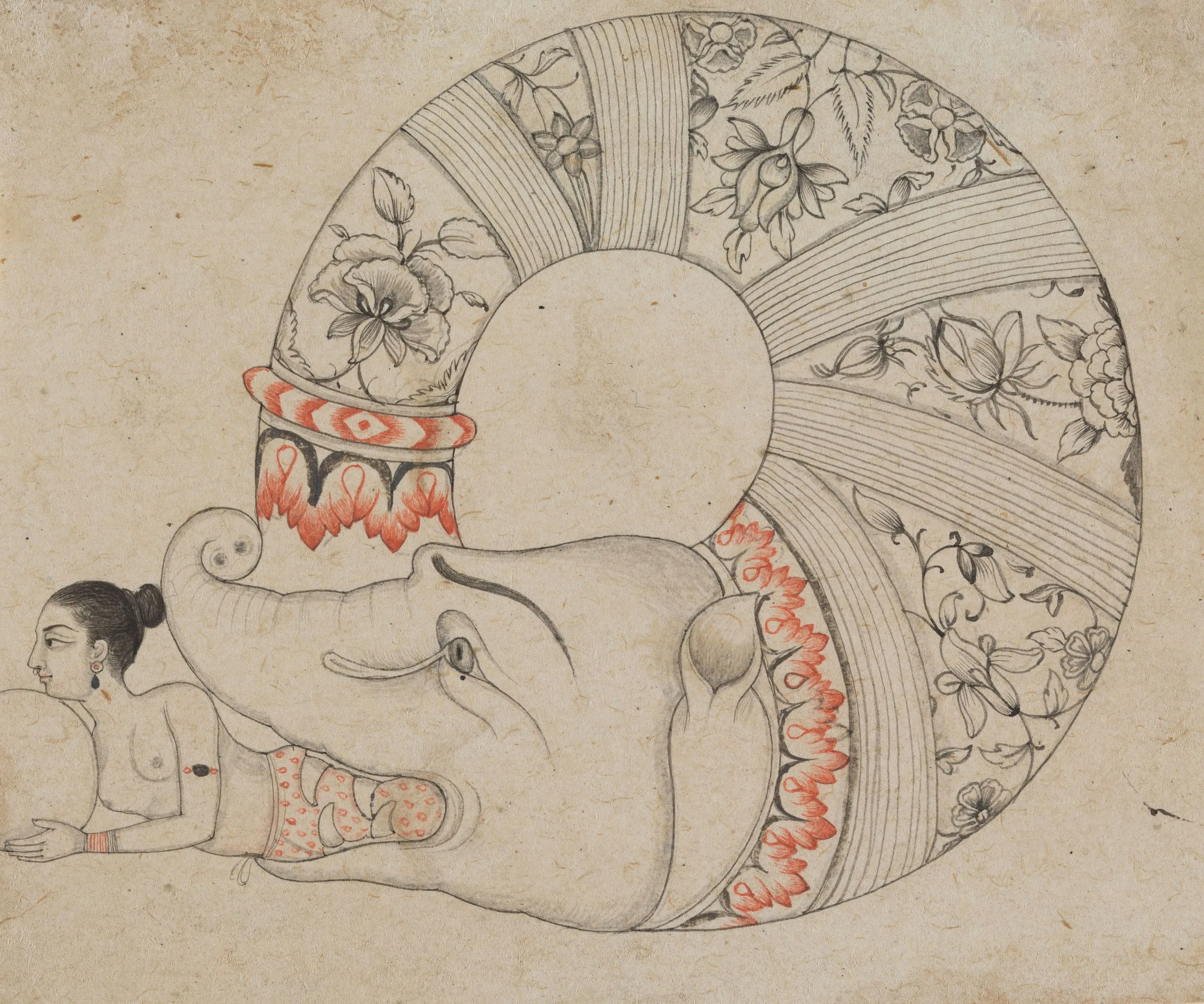
Ink and watercolor drawing on tan paper depicting a reclining hybrid figure with a human torso and elephant head, its body coiling into a spiral filled with floral decoration, with coral-red accents
Artist or Maker
Unknown
Title
Design for a Powder Primer Flask
Place Made
India, Rajasthan, Jaipur
Date Made
circa 1800
Medium
Ink and opaque watercolor on paper
Dimensions
5 7/8 x 7 in. (14.92 x 17.78 cm)
Credit Line
South and Southeast Asian Acquisition Fund
Accession Number
AC1997.276.1
Classification
Drawings
Collecting Area
South and Southeast Asian Art
Curatorial Notes

This partially colored drawing of a woman emerging from the mouth of a curved makara, a mythical Indian aquatic creature, is an accomplished design for a powder primer flask, a container for the priming powder used with early muskets. Powder primer flasks were created in a wide variety of media and forms, including ivory, jade, nautilus shells, ibex horns, and wood. Ivory primer flasks fashioned in the shape of an antelope and decorated with lively hunting scenes are significant for being among the earliest Mughal decorative objects known to have reached Europe.

This design would likely have been for a painted wood powder primer flask, with the woman holding the orb (possibly referring to a musket ball) functioning as the stopper. Extant powder primer flasks made in the form of a curved makara similar to this drawing were popular in Gujarat and Rajasthan in the 19th century. See also M.76.2.9a-b, M.81.140, M.83.218.6, and AC1992.36.1.

Designs of martial and other decorative art objects were drawn by leading Mughal and Rajput painters. They provide important documentation of the interconnectivity of the decorative and pictorial arts; for example, note the exquisitely rendered floral motifs embellishing the body of the flask. Some designs functioned as artists’ models, while others were intended as illustrations for sales catalogues.
Selected Bibliography
  • Markel, Stephen. "The Enigmatic Image: Curious Subjects in Indian Art." Asianart.com, July 28, 2015. http://asianart.com/articles/enigmatic.