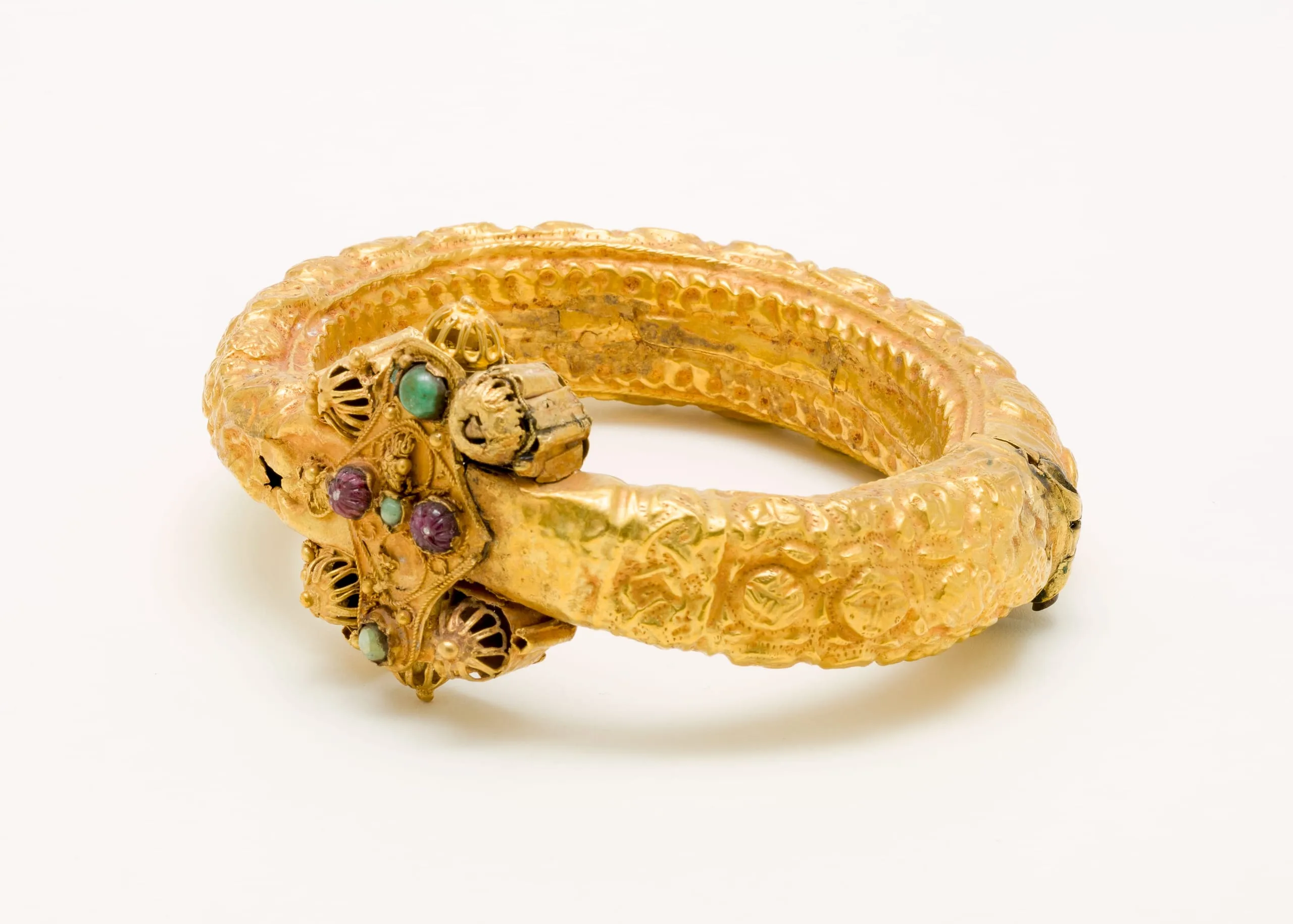
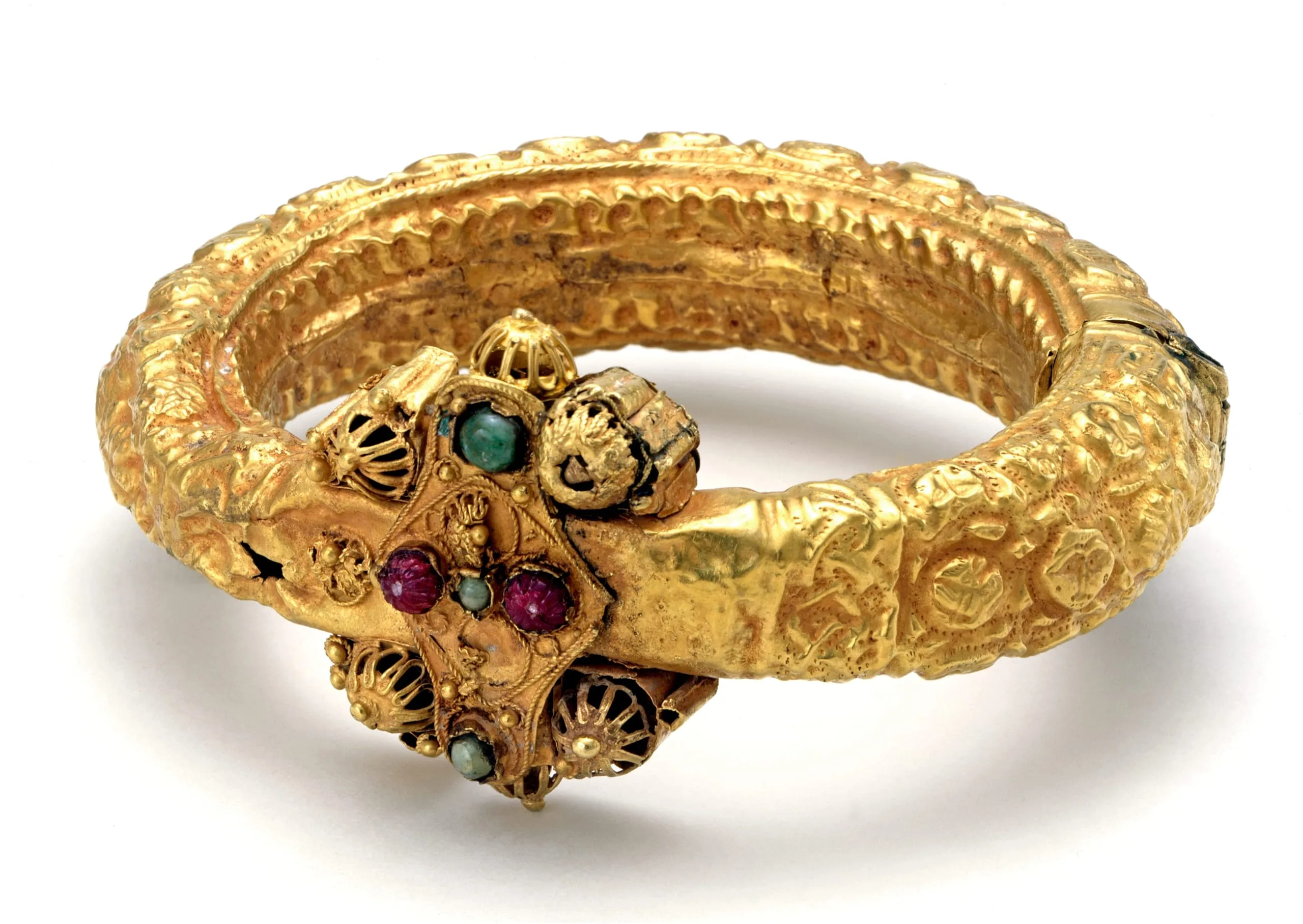
Jewelry played an important role in the lives of women in Fatimid-controlled Egypt and Syria, not only as personal adornment but also as an indicator of affluence and social standing. Surviving trousseau lists tell us that jewelry was the most valuable component of a bride’s dowry, providing a source of financial security in the event of divorce or widowhood. Jewelry such as this large gold repoussé bracelet, which was likely once part of a matched pair, was a spectacular form of wearable wealth. Such tubular or hollow bracelets possibly fit the description manfukh (Arabic for “inflated” or “puffed up”), often found in trousseau lists and associated with the wealthiest of brides.
Fashioned from a single flat sheet of gold, the shank of the bracelet was decorated with repoussé and chased designs, then folded into a hollow tube. Repoussé is a type of relief ornament pushed out from behind; here, the fine relief designs include human heads, birds, and harpies. The clasp’s elaborate decoration illustrates several complex techniques: twisted wire spirals, granulation (decoration of the surface with tiny spheroids or balls), and filigree (wire made into decorative configurations). The stones are emeralds and rubies; the latter have been set with rock crystal, a favorite stone in the Fatimid period (see M.73.5.711).
2024