LACMA

ShopMembershipMyLACMATickets
LACMA
Los Angeles County Museum of Art
5905 Wilshire Blvd.
Los Angeles, CA 90036
info@lacma.org
(323) 857-6000
Sign up to receive emails
Subscribe
© Museum Associates 2026
  • About LACMA
  • Jobs
  • Building LACMA
  • Host An Event
  • Unframed
  • Press
  • FAQs
  • Log in to MyLACMA
  • Privacy Policy
© Museum Associates 2026
Collections

Michael Sweerts
Plague in an Ancient Citycirca 1650-1652

On view:
Geffen Galleries, floor 3
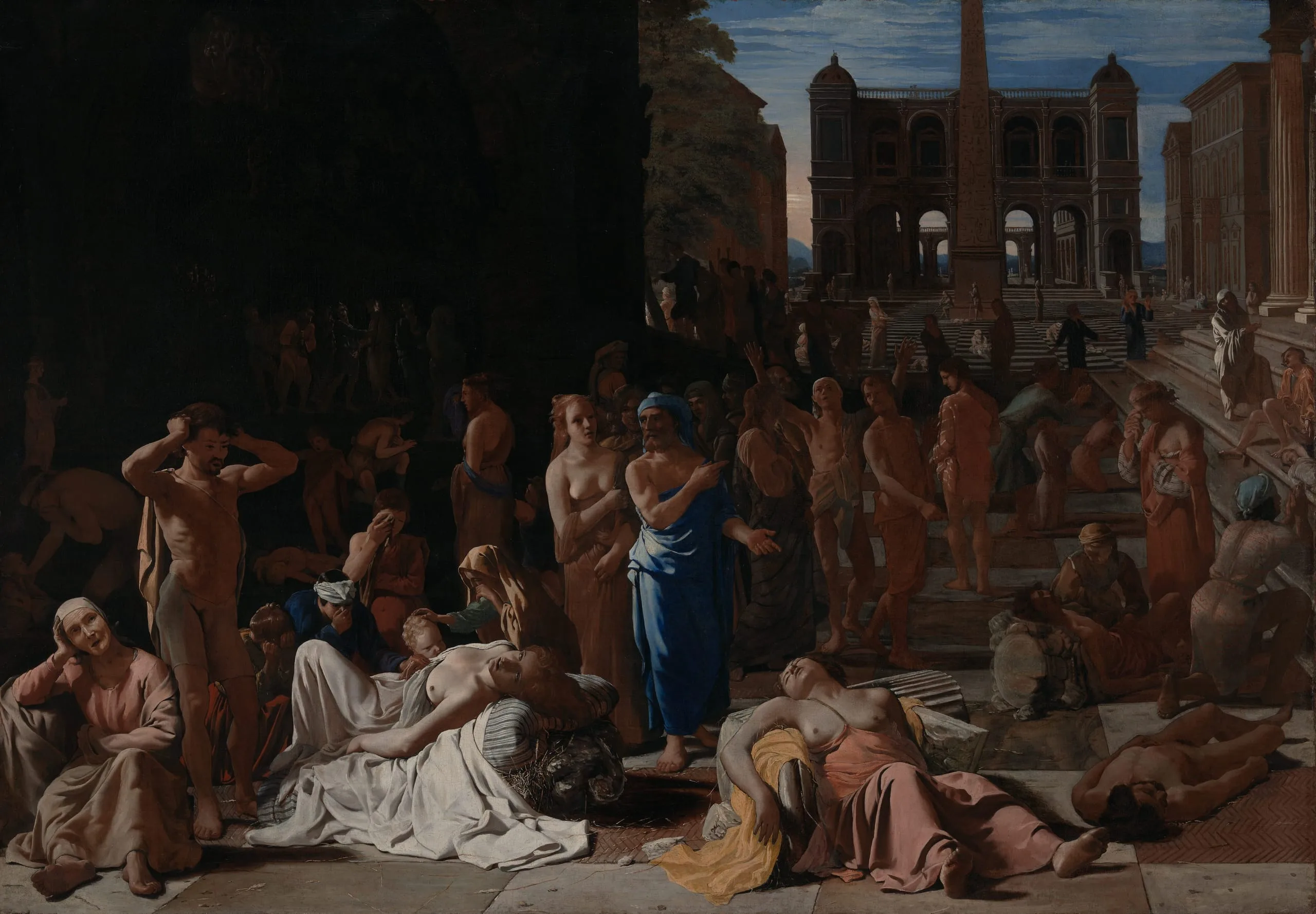
Oil painting of a large crowd of partially clothed figures collapsed, standing, and gesturing on a stone plaza before monumental classical architecture, lit from the right with deep shadow on the left

Michael Sweerts, Plague in an Ancient City, circa 1650-1652, Los Angeles County Museum of Art, Gift of The Ahmanson Foundation, photo © Museum Associates/LACMA

Artist or Maker
Michael Sweerts
Southern Netherlands, 1618-1664, active Italy and India
Title
Plague in an Ancient City
Date Made
circa 1650-1652
Medium
Oil on canvas
Dimensions
Canvas: 46 3/4 × 67 1/4 in. (118.75 × 170.8 cm) Framed: 62 × 84 × 5 in. (157.48 × 213.36 × 12.7 cm)
Credit Line
Gift of The Ahmanson Foundation
Accession Number
AC1997.10.1
Classification
Paintings
Collecting Area
European Painting and Sculpture
Curatorial Notes

Often hailed as Michael Sweerts’s most impressive composition, Plague in an Ancient City is notable for its grand scale and juxtaposition of chaos and harmony within a setting of classicizing architecture. Figures in extreme emotional states mourn over gruesome, decaying bodies, some partially clothed in a combination of antique drapery and seventeenth-century costume. In the center foreground, an elderly man clad in blue points toward a figure behind him who raises his arms, palms facing up, in the orans posture, an attitude of prayer signifying Christian worship amidst the devastation of the epidemic.

Plague was familiar not only as a concept—through ancient texts, old engravings, and contemporary paintings—but also in the more immediate personal experience of many city dwellers, such as those in Rome during the 164850 outbreak while Sweerts was in residence. Twenty years prior to Sweerts’s representation of the epidemic, Nicolas Poussin produced his monumental Plague of Ashdod, around the time of the plague threat of 1632. Sweerts’s composition references the French artist’s picture through the multitude of figures, heroic nudes, and allusions to antiquity as well as the use of intense foreshortening. Given the anachronistic costumes, Sweerts’s canvas is likely less about a specific plague and more a meditation on its social and emotional repercussions.

The patron of Plague in an Ancient City remains unknown, but recent scholarship offers a compelling suggestion. In a sixteenth-century treatise, the Jesuit Antonio Possevino cemented the age-old belief that God frequently sends plagues and other disasters to punish sinful peoples, nations, or rulers. At this time, the Catholic papacy had been combating the Protestant Reformation, which challenged the authority of the clergy and the pope. It is plausible that the patron was someone familiar with the pope’s dissatisfaction and associated the plague with heresy, possibly someone connected to the House of Pamphilj, a noble family that Sweerts knew personally and into which Pope Innocent X (r. 1644−55) was born. The painting could thus be read as a warning not only to Protestants but also to Catholics whose allegiance to the church may have wavered during the call for reformation.

2024

Provenance

Anonymous collection, Cadiz, sold to; John Langston,(1) by inheritance to his son; Horton Langston, by inheritance to;(2) Henry W. Hope (1736–1811), London, by 1810, by inheritance to; [John Williams Hope, London](3) Henry [W.] Hope (estate sale, London, Christie’s, 29 June 1816,(4) lot 97, as Nicolas Poussin, Plague at Athens, sold for £210 to); [Norton for]; Philip John Miles (d. 1845),(5) Leigh Court near Bristol, by inheritance to his son; Sir William Miles (1797–1878), 1st Bart., Leigh Court near Bristol, M.P., by inheritance to his son; Sir Philip John William Miles (1825–1888), 2nd Bart., Leigh Court near Bristol (sale, London, Christie’s, 28 June 1884, lot 53, as Poussin, bought in),(6) by inheritance to his son; Sir Cecil Miles, 3rd Bart., Leigh Court near Bristol (estate sale, London, Christie’s, 13 May 1899, lot 23, sold as Poussin for 73 guineas 10 to); Lawrence. [Thomas Agnew and Sons, London]. Sir Francis Cook (1817–1901), Doughty House, Richmond, by inheritance to his son;(7) Sir Frederick Cook (1844–1920), Doughty House, Richmond, by inheritance to his son; Sir Herbert Cook (1868–1939), Doughty House, Richmond, by inheritance to his son; Sir Francis Ferdinand Maurice Cook (1907–1978), Doughty House, Richmond (sale, London, Christie’s, 6 July 1984, lot 116, sold to); [Richard L. Feigen & Co., New York, sold to]; Saul P. Steinberg (1939–2012), New York (sale, New York, Sotheby’s, 30 Jan. 1997, lot 34, to); LACMA.

Footnotes

(1) According to Young 1822 (the catalogue of pictures at Leigh Court), Horton Langston’s father brought the painting back from Cadiz. John Langston, Esq. of Sarsden House, Oxfordshire, was a member of Parliament from Oxford. He was married to the second daughter of Harriet, the only sister of Henry Hope, and John Goddard, Esq. of Woodford Hall, Bedfordshire. Their son was Horton Langston.

(2) According to Young 1822, “Its [the painting’s] merits appear to have been imperfectly appreciated by Mr. Langston, who assigned it a place on the staircase of his house, in Queen Square; where for a very long period, from the darkness of the situation, it escaped observation. From this gloomy abode, it was rescued by the penetrating eye of Mr. Hope in whose Collection justice was done to its merits.”

(3) The sale was listed as the collection of Henry Hope, Esq., deceased. See notes to the sale published by Getty Provenance Index, Sale Catalogues Database.

(4) This was the third day of the sale that began on 27 June 1816.

(5) Philip Miles was a banker in Bristol and began his collection about 1816.

(6) According to an article about the sale, “The Leigh Court Gallery,” London Times, 30 June 1884, the painting was sold to Phillips for £420.

(7) Danziger 2004, p. 450, mistakenly suggests that Sir Francis Cook acquired the painting about 1884, thus directly from the sale of Miles’s collection or shortly thereafter. On p. 449, Danziger notes, “In his will, Francis had divided the collection between his two sons: ‘the pictures and drawings, the antique sculptures and marbles, the tapestries, glass and terra cotta . . . to Sir Frederick Cook . . . whilst the bronzes, silver, ivories, china miniatures, missals, antique gems and mediaeval jewelry were left to his second son, Mr. Wyndham Cook [1860–1905].’”

Selected Bibliography
  • Sutton, Peter C. The Age of Rubens. Boston: Museum of Fine Arts, 1993.
  • Bauman, Guy C., and Walter A. Liedtke. Flemish Paintings in America: a Survey of Early Netherlandish and Flemish Paintings in the Public Collections of North America. Antwerp: Fonds Mercator, 1992.
  • Jeromack, Paul. "High Taste, Low Budget." Art & Auction 24, no.2 (2002): 84-93.
  • Los Angeles County Museum of Art. New York: Thames and Hudson, 2003.
  • Beckett, Sister Wendy. Sister Wendy's American Collection, Toby Eady Associates, ed. Harper Collins Publishers, 2000.
  • Bindman, David. Hogarth and His Times: Serious Comedy. London: British Museum Press, 1997.
  • Yeager-Crasselt, Lara. Michael Sweerts (1618-1664): Shaping the Artist and the Academy in Rome and Brussels. Turnhout: Brepols, 2015.
  • Marandel, J. Patrice. Abecedario: Collecting and Recollecting. Los Angeles: Art Catalogues; LACMA, 2017.

  • Lehmbeck, Leah, editor. Gifts of European Art from The Ahmanson Foundation. Vol. 3, Dutch Painting, Flemish Painting, Spanish Painting and Sculpture. Los Angeles: Los Angeles County Museum of Art, 2019.
  • Humfrey, Peter. "The Collection of Philip John Miles at Leigh Court." Colnaghi Studies Journal 7 (2020): 42-63.

Related Unframed

Related Unframed

Seven European Paintings from LACMA Now On View at the Getty
  • August 1, 2019
  • Amy Hood
Imagining Rome
Imagining Rome
  • July 9, 2018
  • David Bardeen
From the Collection: Plague in an Ancient City
  • August 3, 2015
  • Scott Tennent
Separated by 1,500 Years, Now Two Feet Apart
  • April 27, 2010