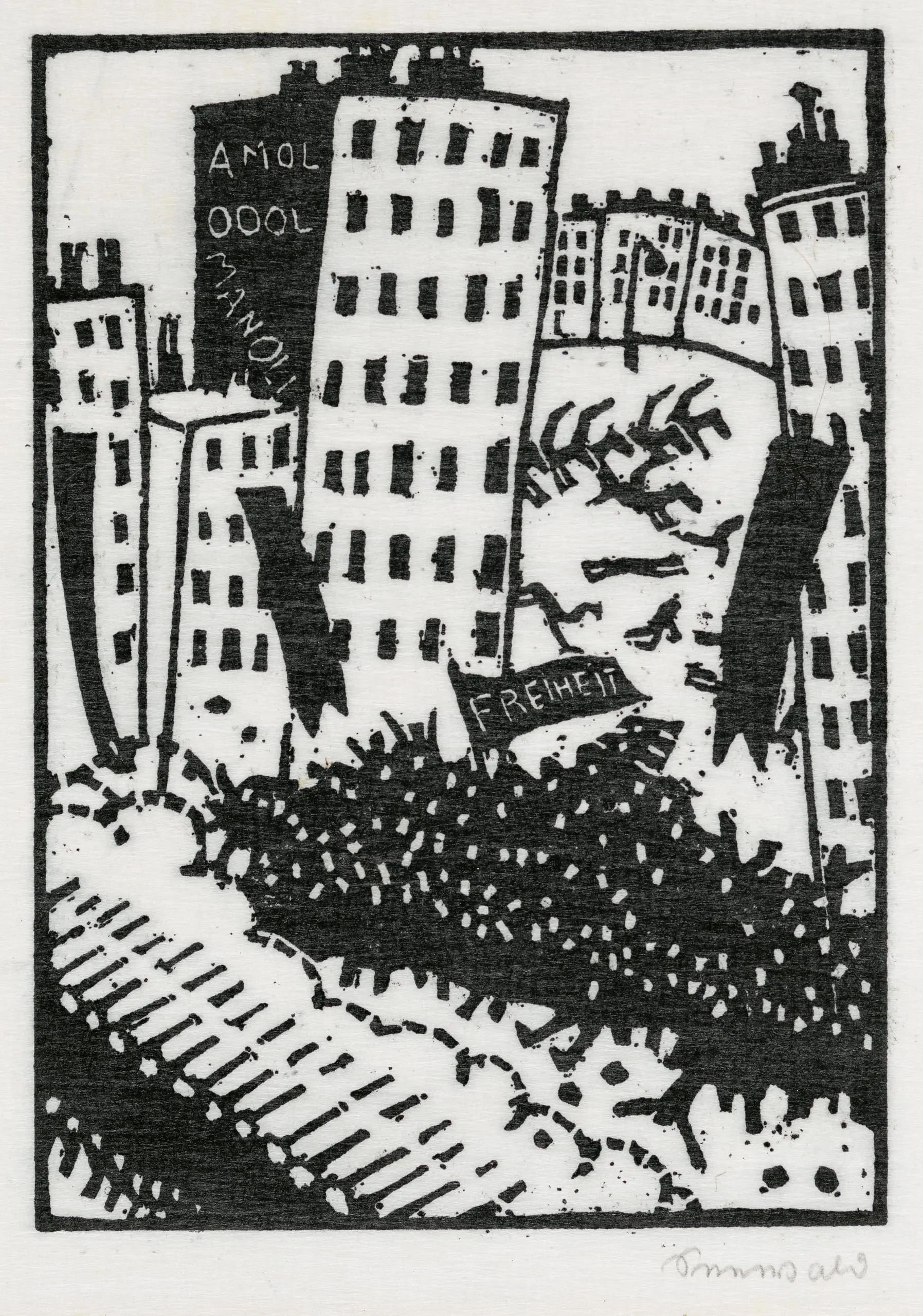
In this small print by Richard Seewald, a faceless mass confronts a uniform firing line of officers. The distanced view gives us a bird’s-eye perspective on the scene. The demonstrators, outnumbering the troops, carry a sign that reads “Freiheit” (freedom), its scale competing for attention with the brands advertised on the building above: Amol, Odol, and Manoli. The scene suggests the moment just after the officers have opened fire: smoke plumes from their weapons, and fear has turned the protesting crowd into a frantic mob. Several figures lie prone on the ground, while others flee. Seewald depicts this action and the ruthlessness of state power with the barest abstract details: the orderly repetition of figures on the firing line contrasts with the disordered jumble of panicked protestors before them, and the smaller group above is mowed down by officers on horseback.
Seewald created this print in 1913, a year before the beginning of World War I and five years before the start of the German Revolution. It appeared on the front page of the first issue of Revolution, a Munich-based radical journal formed in response to the conservatism of German culture, exemplified by the Catholic Center Party’s takeover of Bavarian state politics the year before. The journal advocated anarchy, sexual liberation, and Expressionism, equated avant-garde artists with political revolutionaries, and rejected compromise in favor of violent resistance. Seewald’s woodcut, however, suggests the suppression of revolution rather than its triumph. It also unintentionally anticipated a question that would be asked during the coming revolution: What is the relationship between art and the revolutionary act?
Erin Sullivan Maynes
2022 (adapted from Pressing Politics: Revolutionary Graphics from Mexico and Germany, 40)


![New Acquisition: Beauford Delaney's “Negro Man” [Claude McKay]](/_next/image?url=https%3A%2F%2Funframed.lacma.org%2Fsites%2Fdefault%2Ffiles%2Fstyles%2Farticle_full%2Fpublic%2Ffield%2Fimage%2FEX9040_32-MRG.jpg%3Fitok%3D3vMdSDRy&w=828&q=75)


