- Artist or Maker
- George Grosz
Germany, also active United States, 1893-1959 - Title
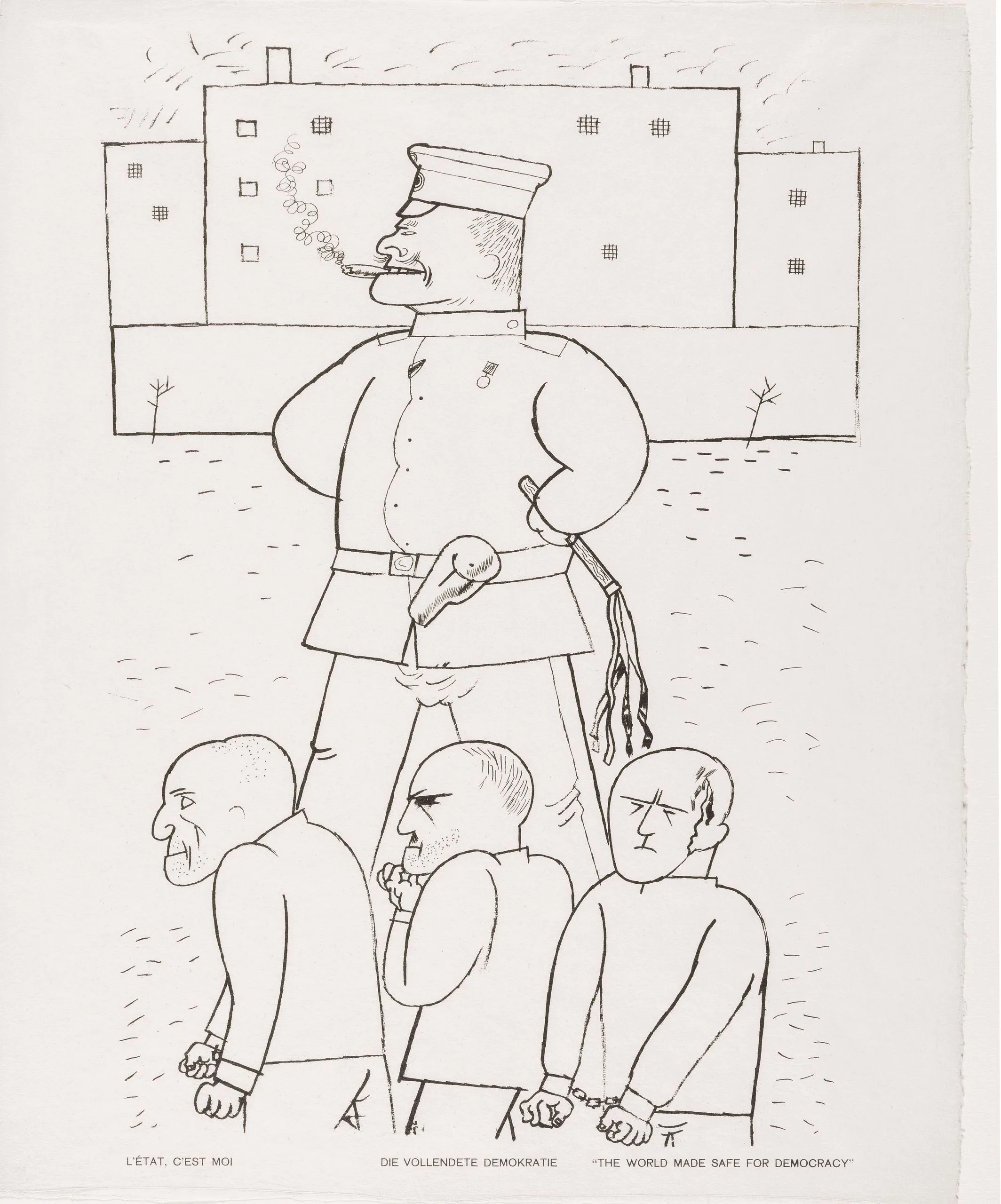
- 'The World Made Safe for Democracy'
- Date Made
- 1919
- Medium
- Photolithograph on G. F. Drey Könige laid paper
- Dimensions
- Image (Image): 17 1/2 x 11 15/16 in. (44.45 x 30.3213 cm)
Sheet: 19 × 15 3/8 in. (48.26 × 39.05 cm)
Frame: 23 × 19 × 1 3/8 in. (58.42 × 48.26 × 3.49 cm)
- Accession Number
- M.82.288.73f
- Curatorial Notes
Grosz’s portfolio God with Us (Gott mit uns) attacks the German military for the follies of World War I (see also M.82.288.73e). The title of the portfolio refers to the nationalistic motto engraved on soldiers’ belt buckles, while the titles of each print are appropriated French, German, and English phrases that sharpen the criticism of Grosz’s images of ill-mannered, fat-bellied officers. In “The World Made Safe for Democracy” (Die vollendete Demokratie), he sketched a gritty, barebones scene of three men in shackles standing before a bloated, smoking guard whose gun holster looks like a displaced phallus—a symbol of dangerous hypermasculinity that appeared frequently in the artist’s drawings.
Grosz volunteered to serve in the war in 1914 and was sent to the front twice, but suffered a serious sinus condition and then a nervous breakdown, twice being declared unfit. Born Georg Gross, he de-Germanized his name in 1916 as a personal protest against the nationalism that had swept his country during wartime. He was a member of the Berlin Dada circle from 1918 to 1920, and a proponent of the New Objectivity in the 1920s, a period in which his own work became more caustically political. After God with Us was exhibited in the First International Dada Fair in Berlin in 1920, Grosz and his publisher, Wieland Herzfelde, were convicted of defaming the military. It was not the last time that Grosz would be persecuted for his work. His repeated arrests have become part of the mythos of his prints, positioning them as important documents of Germany’s political struggles in the Weimar era and as artifacts of authoritarian rule and its repercussions for the cultural avant-garde.
Andrea Gyorody
2017
- Selected Bibliography
Davis, Bruce. German Expressionist Prints and Drawings: The Robert Gore Rifkind Center for German Expressionist Studies. Los Angeles, CA: Los Angeles County Museum of Art, 1989; Munich, Germany: Prestel, 1989.
- Rigby, Ida Katherine. An alle Künstler! : War-Revolution-Weimar : German Expressionist Prints, Drawings, Posters and Periodicals from the Robert Gore Rifkind Foundation. San Diego : San Diego State University Press, 1983.
- Reed, Orrel P., German expressionist art: the Robert Gore Rifkind Collection: prints, drawings, illustrated books, periodicals, posters. Exhibition Catalogue. Los Angeles: Frederick S. Wight Art Gallery, University of California, Los Angeles, 1977.
- Chipp, Herschel B. and Karin Breuer. The Human Image in German Expressionist Graphic Art From the Robert Gore Rifkind Foundation. Berkeley: University Art Museum, Berkeley, 1981.
- Dückers, Alexander. George Grosz: das druckgraphische Werk/Alexander Dückers. Frankfurt am Main; Berlin; Wien: Propyläen-Verlag, 1979.
Barron, Stephanie, and Sabine Eckmann. New Objectivity: Modern German Art in the Weimar Republic, 1919–1933. Los Angeles: Los Angeles County Museum of Art and DelMonico Books/Prestel, 2015.
- Benson, Timothy O. and Andrea Gyorody. A New Generation of Creators: Selections from The Robert Gore Rifkind Center for German Expressionist Studies. Los Angeles: Los Angeles County Museum of Art, 2017.
- Copyright
- © Estate of George Grosz / Licensed by VAGA at Artists Rights Society (ARS), New York