LACMA

ShopMembershipMyLACMATickets
LACMA
Los Angeles County Museum of Art
5905 Wilshire Blvd.
Los Angeles, CA 90036
info@lacma.org
(323) 857-6000
Sign up to receive emails
Subscribe
© Museum Associates 2025

Museum Hours

Monday

11 am–6 pm

Tuesday

11 am–6 pm

Wednesday

Closed

Thursday

11 am–6 pm

Friday

11 am–8 pm

Saturday

10 am–7 pm

Sunday

10 am–7 pm


  • About LACMA
  • Jobs
  • Building LACMA
  • Host An Event
  • Unframed
  • Press
  • FAQs
  • Log in to MyLACMA
  • Privacy Policy
© Museum Associates 2025
Collections

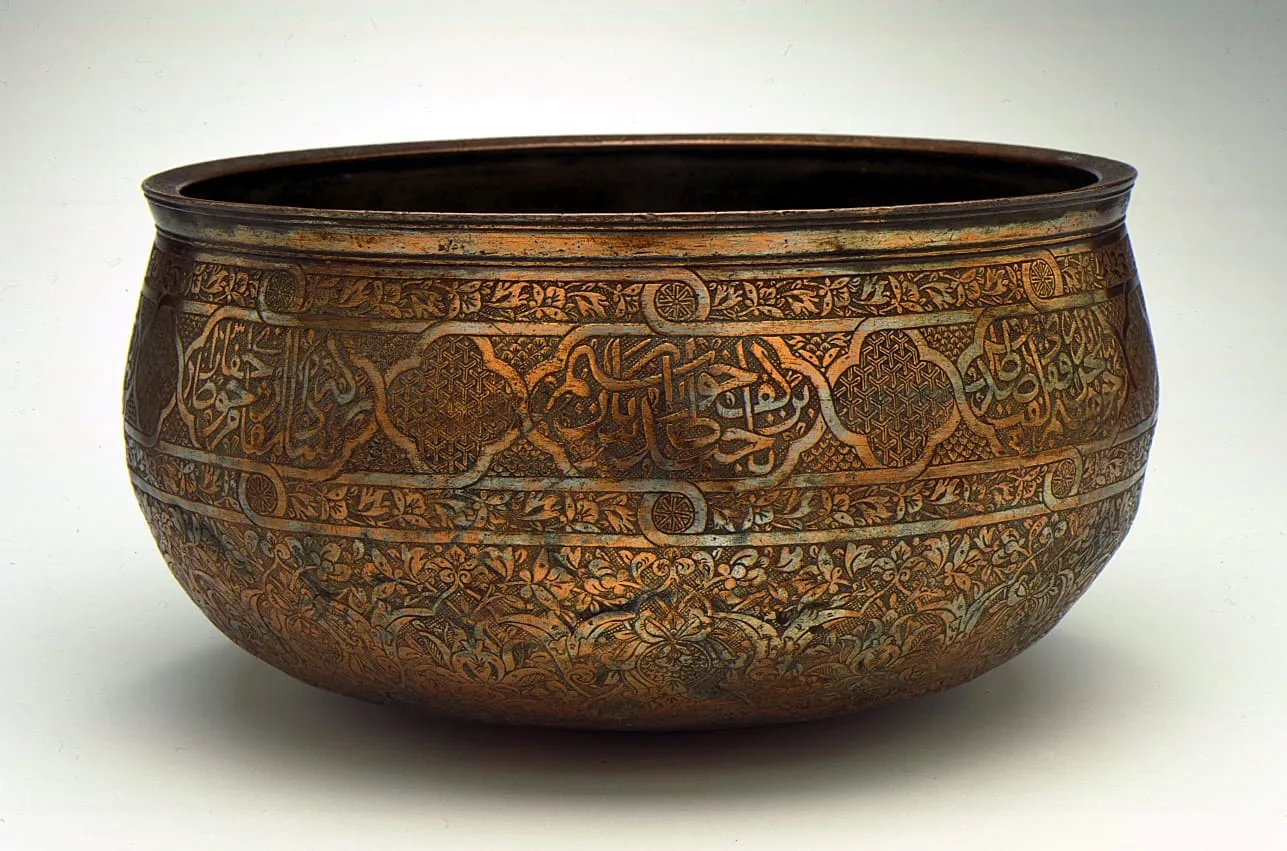
Bowllate 15th century

Not on view
Engraved copper alloy bowl with globular form, covered in horizontal bands of Arabic calligraphy in cartouches and dense scrolling floral decoration, with blue-green patina
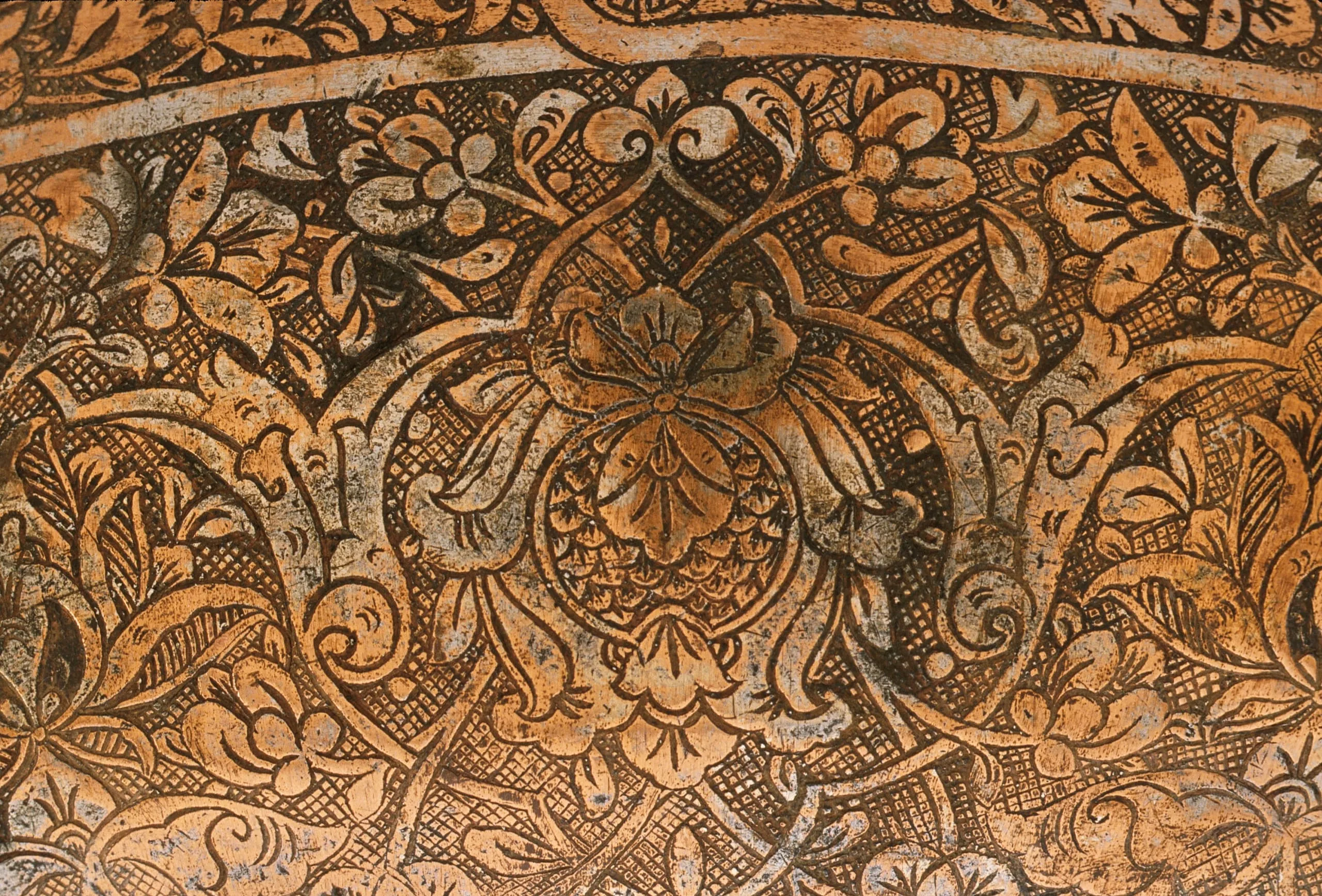
Close-up of a ceramic vessel's curved surface with densely incised decoration in warm amber and dark brown tones; a central medallion with a pinecone or pomegranate motif surrounded by scrolling vines, foliage, and stylized flowers filling the entire field with crosshatched ground patterns.
Title
Bowl
Place Made
Afghanistan, Herat
Date Made
late 15th century
Period
Timurid (1370-1506)
Medium
Copper, engraved and originally tinned
Dimensions
Diameter: 10 9/16 in. (26.83 cm); Height: 5 3/4 in. (14.61 cm)
Credit Line
Purchased with funds provided by the Nasli M. Heeramaneck Collection, gift of Joan Palevsky
Accession Number
AC1996.38.1
Classification
Metal
Collecting Area
Art of the Middle East: Islamic
Curatorial Notes

This bowl belongs to what is arguably one of the most brilliant periods in Persian art, the reign of the Timurid Sultan-Husayn Bayqara (1470-1506). Sultan-Husayn's court attracted the preeminent artistic and literary talents of the day, and Herat (in modern Afghanistan), the Timurid capital, was the focal point of this cultural efflorescence. The Timurid court is best known for the arts of the book, but the decorative arts, including metalwork, also flourished there. The museum's bowl, the decoration of which combines lush floral ornament and handsome calligraphy, typifies the artistic milieu of the period. Made of almost pure copper, the bowl was originally tinned, which produced a silvery surface that is only partially preserved. Because tin is highly resistant to organic acids, it was frequently used on the interiors of food and beverage receptacles to protect both vessel and owner. Beginning in the Timurid period, the exteriors of bowls and other objects were often tinned as well, but for a purely coloristic effect and perhaps to emulate actual silver. The bowl's boldly drawn floral and vegetal designs are among the numerous distinctive features that relate this vessel to a small group of high-quality tinned copper wares, two examples of which are dated to the year 902/1497-98. Many of these motifs, as well as the rigid symmetry of the ornament, are illustrated in a series of 15th century drawings that may have served as patterns for Timurid artists. This could explain the recurrence of the same floral and vegetal designs in nearly all contemporary media, including manuscript illuminations, bookbindings, textiles, woodwork, and stone carvings. Along with the floral ornaments, a Persian poem, in four couplets, contained within a series of eight cartouches dominate the bowl's decoration:

My ear discerned a voice reverberating from the bowl:

"I drew and made a thousand designs for the sake of the bowl."

Seeking what is hidden on our lips

We want to say one hundred words into the bottom of the bowl:

"How long will he find his useless presence in the palm of the silver-breasted beauties?"

Alas, such is the cruelty of the bowl.

Fill the bowl with clear wine, O Sage

And then experience the bowl with your searching gaze.

It seems likely that the poem was written specifically for the object to which it appears to give voice—the bowl. It is referred to as a tas (bowl), which is used as the fixed end rhyme, while its presumed function is as a receptacle for wine, as in the fourth couplet. The repetition and multiplicity of the same designs as on the bowl in contemporaneous drawings recommends that the verse "I drew and made a thousand designs for the sake of the bowl" is not entirely hyperbolic but rather is indicative of a specific creative practice in Timurid ateliers.


For more information on this bowl, see this https://sites.lsa.umich.edu/khamseen/topics/2022/on-a-tinned-copper-bowl-and-designs-on-paper/">video.

Selected Bibliography
  • Komaroff, Linda. "Islamic Art Now and Then." In Islamic Art: Past, Present, Future, edited by Sheila Blair and Jonathan Bloom, 26-56. New Haven, New York, and London: Yale University Press, 2019.

  • Blondet, José Luis. Six Scripts for Not I: Throwing Voices (1500 BCE-2020 CE). Los Angeles: Los Angeles County Museum of Art, 2020.