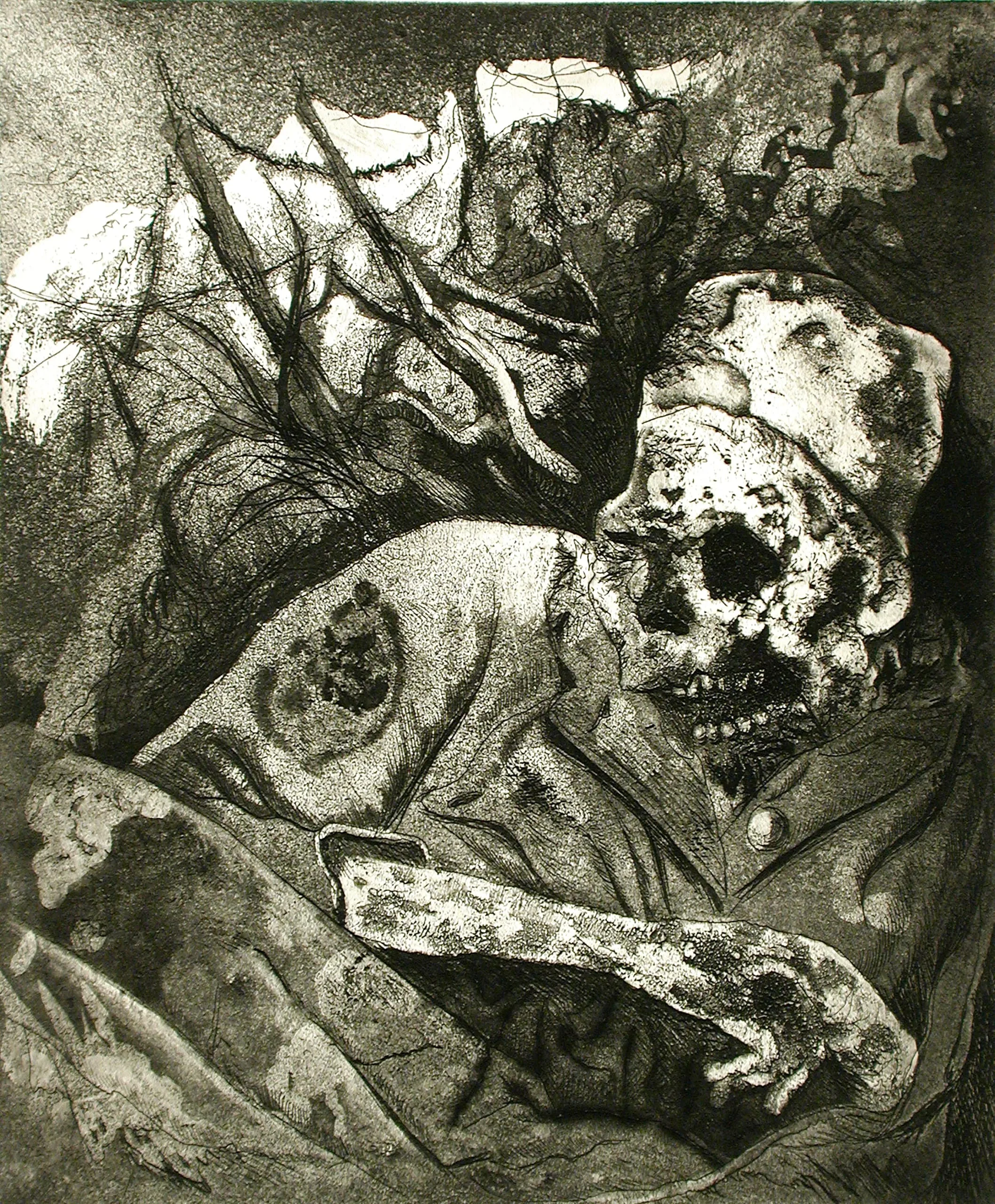
- Artist or Maker
- Otto Dix
Germany, 1891-1969 - Title
- Corpse in Barbed Wire (Flanders)
- Date Made
- 1924
- Medium
- Etching and aquatint on wove copperplate paper
- Dimensions
- Plate: 11 13/16 x 9 9/16 in. (30 x 24.29 cm)
Sheet: 18 13/16 x 13 7/8 in. (47.78 x 35.24 cm)
- Accession Number
- M.82.288.52f
- Selected Bibliography
Davis, Bruce. German Expressionist Prints and Drawings: The Robert Gore Rifkind Center for German Expressionist Studies. Los Angeles, CA: Los Angeles County Museum of Art, 1989; Munich, Germany: Prestel, 1989.
- Rigby, Ida Katherine. An alle Künstler! : War-Revolution-Weimar : German Expressionist Prints, Drawings, Posters and Periodicals from the Robert Gore Rifkind Foundation. San Diego : San Diego State University Press, 1983.
- McGreevy, Linda F. Bitter Witness: Otto Dix and the Great War. New York: Peter Lang, Inc., 2001.
- Karsch, Florian. Otto Dix: das graphische Werk. Hrsg. von Florian Karsch. Eingeleitet von Hans Kinkel. Hannover: Schmidt-Küster, c. 1970
- Copyright
- © Otto Dix Estate / Artists Rights Society (ARS) New York / VG Bild-Kunst, Bonn