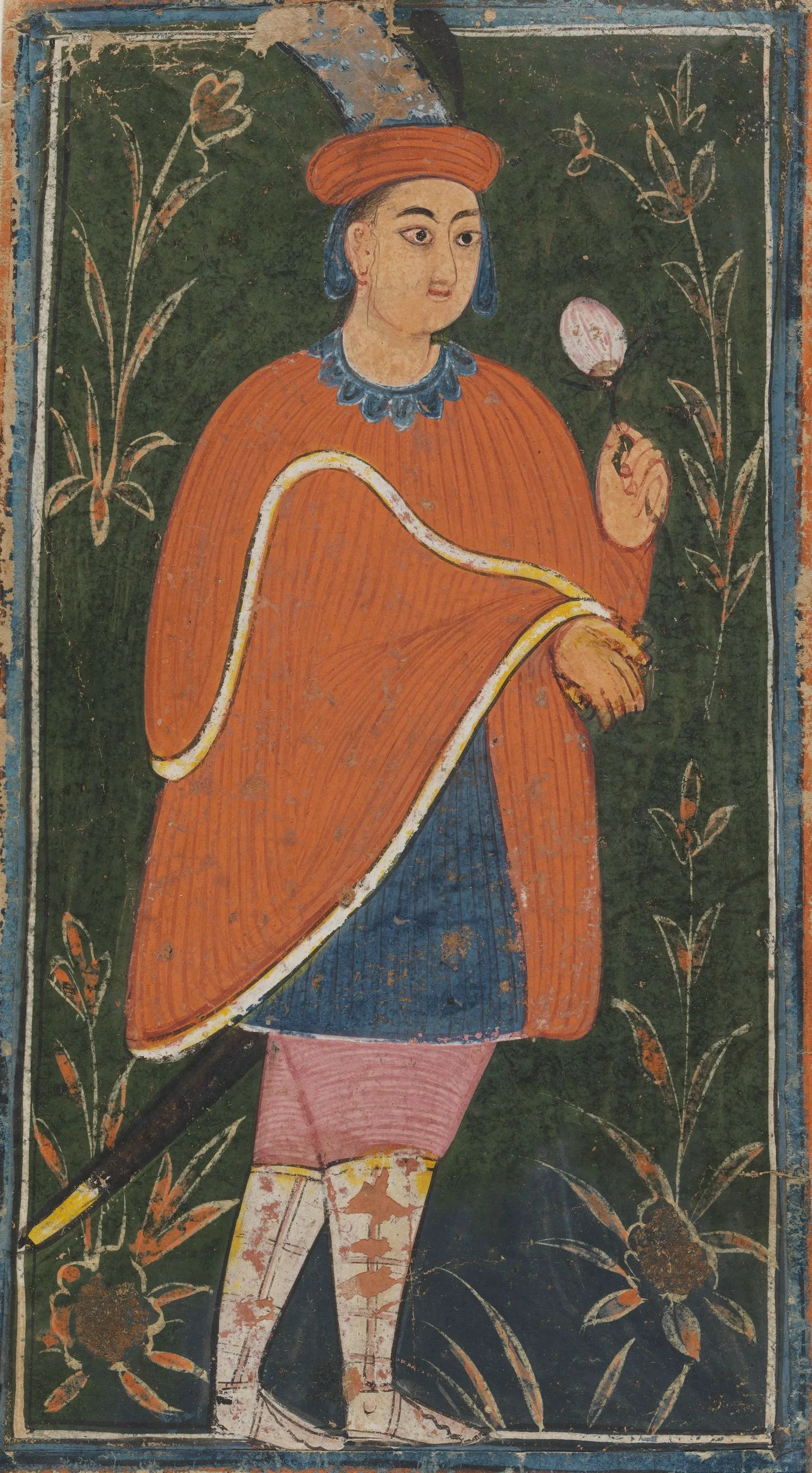
An unusually early Rajput representation attributed to Bundi (?), c. 1600, is likely intended to depict a Portuguese courtier. The elegant figure wears a 15th-century style padded roundlet hat topped by a peacock feather, a cape with a crenellated collar, baggy pants, and knee-length leather boots. All of these garments, so alien and unsuitable to the Indian climate, must have served as an immediately recognizable visual trope for artists wishing to portray exotic foreigners. Curiously, the Portuguese gentleman holds a white lotus bud, an atypical attribute in a European context. Its presence here may have been intended to symbolize the subject’s cultural sophistication as an allusion to refined Indian rulers and courtesans similarly shown holding a single flower.
As early as the 1560s Portuguese traders and Jesuit missionaries brought illustrated Bibles, engravings, and prints as gifts to the Mughal monarchs. Imperial court painters drew inspiration from these works, and as a result their own paintings and drawings reveal a new interest in volume, depth, and the use of light and shadow. Indian artists also utilized European iconographic elements and figural types, creating a pastiche of Western design elements in their works. The taste for European-style paintings was especially great during the reigns of Emperor Akbar (r. 1556-1605) and his son Emperor Jahangir (r. 1605-27).