- Title
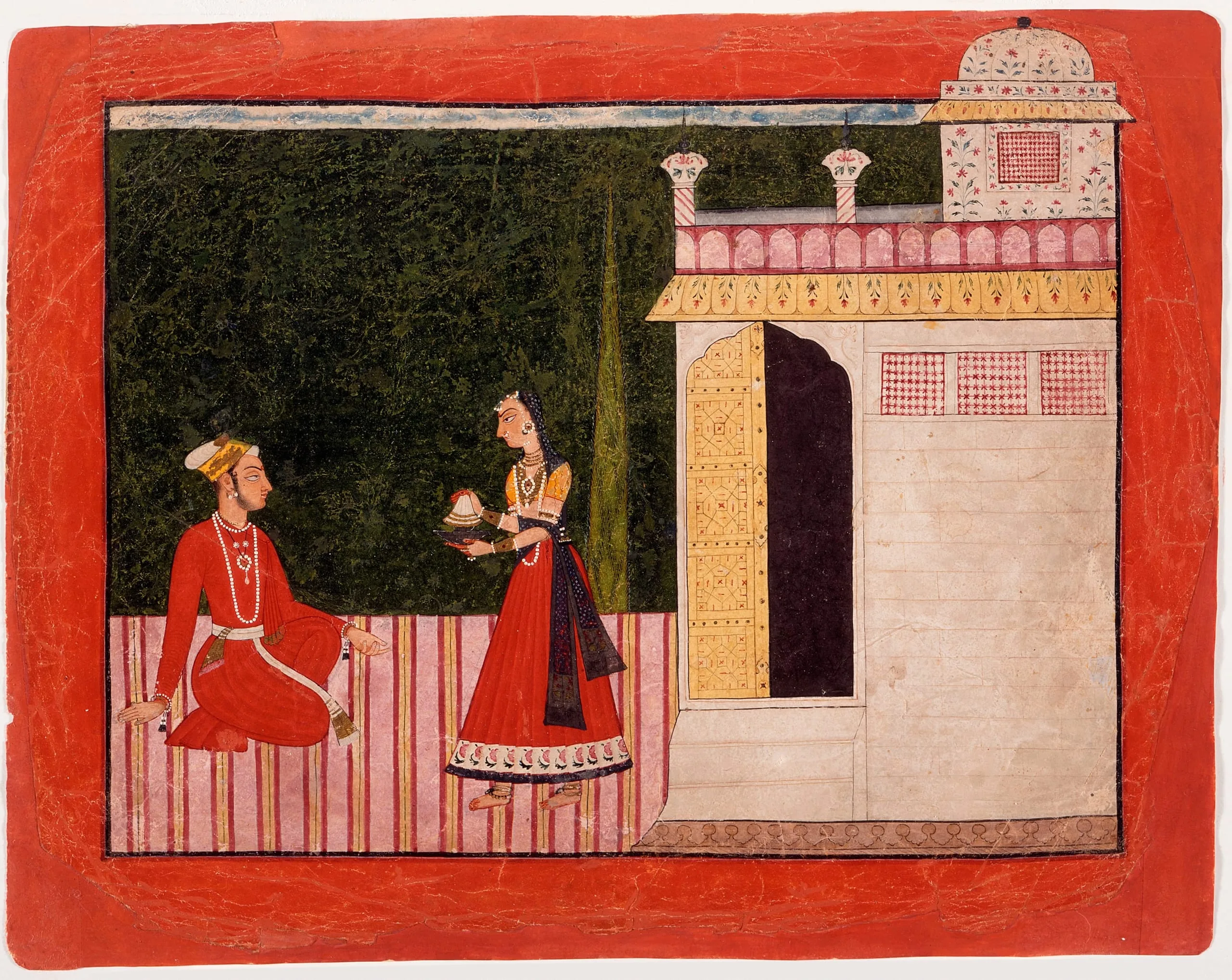
- Malkos Raga, Folio from a Ragamala (Garland of Melodies)
- Date Made
- circa 1690-1700
- Medium
- Opaque watercolor and gold on paper
- Dimensions
- Sheet: 8 1/2 x 10 7/8 in. (21.59 x 27.62 cm); Image: 7 1/2 x 9 1/8 in. (19.05 x 23.17 cm)
- Accession Number
- AC1995.143.1
- Curatorial Notes
Malkos Raga is the second raga in all the ragamala (garland of melodies) classification systems. It is a sublime melody associated with midnight and late winter (December–January). It is one of the least distinctive ragas but is often personified as a hero or prince seated in or near a pavilion with a courtly woman. The couple is typically partaking of betel nut quids (pan). A woman (or women) sometimes holds an honorific fly whisk. Here, the hero is kneeling on a terrace with a striped carpet beside a white pavilion with floral decoration. A woman offers him a dish of betel nut quids. A lone cypress tree stands against a dark background indicating that it is a nighttime melody. See also M.71.1.22 and M.83.105.12.
Although the hero does not wear the idiosyncratic quatrefoil-shaped pendant worn by Basohli royalty for regal identification and proclamatory purposes (see M.81.271.8 and M.83.105.8), which suggests that he may not be intended as a Basohli prince, he wears the same type of related pendant, sports the same thin, scruffy facial hair, and has a similar stylistic treatment of his eye as the Basohli figural type typified in a Basohli Velavala Ragaputra attributed to circa 1710 in the Art Gallery of New South Wales, Sydney (199.1992). At least three Basohli ragamalas from circa 1680-1710 have been identified to date, but the LACMA folio appears to be from another distinct series based on its dimensions and border style.