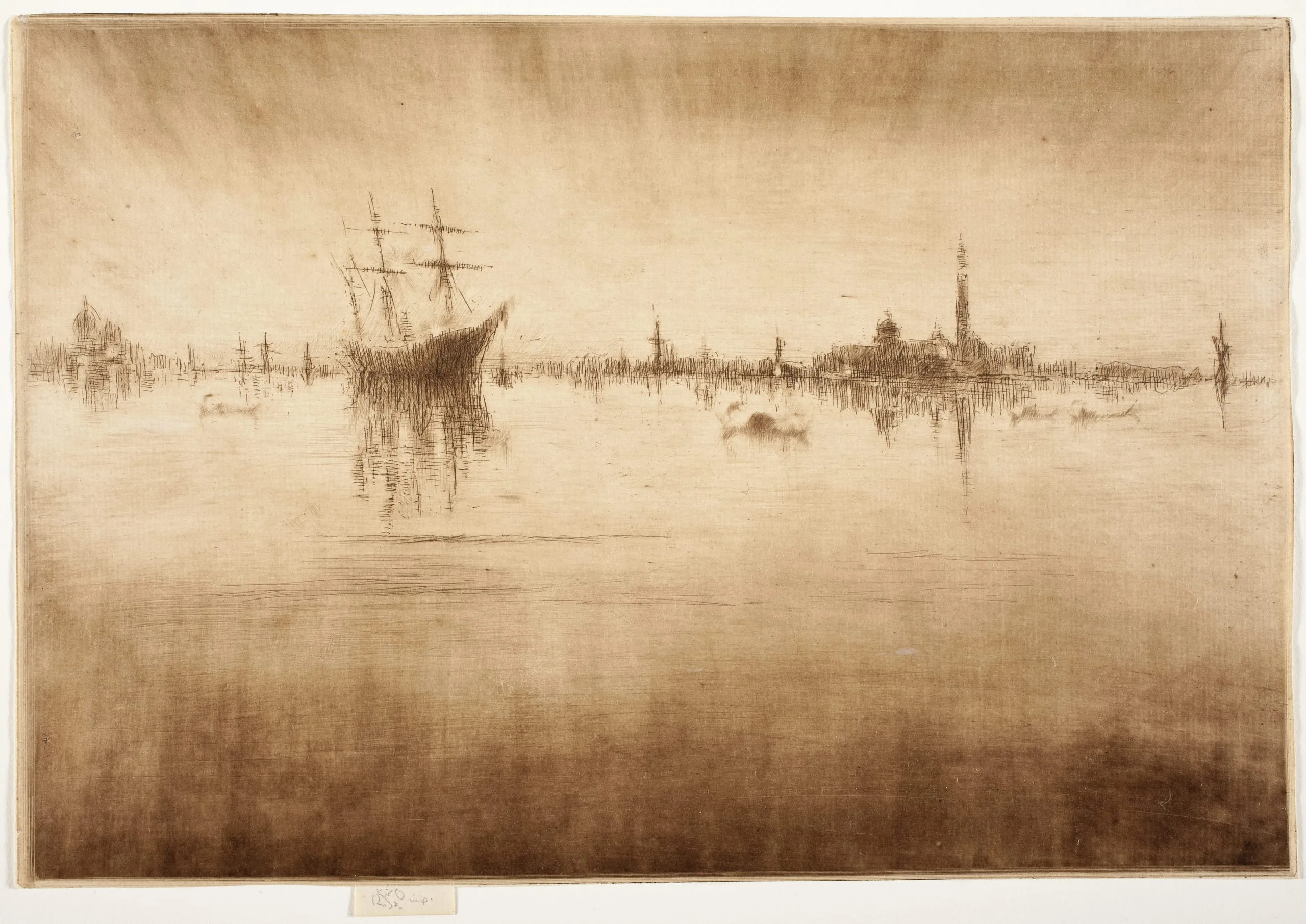
Whistler enhanced the drawn lines of his etchings with painterly tonal solutions achieved through unique manipulations of ink left on the surface of the plate. In Nocturne, the strong directional wiping of the translucent film of ink creates rich atmospheric effects, evoking the darkening evening sky and the reflection of its last light on the water. From a position on the Venetian Lagoon, he sketchily depicted a panorama of churches, from Santa Maria della Salute on the left to San Giorgio Maggiore on the right. He composed the view so that the large ship is similar in scale to the buildings in the distance. The city thus appears to float on a glowing horizon as gondolas waver like the skyline’s reflections on the water.
Starting in the early 1870s, in both prints and paintings of evening subjects, Whistler adopted the musically inspired title Nocturne through which he emphasized the absence of narrative content. “By using the word ‘nocturne,’” he explained, “I wished to indicate an artistic interest alone, divesting the picture of any outside anecdotal interest which might have been otherwise attached to it. A nocturne is an arrangement of line, form, and color” (Dorment and MacDonald 1995: 122).
Naoko Takahatake and Claudine Dixon
2012/2024
Bibliography
Dorment and MacDonald 1995. Richard Dorment and Margaret F. MacDonald. James McNeill Whistler. New York: Abrams, 1995.