LACMA

ShopMembershipMyLACMATickets
LACMA
Los Angeles County Museum of Art
5905 Wilshire Blvd.
Los Angeles, CA 90036
info@lacma.org
(323) 857-6000
Sign up to receive emails
Subscribe
© Museum Associates 2026
  • About LACMA
  • Jobs
  • Building LACMA
  • Host An Event
  • Unframed
  • Press
  • FAQs
  • Log in to MyLACMA
  • Privacy Policy
© Museum Associates 2026
Collections

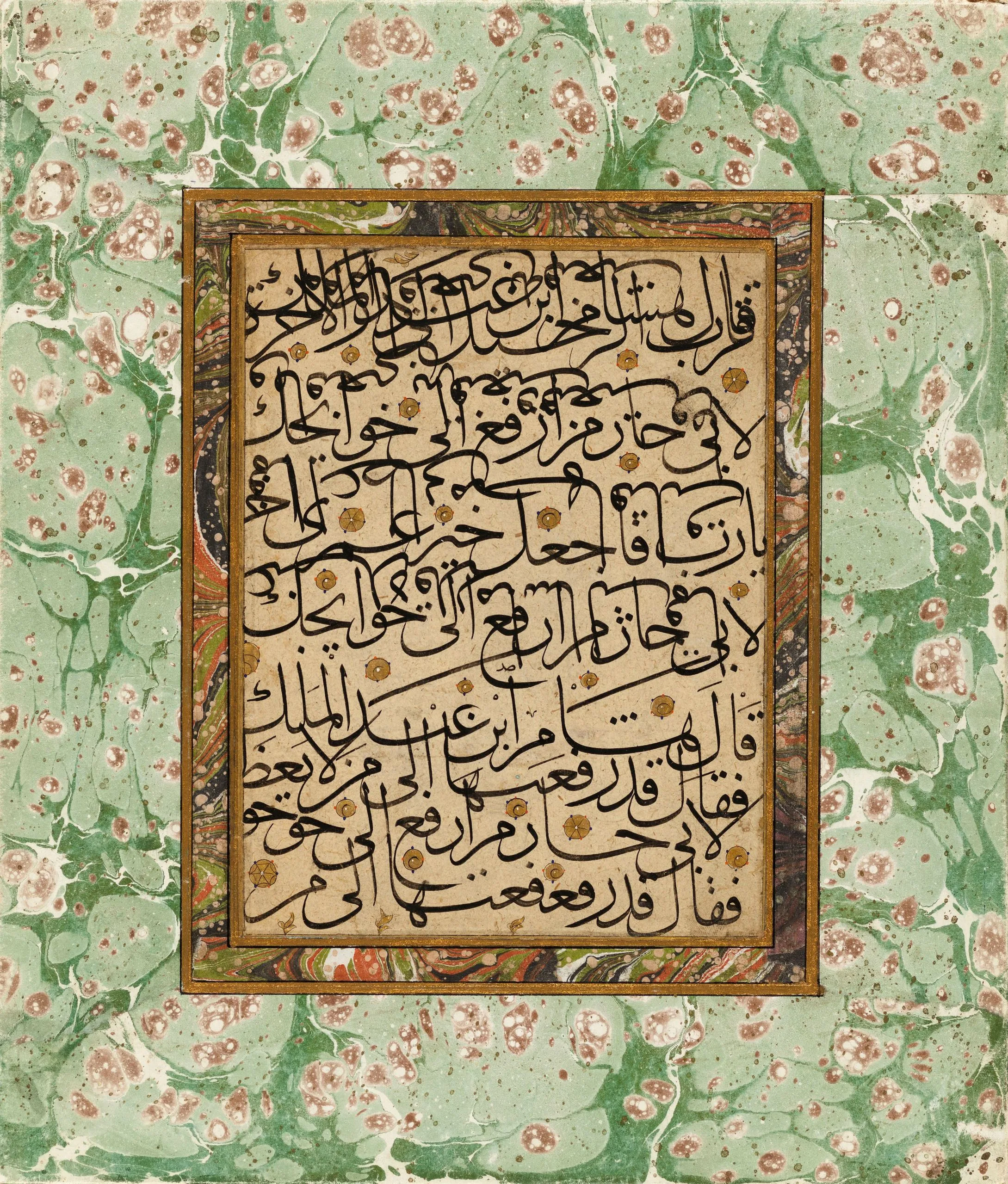
Page of Calligraphy18th century

On view:
Geffen Galleries
Vertical calligraphic page with Arabic script in bold cursive ink on parchment, gold rosette dividers, and a wide sage green ebru marbled paper border

Unknown, Page of Calligraphy, 18th century, Los Angeles County Museum of Art, Bequest of Edwin Binney, 3rd, Turkish Collection, photo © Museum Associates/LACMA

Title
Page of Calligraphy
Place Made
Turkey
Date Made
18th century
Period
Ottoman (1281-1924)
Medium
Ink and gold on paper with marbleized border
Dimensions
Page: 13 3/4 × 11 3/4 in. (34.93 × 29.85 cm) Calligraphy: 8 × 6 in. (20.32 × 15.24 cm) Frame: 23 × 19 × 1 1/2 in. (58.42 × 48.26 × 3.81 cm)
Credit Line
Bequest of Edwin Binney, 3rd, Turkish Collection
Accession Number
AC1995.124.8
Classification
Manuscripts
Collecting Area
Art of the Middle East: Islamic
Curatorial Notes

In Muslim cultures, words are used not only to communicate but to decorate. Because it is through writing that the Qur’an is transmitted, scripts in the Arabic alphabet were devised and perfected to be worthy of divine revelation. On this account, calligraphy became the most important art form regardless of the text.

Like other artists, Islamic calligraphers honed their skills or worked out new ideas on practice sheets, repeating the same words—or even single letters—until the blank page was almost entirely covered in ink. Never intended to be read, such calligraphic “sketches” were appreciated by connoisseurs in early modern times for their pure visual appeal. In this Ottoman example, mounted on ornamental paper and once preserved in an album, words and phrases written in the thuluth script have been repeated, interlaced, and reversed in orientation, resulting in an attractive weblike composition.
Selected Bibliography
  • Lo Terrenal y lo Divino: Arte Islámico siglos VII al XIX Colección del Museo de Arte del Condado de Los Ángeles. Santiago: Centro Cultural La Moneda, 2015.