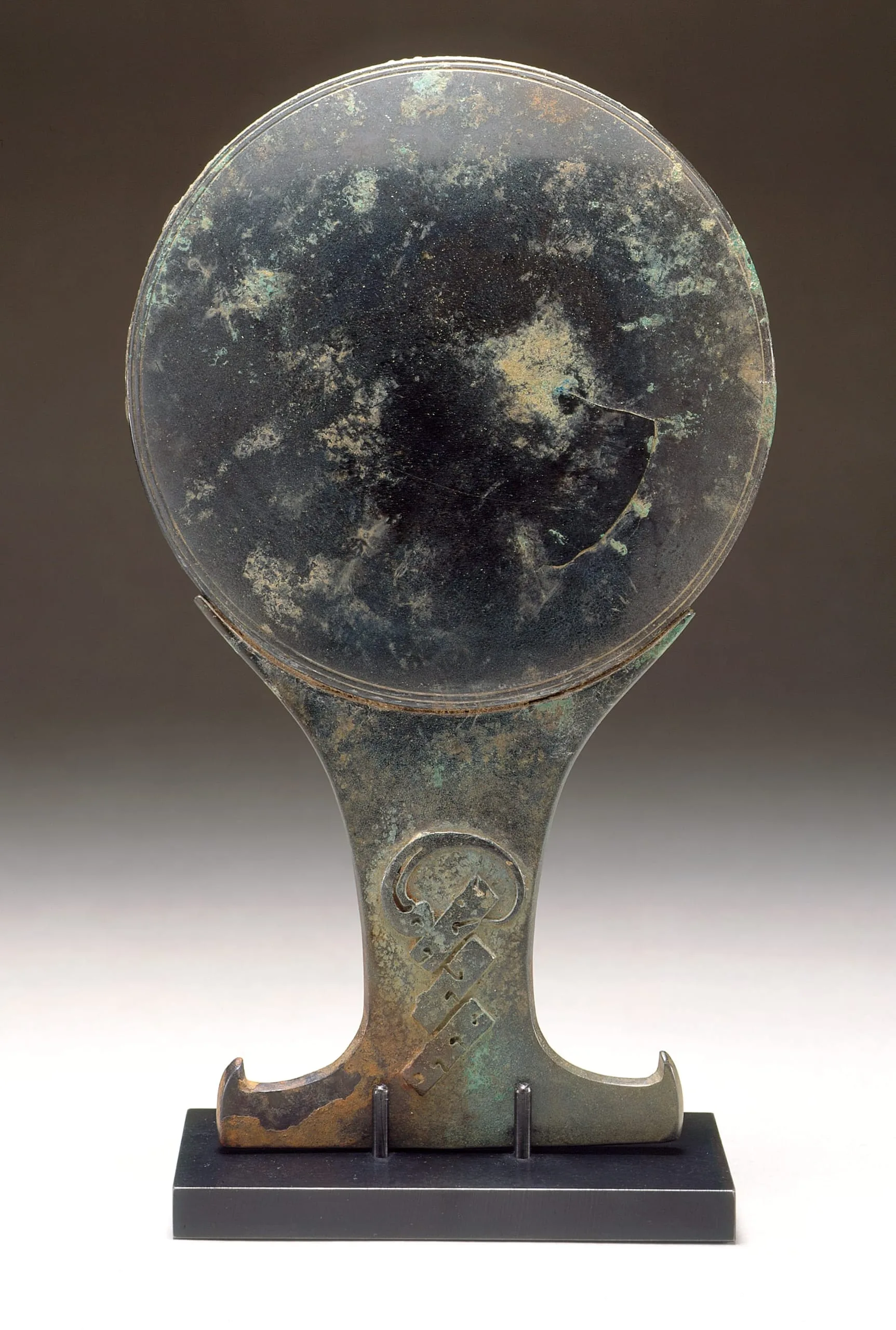
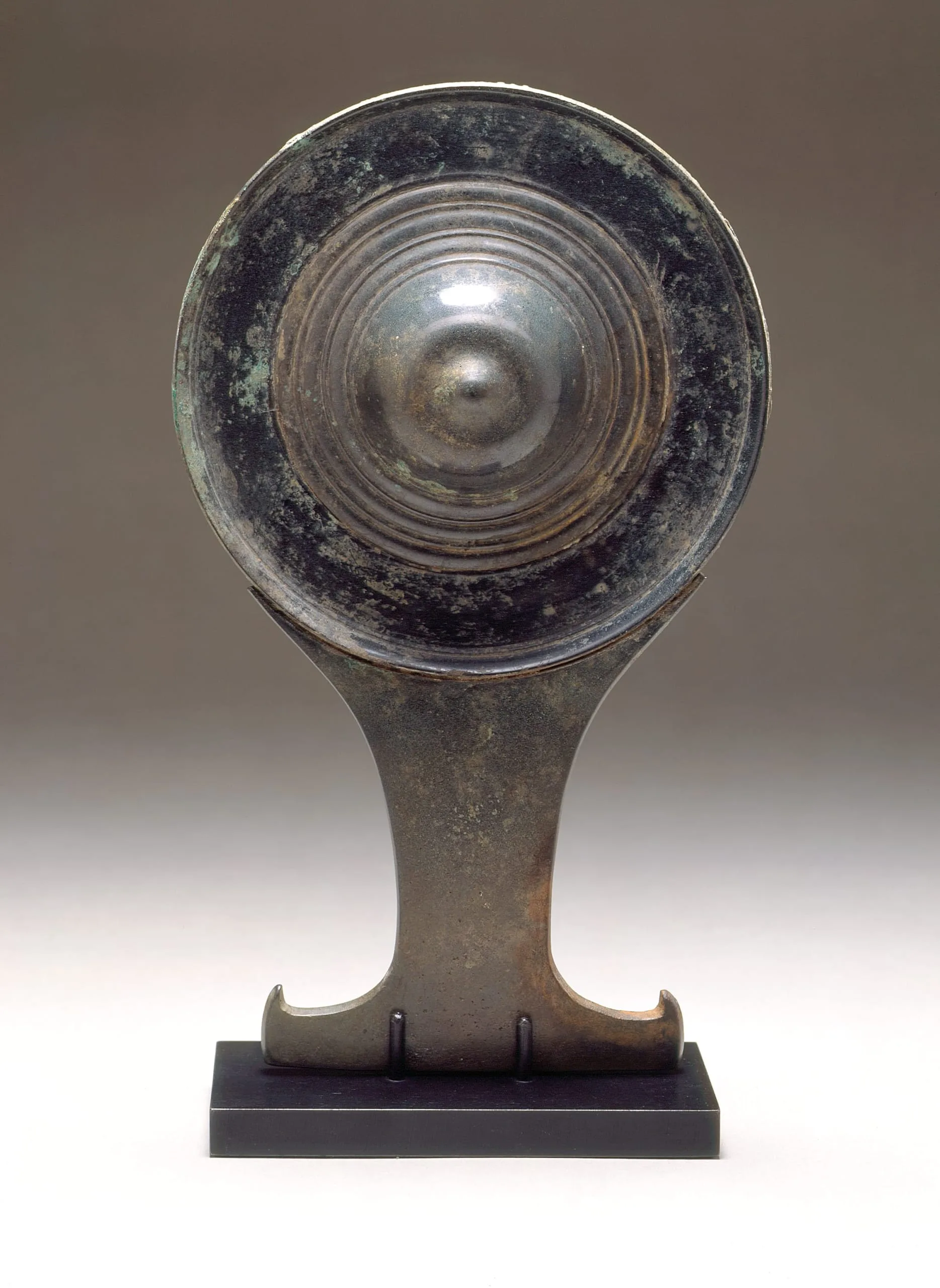
Handheld mirrors survive in significant numbers from Central and Eastern Java. They were used as both cosmetic items and ritual objects. They are typically cast in two parts, consisting of a mirror disk and a handle that were welded together. Occasionally, they are made in one piece. The mirror disk was originally highly polished on the front for reflective purposes, while the unpolished back typically features concentric rings with a protruding center that is often thought to resemble a female breast. The handles are made in several styles and forms. The most distinctive type ends in an inverted T-shape with upturned points. The sides of this type of handle are either plain, embellished with embossed characters in quadratic Kediri script, or have figural decoration. The LACMA mirror has an inverted T-shaped handle with quadratic Kediri script. Another major handle type is a tapering hilt with a pedestal base and figural and/or decorative motifs. See J. E. van Lohuizen-de Leeuw, Indo-Javanese Metalwork (Stuttgart: Linden-Museum, 1984), pp. 135-157, nos. 108-132, especially p. 136, no. 109; and Pauline Lunsingh Scheurleer and Marijke J. Klokke, Divine Bronze: Ancient Indonesian Bronzes from A.D. 600 to 1600 (Leiden: E. J. Brill, 1988), pp. 157-159, nos. 105-107, especially p. 157, no. 105.
A closely comparable Eastern Javanese mirror is in the Linden-Museum, Stuttgart (SA 35 326 L).