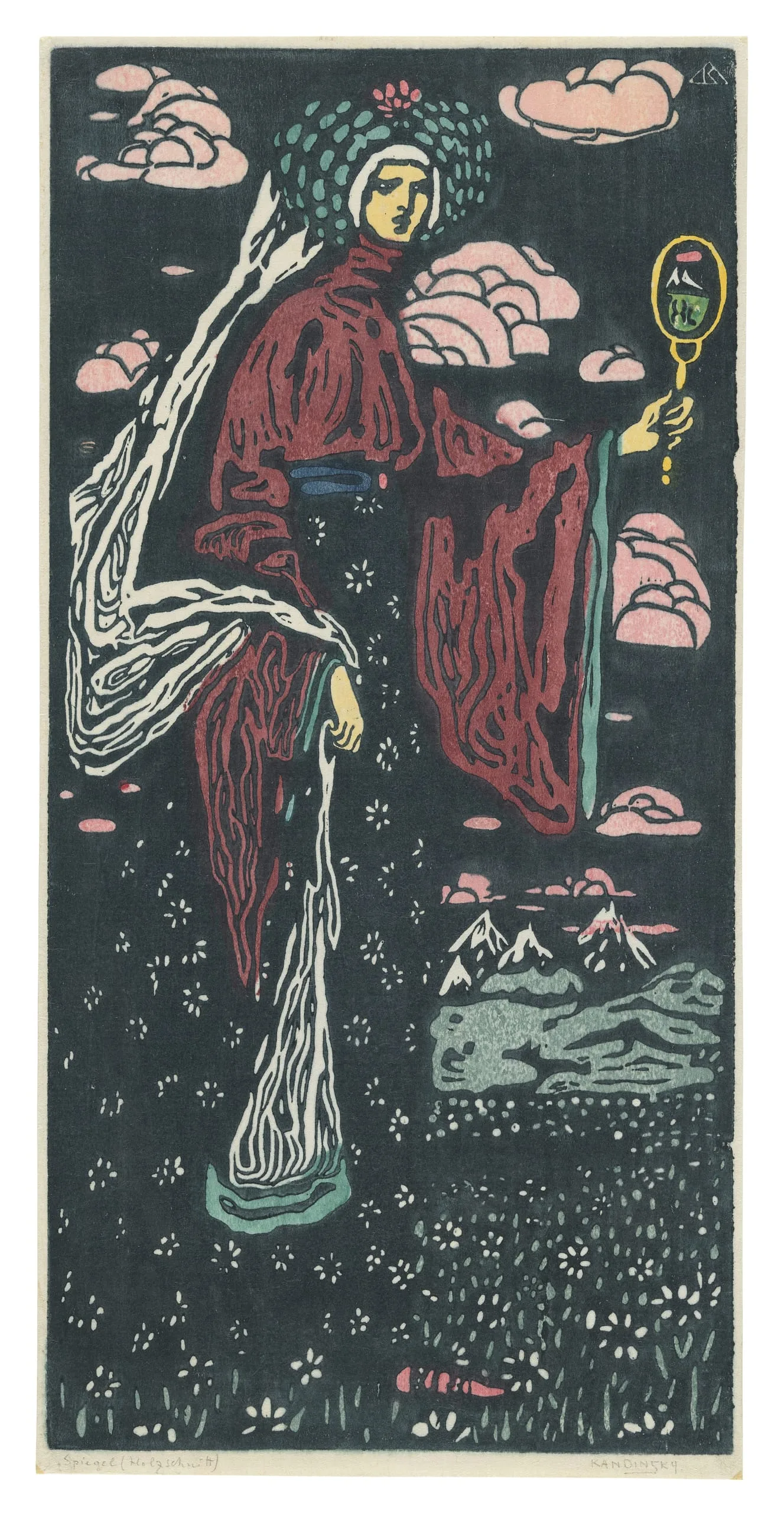
The Mirror exemplifies Kandinsky’s early interest in combining an inventive and stylized vision of Russian folk culture with an evolving Jugendstil aesthetic that presaged his foray into abstraction. The woman’s medieval clothing and the fantastical fairy-tale-like setting suggest an atmosphere more than a narrative. The starburst pattern on her skirt gradually transforms into flowers dotting the field below her feet, merging figure and ground. The mirror of the title reflects not her face but an abstract view of the landscape beyond. The image emerges from a dark ground, with heavy outlines both describing form and dividing the picture into discrete areas of shape and color. Its flat, decorative quality recalls the compartmentalized patterning of cloisonné metalwork, stained glass, or the Bavarian folk tradition of reverse glass painting.
Kandinsky studied ethnography at the University of Moscow, where he was a student of law and economics, before he relocated to Munich in 1896. While still at university, he visited the Vologda region of northwest Russia and was deeply impressed by the immersive effect of peasant homes, which were decorated with carvings and brightly painted ornament. He later wrote that in the “magic” houses in Vologda he learned to “move within the picture, to live in the picture.” This organic integration of art and life had a profound impact on the artist.
In Munich, Kandinsky became involved with Jugendstil artists years before he cofounded the Expressionist group Der Blaue Reiter with Franz Marc in 1911. Jugendstil—the German offshoot of the English Arts and Crafts—originated in Munich and played an important role in the progressive art scene there. Active in the Munich Vereinigung für angewandte Kunst (Applied Arts Society), Kandinsky designed jewelry, embroidery for textiles, and clothing, in addition to painting and printmaking. Creating his first print in 1902, he was prolific in producing works in woodcut and linocut between 1902 and 1912. These media, as scholar Peg Weiss has noted, “serve[d] as the bridge over which Kandinsky was able to advance from ‘decorative’ art to abstraction” (Weiss 1985: 127). They forced simplification, condensation, and a refinement of visual language down to its most basic elements.
Erin Sullivan Maynes
February 2025
Bibliography
Weiss, Peg. Kandinsky in Munich: The Formative Jugendstil Years. Princeton University Press, 1985.