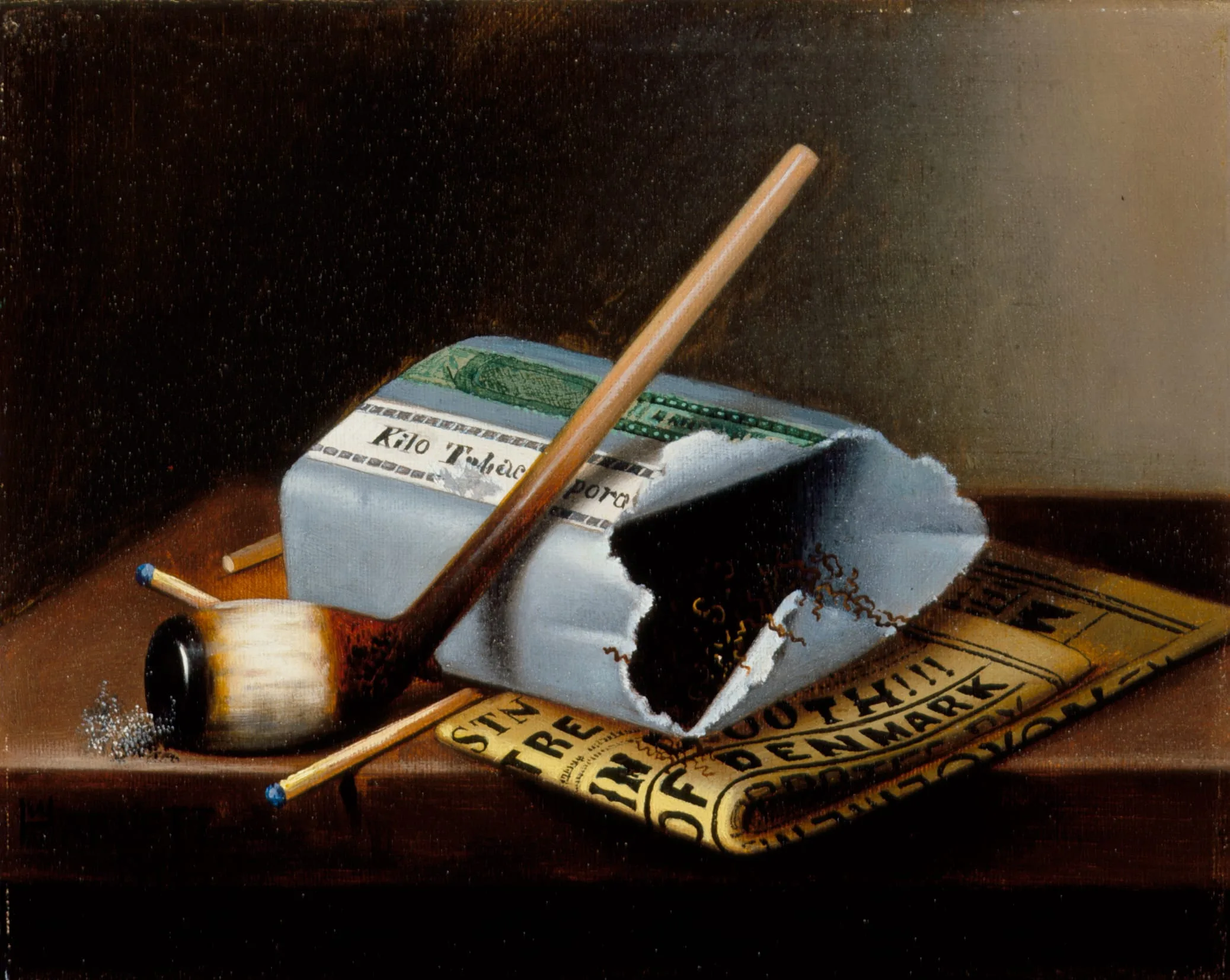
Curly strands of Caporal tobacco spill from a package, while burnt ashes—the byproduct of smoking the substance—fall from a pipe. Matches, the tools used to consume the ribbons of processed tobacco leaves, are scattered alongside a folded paper, perhaps a playbill, referencing Shakespeare’s Hamlet and the famous actor Edwin Booth. The focus on smoking and tobacco here is characteristic of a group of Harnett’s paintings that have come to be known as his “bachelor still lifes.” These small but intimate works feature objects primarily considered “masculine”; however, rather than the shiny, elegant, or expensive arrangements that often populate trompe l’oeil paintings (a style intended to be so realistic that it fools the eye), Harnett selected more ordinary, even rugged objects for these intricately detailed, tabletop still lifes.
A cash crop of the Americas, tobacco was, by the late nineteenth century, a common and popular commodity in the United States and abroad. Hartnett’s painting draws attention to the abundance of this staple, as well as the active consumption of the plant. Choosing to avoid any indication of ephemeral smoke, the artist relies on tobacco in different tangible forms before and after use. He claimed to have painted such still lifes early in his career when he could not afford models for figurative work and, over time, amassed a collection of objects to use in his paintings. After his death, many of these items, including multiple pipes and “a box of smoking tobacco,” were sold alongside his paintings and drawings. Despite being perishable, the “smoking tobacco” was just as worthy of sale as Harnett’s loftier props and artworks.
Selected Bibliography
Barrett, Ross. “Harnett’s Habit: Still Life Painting and Smoking Culture in the Gilded Age.” American Art 33, no. 2 (2019): 62–83. https://doi.org/10.1086/705626.
Bolger, Doreen, Marc Simpson, and John Wilmerding, eds. William M. Harnett. Amon Carter Museum, Metropolitan Museum of Art, and Abrams, 1992. http://archive.org/details/williammharnett0000harn.
Frankenstein, Alfred V. After the Hunt; William Harnett and Other American Still Life Painters, 1870−1900. University of California Press, 1969. http://archive.org/details/afterhunt0000unse.
Thomas Birch, Philadelphia and Stan. V. Henkels (Firm). Exquisite Examples in Still Life Being Oil Paintings by the Late William Michael Harnett. Philadelphia, 1893. http://archive.org/details/exquisiteexample00thom.