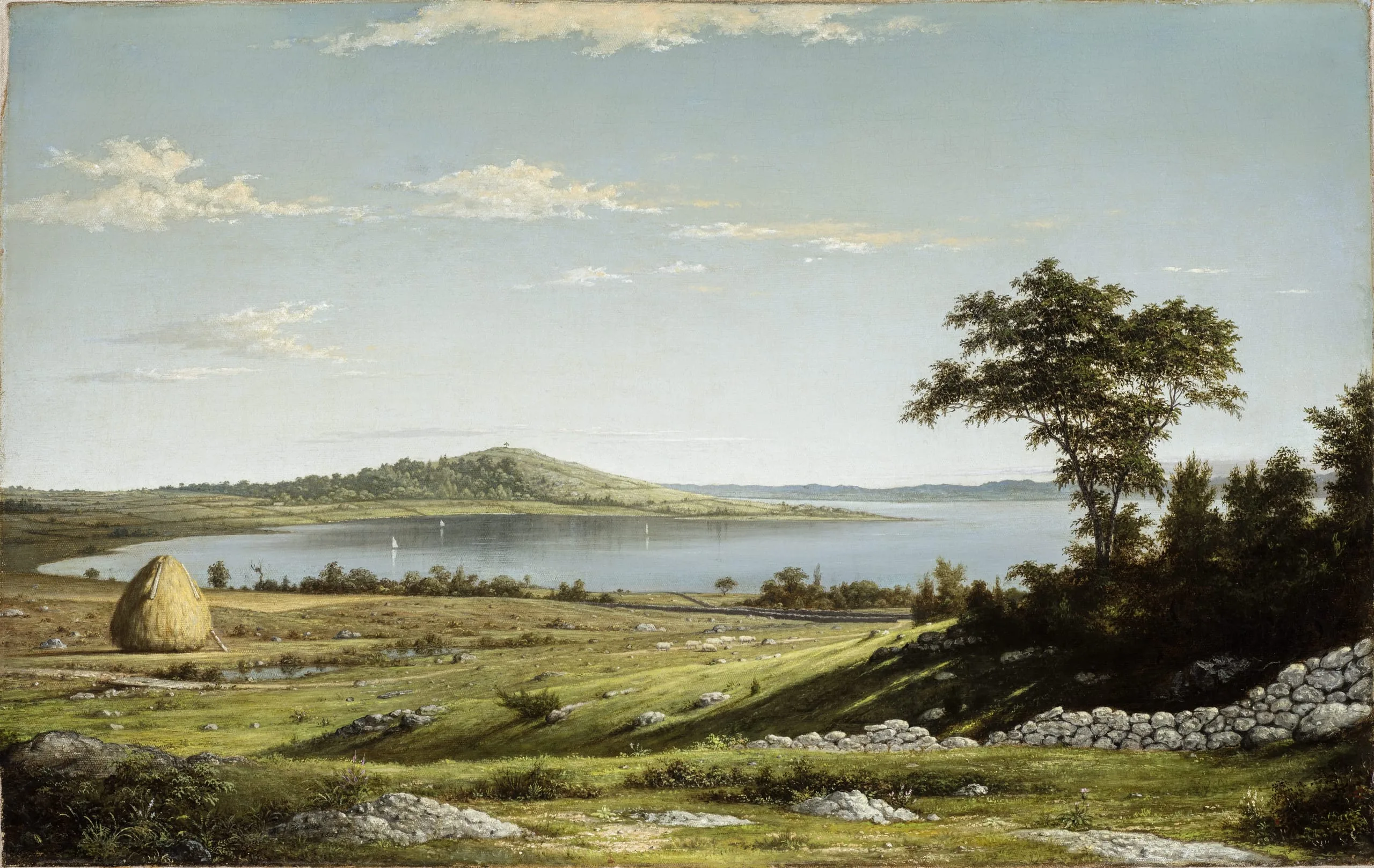
Martin Johnson Heade (1819-1904) was one of the central figures in the American luminist movement, a late manifestation of the Hudson River school of landscape painting. During the third quarter of the 19th century, landscape artists such as Heade combined accurate, naturalistic detail with brilliant illumination and a sense of order and harmony to create timeless, silent images that seemingly defy their specificity.
Among Heade’s most prized works are his views of the salt marshes around Narragansett Bay in Rhode Island, along the New Jersey coast, and in Newburyport, Massachusetts. Rhode Island Shore dates from the artist’s first stay in Providence, in 1858, when he initially turned to the theme.
The site – Church Cove in Mount Hope Bay looking toward Mount Hope – was rich in historical associations. This was the place where King Philip, the chief of the Wampanoag Indians, died in 1676. Although his death marked a critical point in the subjugation of the Indians of southern New England by the European settlers, the landscape as it appeared in the mid-19th century offered no hint of this past conflict. Yet the 19th-century public would have been well aware of the site’s significance. The serenity of the scene also belied the actual turbulence of Heade’s own era. Through such hushed images as Rhode Island Shore as well as other placid harbor views and picturesque scenes of the Eastern coast, luminists offered the American viewing public a sense of order and clam at a time when heightening political, social, and economic tensions were erupting into a bloody civil war.
Heade’s marsh scenes, of which Rhode Island Shore is the earliest known example, are panoramas of flat terrains punctuated by small mounds of hay. Most of the marsh scenes are small in scale, presented in a narrow, open-ended horizontal format. The sky, often in dramatic sunset hues, usually dominates at least half of the composition. All is meticulously painted, the brushstrokes barely discernible. Nothing is allowed to distract the observer from the simplicity and order of the tautly composed landscapes. Even humans are absent, although the haystacks signify the presence of an important industry derived from the marshy swamp area. The scenes gain their quiet power from the abstract relationships of horizontals and verticals, a limited vocabulary of harmonious contrasts. Although the views often appear airless, they are about light and atmosphere.
Because Rhode Island Shore was the first of Heade’s marsh paintings, it does not strictly conform to his later, more characteristic haystack scenes but instead suggests affinities to the earlier Hudson River School aesthetic from which it emerged. Larger and squarer in format, the scene is also livelier and more atmospheric, with the view framed by a large dark tree on the right. Yet the elements that are the hallmark of Heade’s mature art and the quintessential luminist approach are already present.
Through the generosity of the late Charles and Elma Shoemaker, the Los Angeles public can now enjoy Rhode Island Shore in all its delicate splendor, a gentle reminder of our nation’s nostalgic desire for tranquility.