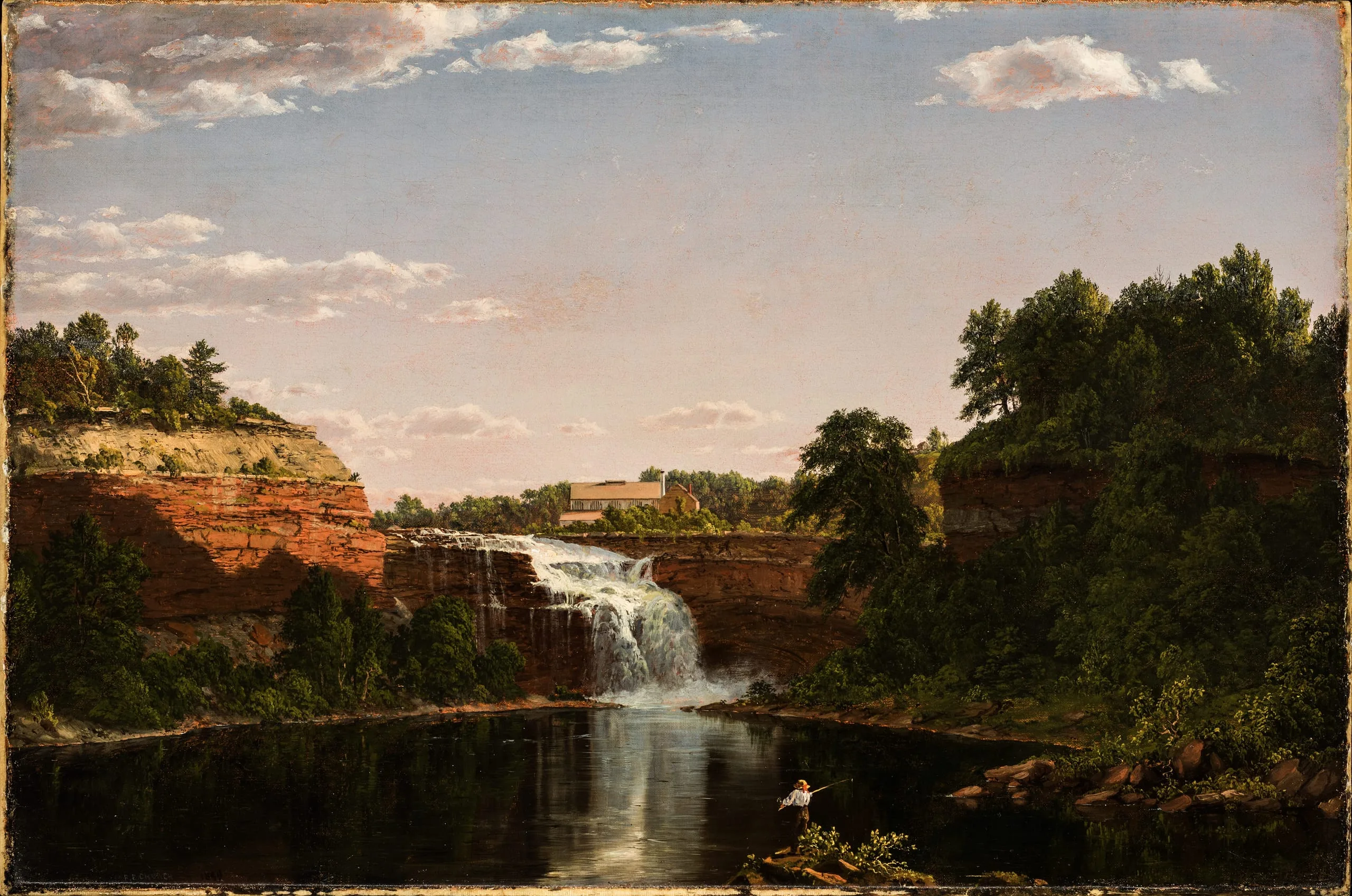
In this serene, early landscape, Frederic Church captured growing tensions between nature and encroaching industrialization. Painted only a few years after a newspaper article popularized the term “Manifest Destiny” and at the start of the California gold rush, the work was completed as the United States was vigorously pursuing westward expansion and the forced dispossession of Indigenous communities. In this view of the Lower Falls on the Genesee River in Rochester, New York, Church depicted many of the resources that made North American land so desirable to white settlers, including water and hydropower, wooded land, and food supplies.
In the scene, a waterfall flows between a structure at the top of a rocky ledge and a figure fishing at the bottom. An 1851 map identifies buildings at the top of these falls as a tannery and a paper mill. In an earlier sketch of the Lower Falls, Church labeled one of the buildings as a mill (see Carr, vol. 2, no. 226r). Although it is difficult to be sure which structure Church sought to portray in the finished painting, his relatives owned the paper mill at this spot. In newspaper advertisements, the company, referred to as Stoddard & Freeman or, sometimes, as the Genesee Paper Mills or Warehouse, solicited rags to recycle into a variety of papers, including “printing foolscap, letter, flat cap, folio post, and demi; medium, fine colored mediums, tobacco, post office, seed, envelope and wrapping.” A few years before Church’s visit to the falls in September 1848, the company had expanded and “erected a large and commodious Mill and filled it with an entire new sett [sic] of machinery embracing all the real improvements of the age.”
Church was already familiar with paper manufacturing from his father and uncle, who had owned a paper mill in Massachusetts during his youth. Cyrus Field, the artist’s friend and patron who bought this painting, also started his career as a dealer of fine paper. Here, Church paints a particular industrial landscape imbued with personal meaning for both him and his patron. Further, as an artist who sketched on paper at this very site, his many connections to paper manufacturing reveal how industrialized production could reach even artistic practices that valued careful handcrafting.
This part of the Genesee River was also significant to developments in the fishing industry. The fisherman in the painting gestures to the bounty of the river and its popularity as a fishing spot. Juxtaposed with the industrial building at the top of the falls and the powerful flow of the waterfall, the fisherman might initially suggest a serene moment of leisure in the midst of loud machinery and rushing water. However, his position in the scene also raises questions about the relationships between fishing and industry, including the pollution deposited by manufacturers into waterways, the negative effects of mass fishing, and the consequent need for artificial propagation to increase supplies. Church’s scene of an industrial site on one side of the waterfall and a fisherman on the other depicts two important facets of Rochester’s local character while also anticipating that the pursuit of industrial growth and resource extraction would spread far beyond the region.
Selected Bibliography
Bailly, Austen Barron, and Sandra Benito Vélez, eds. LACMA, Obras Maestras, 1750−1950: Pintura Estadounidense del Museo de Arte del Condado de Los Ángeles. Museo Nacional de Arte, 2006.
Barringer, Tim, Elizabeth Mankin Kornhauser, and Jennifer Raab. Frederic Church: Global Artist. Yale University Press, 2026.
Carr, Gerald L. Frederic Edwin Church: Catalogue Raisonné of Works of Art at Olana State Historic Site. 2 vols. Cambridge University Press, 1994.
Raab, Jennifer. Frederic Church: The Art and Science of Detail. Yale University Press, 2015.
Selected Exhibition History
Frederick Edwin Church, National Collection of Fine Arts, Smithsonian Institution, February−March 1966.
A Gallery Collects, Hirschl & Adler Galleries, New York, October−November 1977.
LACMA Masterworks 1750–1950: American Painting from the Los Angeles County Museum of Art (LACMA: Obras Maestras 1750–1950: Pintura Estadounidense del Museo de Arte del Condado de Los Angeles), October 2006−May 2007.