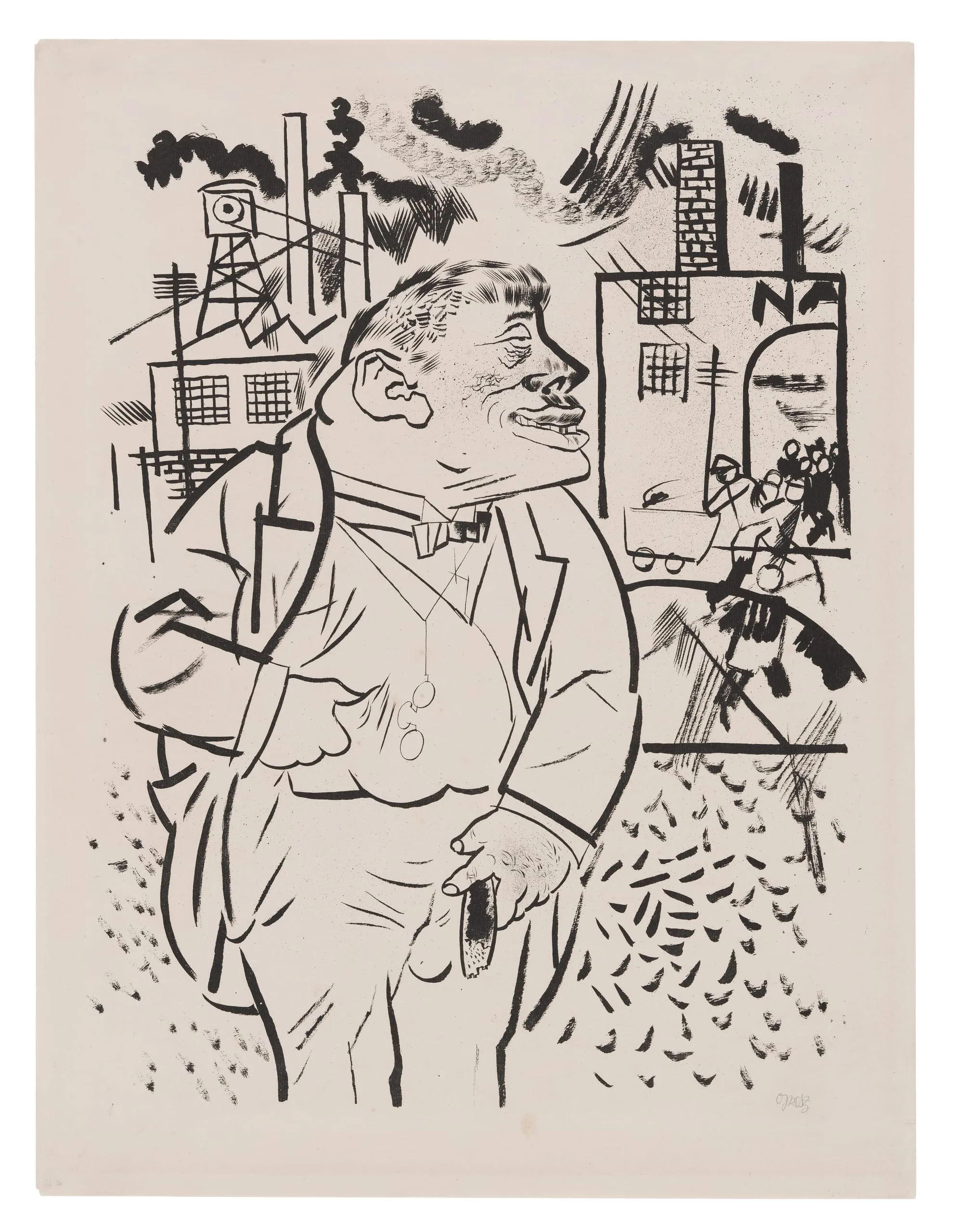
In The Robbers (Die Räuber), a nine-print portfolio illustrating Friedrich Schiller’s first play (1781), George Grosz brought the drama’s subject matter into the present, featuring the industrialists and working class of his own time, characters that populate many of his drawings and prints of the 1910s and 1920s. In this sheet, the capitalist businessman is a grotesque caricature, a bestial übermensch whose rapacity is signaled in the title. Dangling a phallic cigar limply at his crotch, he sports a leering gaze and sinister smile. In the background, abstract gray curlicues, hatchmarks, and smudges suggest the dingy haze of heavy industry, and faceless factory workers do the actual laboring that feeds their bloated boss. While the original play follows the son of an aristocrat who becomes a thief to protest societal corruption, Grosz’s illustrations offer a timely critique of a capitalist system that exploits the proletariat for the benefit of very few.
Grosz and his closest collaborator Wieland Herzfelde, who ran the publishing house Malik Verlag, were ideologically committed to communism even as they resisted Party strictures. Grosz was Malik’s most prolific political artist, and the press published three of his portfolios between 1919 and 1921. The Robbers appeared in 1922, nearly two years after the German Revolution ended in disillusionment for the left. Disorder and economic misery persisted as inflation decimated the assets of all but the wealthiest and most well-connected Germans until the end of 1923.
Erin Sullivan Maynes
2022 (adapted from Pressing Politics: Revolutionary Graphics from Mexico and Germany, 88)