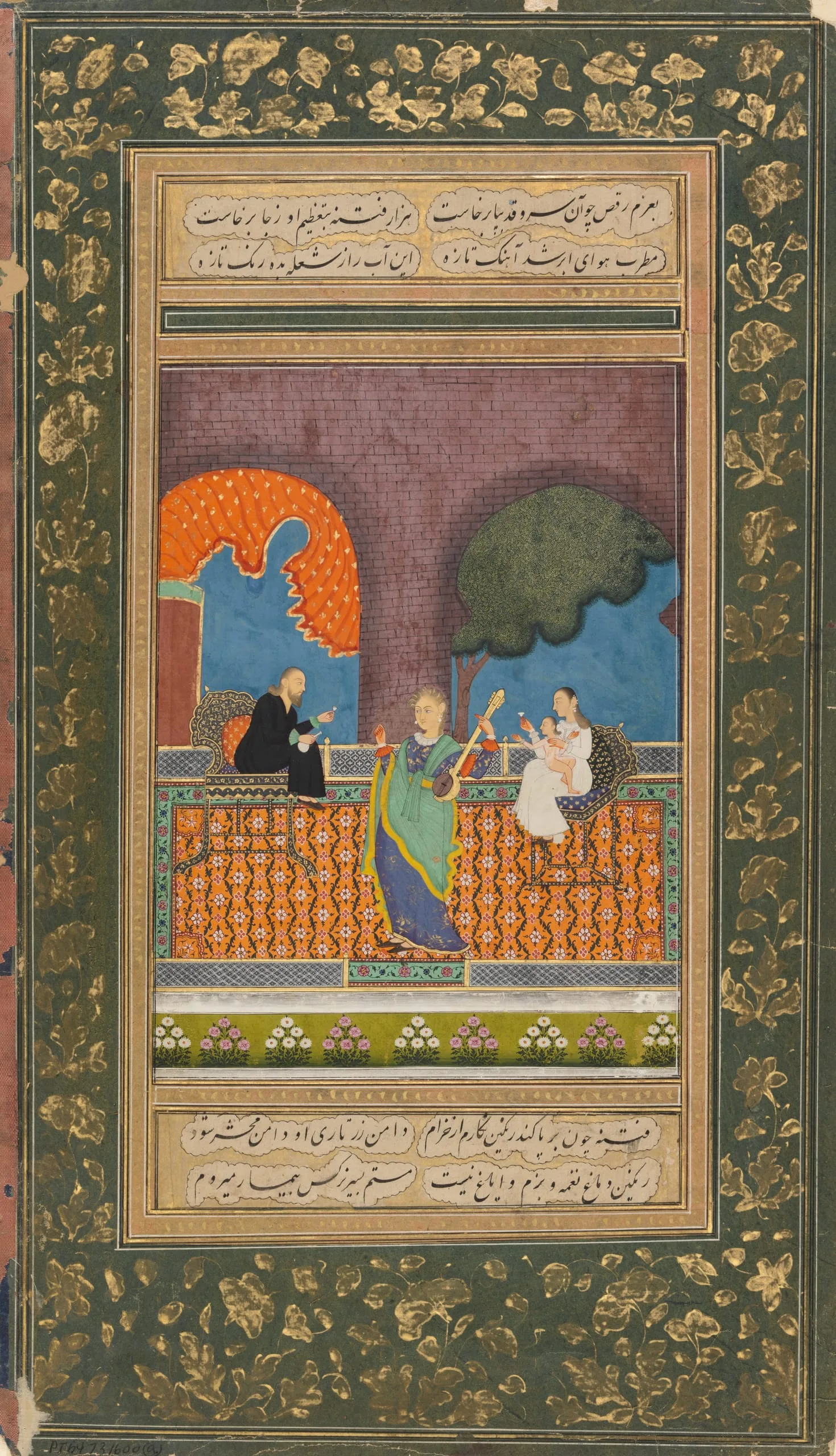
The visual subject of this intriguing painting seems to have been intended to personify the musical and anti-bacchanalian imagery of the poem inscribed in fine Nasta'liq script. This interpretation is suggested by several elements of concordance, particularly the allegorical musician wearing a skirt with gold threads and the man tempting a mother and child with a cup of wine. The representation of the figures as Europeans may have been meant as a subtle comment on Western virtues and sensual pursuits. While at first glance the painting is a standard terrace scene, by reading the poetry one transcends the superficial setting to understand the work's inherent meaning:
When that cypress-statured [beloved one] rose to
his feet with the intention of dancing,
A thousand mischiefs rose from their seat
out of respect for her.
O musician! The atmosphere has become cloudy.
Bring forth a new [musical] note.
Impart to this water a fresh color with [burning] flame.
When, O luxury-loving one, my sweetheart by his graceful gait
raises mischief on [his] foot [i.e., wrecks havoc on the hearts of lovers],
His gold-threaded skirt becomes the skirt of [heavenly] Resurrection.
O luxury-loving one! I have no head for song, banquet, or [wine]cup.
I am [already] intoxicated [with the wine of love]
[and] I am going to see the sick [languishing] Narcissus.
(Translation by Z. A. Desai.)