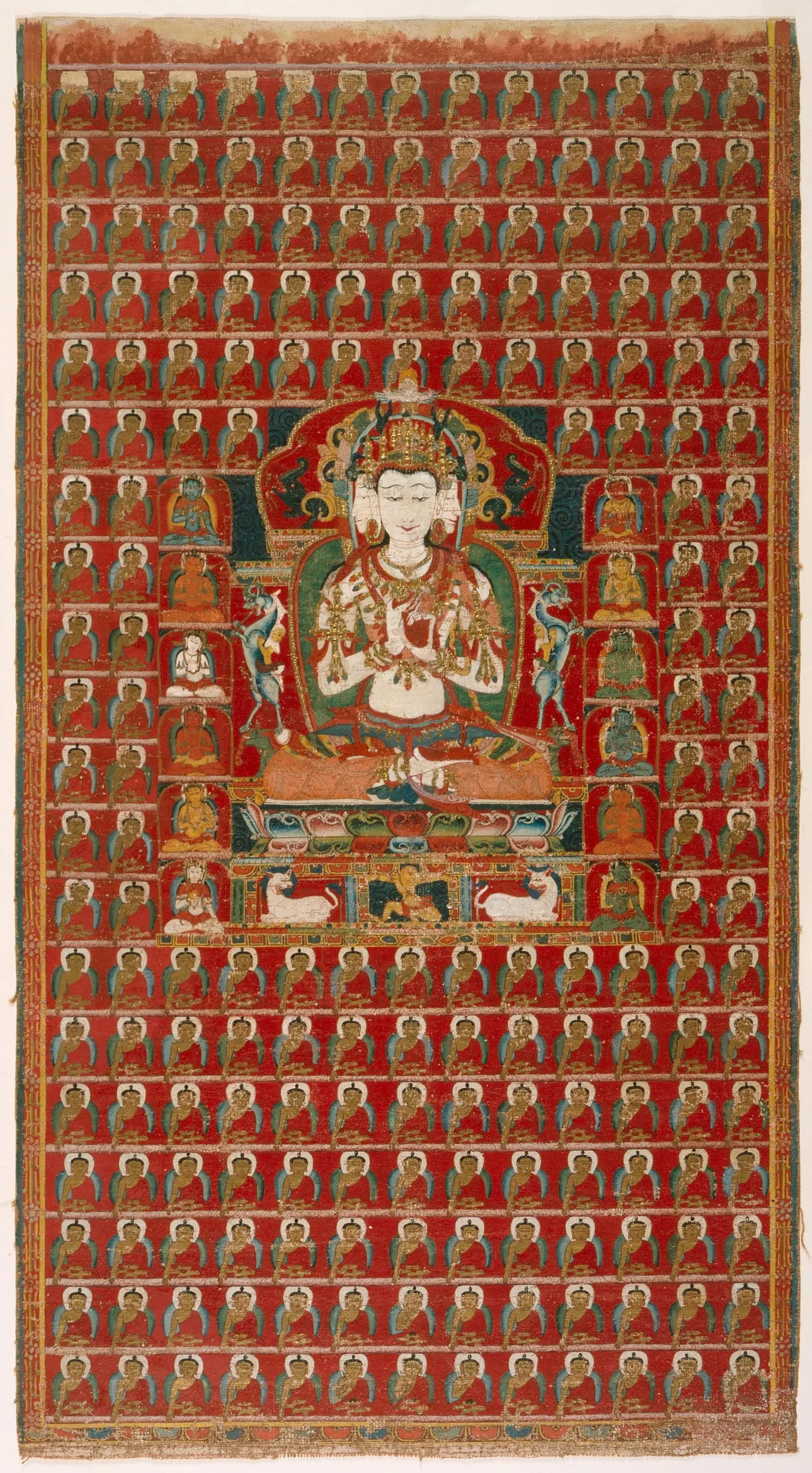
- Title
- Sarvavid Vairochana, From a Set of the Five Jina Buddhas, based on Complete Purification of All Evil Rebirths (Sarva Durgati Parishodana Tantra)
- Date Made
- circa late 13th - early 14th century
- Medium
- Mineral pigments and gold on cotton cloth
- Dimensions
- 21 1/2 x 12 in. (54.61 x 30.48 cm)
- Accession Number
- AC1994.121.1
- Curatorial Notes
This painting was likely based on the Complete Purification of All Evil Rebirths (Sarva Durgati Parishodana Tantra). It was composed in India in the 8th century as part of the Yoga Tantra class of Buddhist literature. The tantra was introduced to Tibet in the late 8th century by the Indian master Shantigarbha and translated into Tibetan at the Samye Monastery during the reign of King Khri srong lde brtsan (r. 755–797). The overriding concerns of the painting and the underlying rituals are associated with health, well-being, and prosperity. The central figure is Sarvavid Vairochana, (Vairochana of Universal Knowledge). As such he is identical to Vajrasattva, the Universal Teacher. Overall, the painting is part of an iconographic statement that the insights (jñana) manifested by the five Jina Buddhas are the basis for all 1,000 Buddhas of the present eon.
Interestingly, this central image of Sarvavid Vairochana displays an otherwise unknown variant of the symbolic gesture of "quick enlightenment" (bodhyangi mudra) with all four fingers and the thumb of the left hand displayed simply in front of a fist holding a thunderbolt (vajra). Sarvavid Vairochana is accompanied by four Perfection (Paramita) goddesses, eight standard Bodhisattvas, and a field of 209 Buddhas all with their right hand extended in the gesture of calling upon the earth to witness the Buddha’s right to achieve Enlightenment after his many lifetimes (bhumisparsha mudra).
See Himalayan Art Resources, no. 85701, https://www.himalayanart.org/items/85701
- Selected Bibliography
- Huntington, John C. and Dina Bangdel. The Circle of Bliss: Buddhist Meditational Art. Columbus: The Columbus Museum of Art; Chicago: Serindia Publications, 2003.