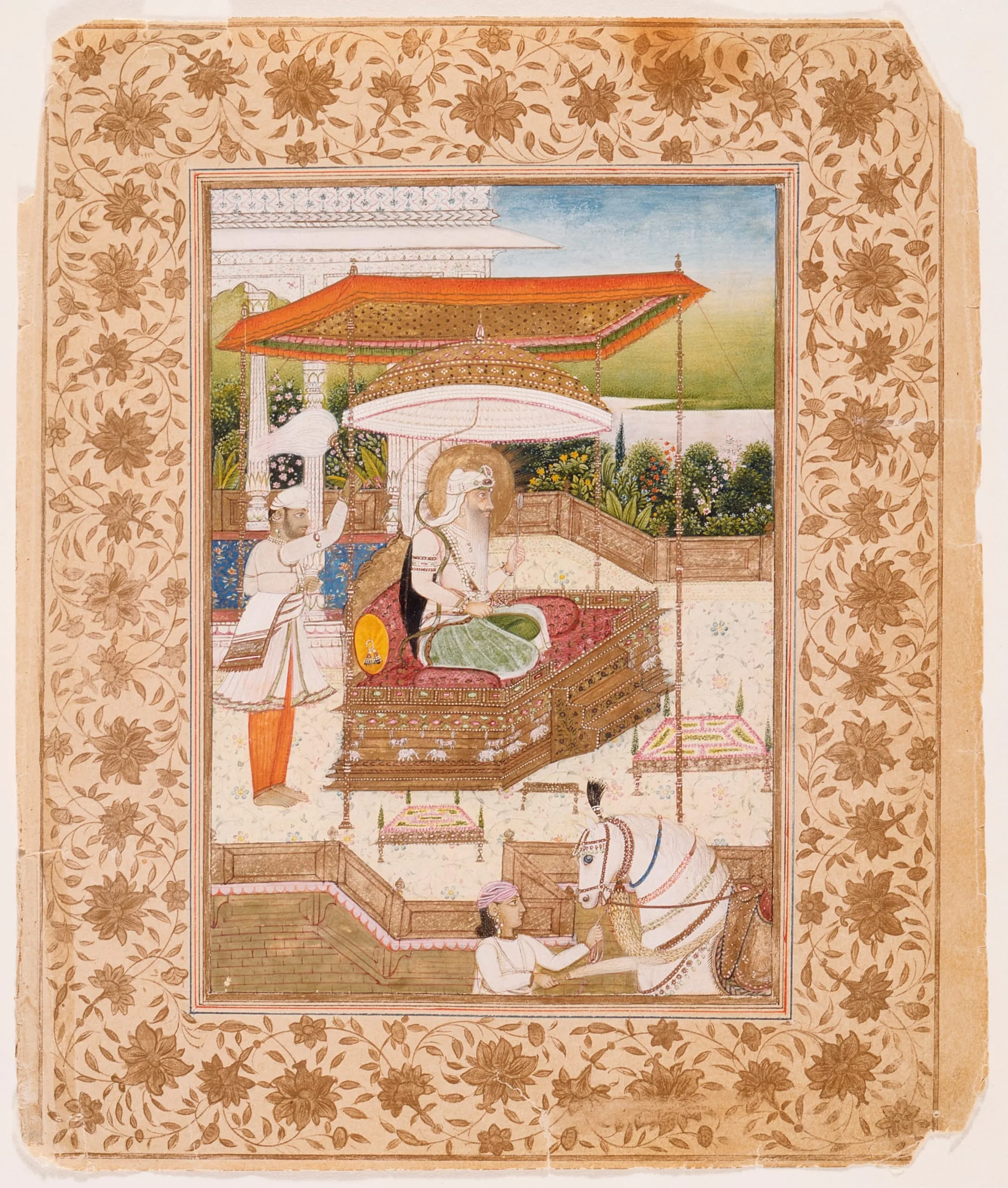
This is a posthumous portrait of the Sikh sovereign Ranjit Singh, who ruled the Panjab and its environs from 1799 to 1837. As Mughal power declined in the eighteenth and nineteenth centuries, this region suffered a period of political obscurity. Ranjit Singh, known as the Lion of the Panjab, captured its capitol, Lahore, and declared himself king in 1799. At its height, his empire extended as far north as the border of Afghanistan. Through astute treaties, he remained undefeated by the colonialists and became symbolic of the final resistance to British rule. Only after his death did the British succeed in annexing the Panjab.
This posthumous portrait of the ruler depicts him on a palace terrace seated on an elaborate golden throne inset with gemstones and painted with floral sprays and registers of horses, elephants, and standing figures. He has a golden solar nimbus and carries an arrow held vertically, a bow and shield slung over his shoulder, and a dagger tucked in his waist sash. The golden parasol over the king’s head and the attendant waiving an honorific flywhisk are symbolic of his royal status. The bejeweled white steed in the lower right corner is most likely Ranjit Singh’s favorite mount, Layla. An annotation in English on the verso identifies the artist as Jagannath of Amritsar.