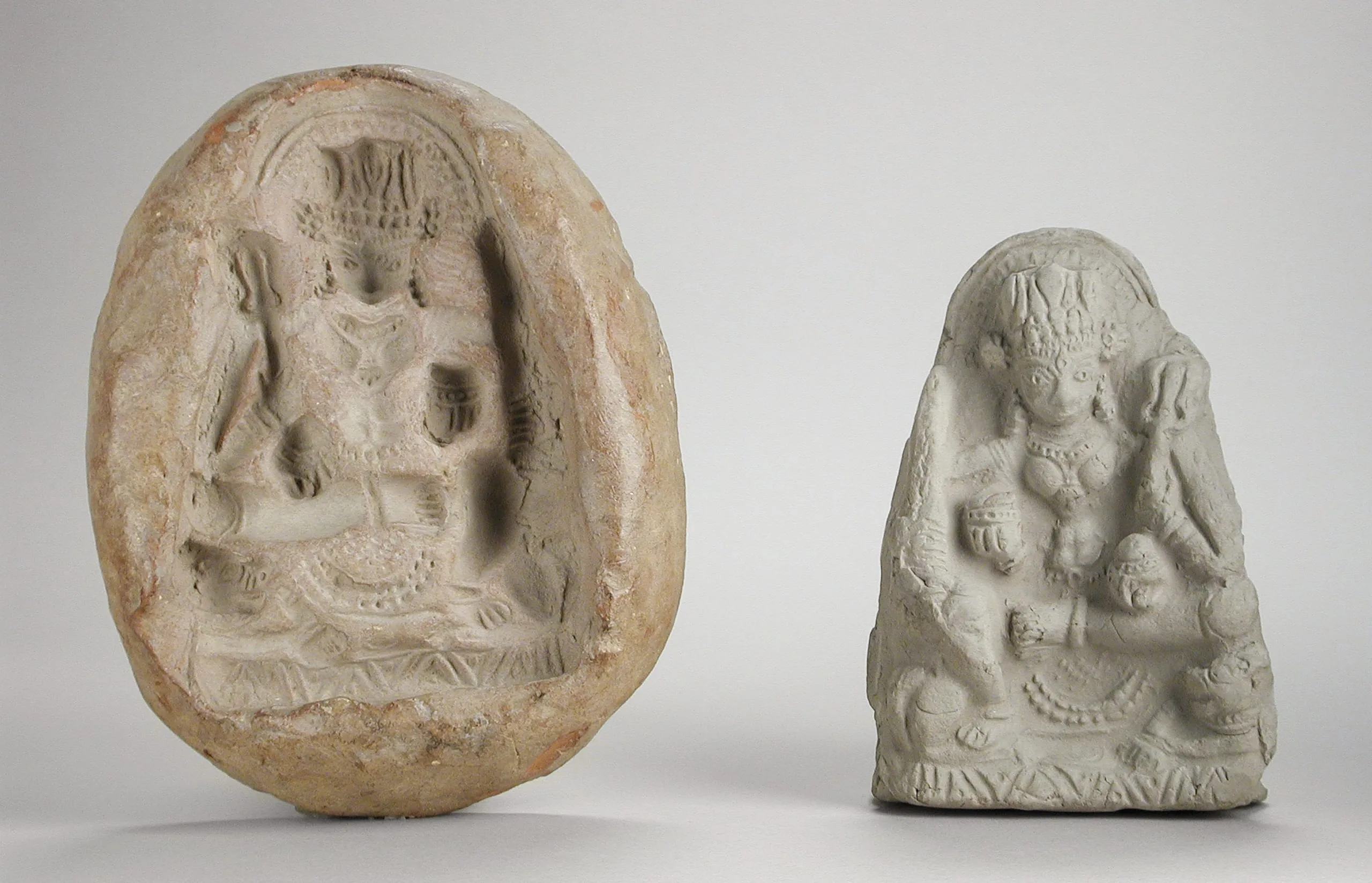
The use of earthenware molds to fashion religious images dates back in South Asia to at least the period of the Mauryan Empire (circa 321–185 BCE). Single molds, such as this example, were used to form solid figures in relief (see M.83.221.2, M.85.62, and M.90.196.1). Double molds were used to create hollow, solid, or partially solid figures to be joined together to make sculptures in the round (see M.80.6.3 and M.89.130.1–.5). For more molds, see M.76.23, M.83.252, AC1993.239.10, and M.2001.209.
This Durga is nimbate, has Shiva’s third eye of wisdom (jñana netra), and wears a Kashmiri-style crown with three points. She is four-armed. In her upper left hand, she carries Shiva’s trident (trishula). In her lower left hand, she holds an auspicious vase of plenty (purna kalasha), which supplants the cornucopia or rhyton of earlier Durga images. In her upper right hand, she wields Yama’s sword (khadga). In her lower right hand, she holds a fire pot emitting wavy flames (agni kunda). It symbolizes the primeval cosmic energy, ritual purification, and the sacrificial fire from which the supreme feminine power is manifest (see M.82.226). The goddess is seated in the relaxed posture (lalita asana) with her right leg pendant on her lion mount (sinha vahana). The base of the image has stylized rocks that evoke the mountainous terrain of the Himalayas.
For an analogous, contemporaneous Kashmiri Uma-Maheshvara stone sculpture with Shiva wearing the same style of crown and seated on his bull mount in the same relaxed posture, see M.78.103.
An iconographically comparable image of Durga with four arms seated on her lion, albeit made of stone and attributed to eastern India, 13th–14th century, is in the University of Michigan Museum of Art, Ann Arbor (1981/1.315).
See Amy G. Poster, From Indian Earth: 4,000 Years of Terracotta Art (Brooklyn: Brooklyn Museum, 1986); and Pratapaditya Pal, "Durga in Kashmir," in Goddess Durga: The Power and The Glory, ed. Pratapaditya Pal (Mumbai: Marg Publications, 2009), pp. 92-93, fig. 9.