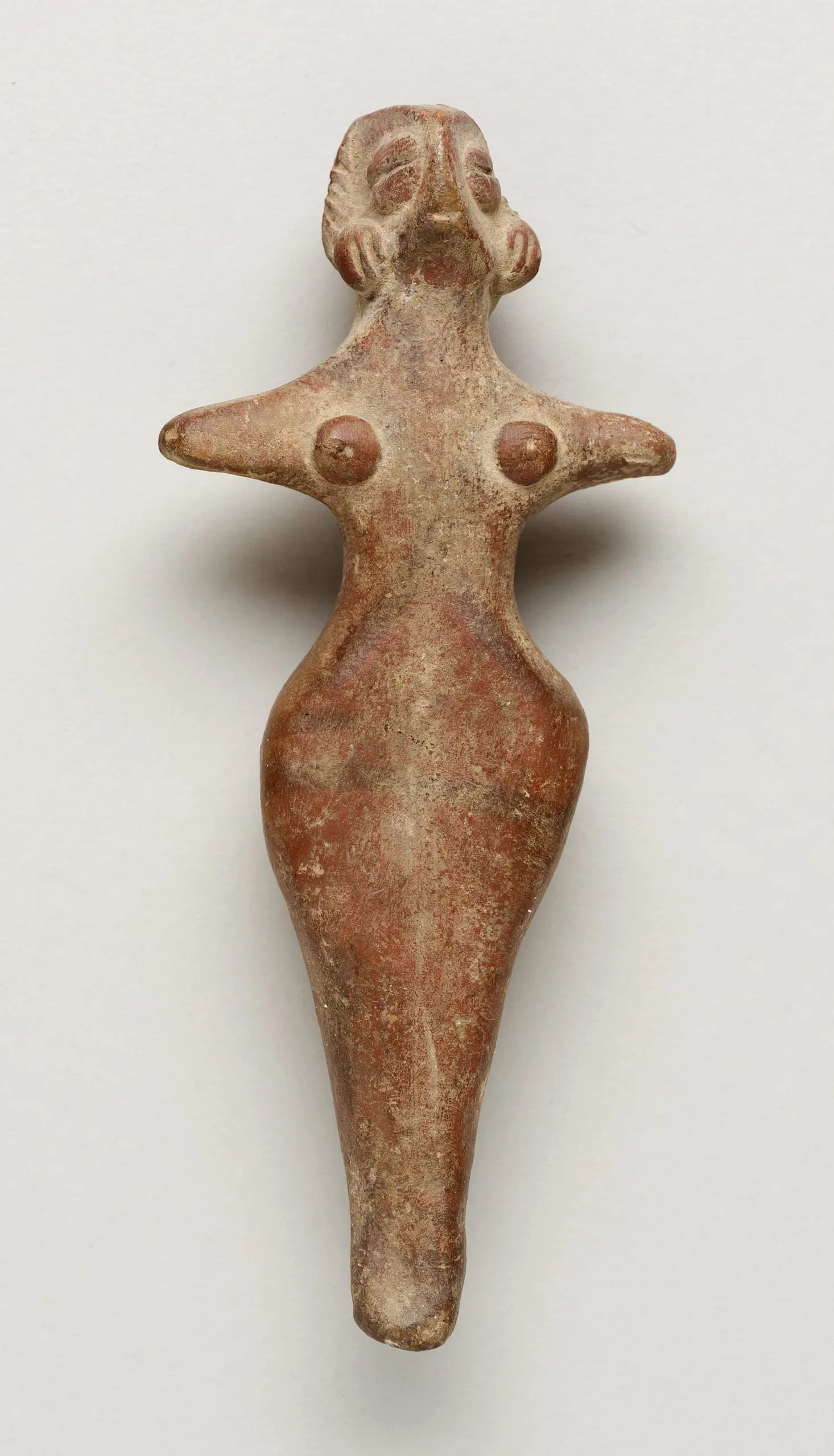
Descriptively termed "baroque ladies" when excavated in 1958 by Sir Mortimer Wheeler at Charsada, Peshawar district, Pakistan, this type of hand-modeled earthenware female figurine typically features a stylized face with a pinched nose; appliqué cowrie-shell eyes, breasts, ornaments, and headdresses; and incised lines indicating their waist and hips. The arms are held in a T-pose with their hands stretched out horizontally at shoulder height. Their legs are joined together to form a triangular shape. The backs are generally flat with rounded buttocks. Interpreted generally as goddesses of abundance or cult icons, these distinctive figurines from various sites in the Peshawar district have been dated from 200 BCE–200 CE through stratigraphic excavations conducted in 1963-1964 by Ahmad Hasan Dan. See Sir Mortimer Wheeler, Charsada: A Metropolis of the North-West Frontier: Being a Report on the Excavations of 1958 (London: Published for the Government of Pakistan and the British Academy by Oxford University Press, 1962), pp. 104-108, pls. 20-25; and Ahmad Hasan Dani, "Shaikhan Dheri Excavation (1963 and 1964 Seasons)," Ancient Pakistan 2 (1965-66): pp. 46-61, pls. 24-27.
Compared to most Peshawar female figurines, the LACMA example has a sparse headdress and lacks applied jewelry and incised lines. Rather, she wears a crossbelt and hip wrap executed in black paint.
A comparable but more ornate figurine is in the Ashmolean Museum, Oxford University (EA1958.3)