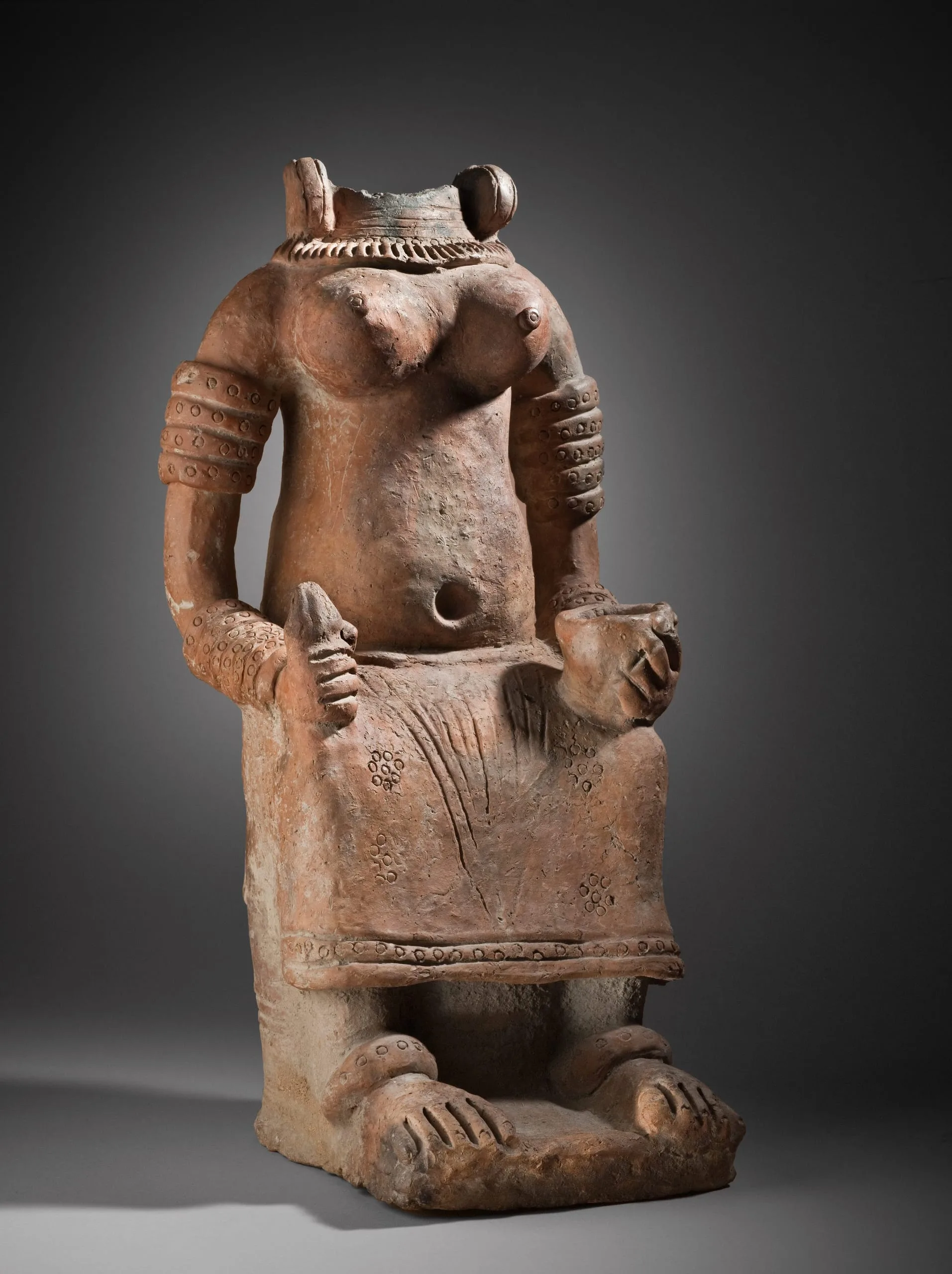
This sizable earthenware sculpture was previously attributed to the 2nd century and to circa 3rd century. See respectively Pal 1987, pp. 40-41, no. 5; and Vidya Dehejia, "Paul F. Walter (1935- )," in American Collectors of Asian Art, ed. Pratapaditya Pal (Bombay: Marg Publications, 1986), pp. 220, 223, fig. 17. It has since been reattributed to the 4th century on stylistic grounds, especially the treatment of the jewelry and clothing and the articulation of the physique. For comparable and roughly contemporaneous earthenware sculptures from the same general region, see M.81.240 and M.74.40.2.
The now-headless hollow figure represents a Mother Goddess. She sits with her legs pendent in the so-called European posture (pralambapadasana), a related version of which was shared by images of Mother Goddesses made in Uttar Pradesh from at least the 2nd century (depicted squatting with knees forward) through the 8th century (depicted seated on a stool or dais with knees forward). See M.85.212.3 and M.72.53.2. In her left hand on her knee, she holds a bowl (patra), while in her right hand on her knee she carries what is likely a citron (jambhira).
It has been suggested that the goddess represents Hariti and was originally paired with an image of Panchika (Dehejia 1986, p. 223). For example, see M.83.66. As Hariti is more commonly shown with children (see M.78.105), the omission of the children would make this an unusual representation. Similarly, the attributes of a bowl and citron rather than Hariti’s more customary cornucopia and/or pomegranate (dadima) would also be atypical.
A comparable earthenware goddess, identified as Hariti and attributed to Uttar Pradesh, 1st century CE or later, is in the Allahabad University Museum. See Amy Poster, From Indian Earth: 4,000 Years of terracotta art (Brooklyn: Brooklyn Museum, 1986), p. 123, no. 57.