- Title
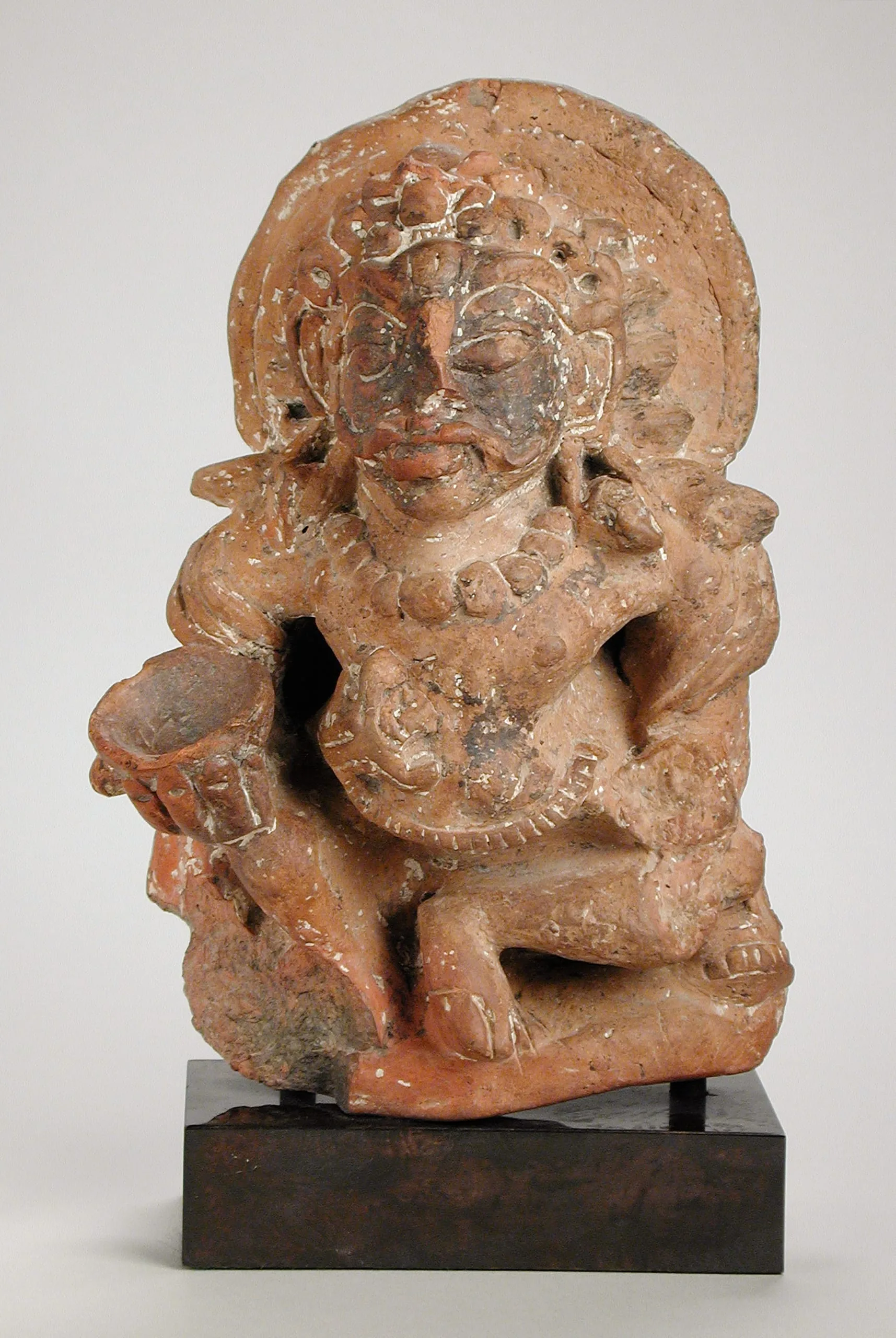
- Kubera, the God of Riches
- Date Made
- 5th century
- Medium
- Reddish brown earthenware with traces of black and white paint
- Dimensions
- 9 3/8 x 6 1/2 x 3 in. (23.81 x 16.51 x 7.62 cm)
- Accession Number
- AC1993.239.5
- Curatorial Notes
Kubera, The God of Riches, is also known as Vaishravana or Jambhala. He is venerated by Hindus, Buddhists, and Jains. Kubera was originally the chief of the demigods and guardians of treasures (yakshas). He is also the Regent of the Northern Direction (dikpala).
The nimbate Kubera is portrayed with his characteristic iconography of being potbellied (tundila) He has a third eye of wisdom (jñana netra) indicating his theological affiliation with Shiva, curly hair, thick moustache, and wears copious princely ornaments (bodhisattva abharana). He is seated in the kingly posture of royal ease (maharajalila asana) with his left leg lying flat and his right knee raised. His right hand holds a wine cup. His now-missing left hand may have originally held a moneybag.
See also M.69.13.8, M.87.274, and AC1992.204.1a-b.
- Selected Bibliography
- Pal, Pratapaditya. Icons of Piety, Images of Whimsy: Asian Terra-cottas from the Walter Grounds Collection. Los Angeles: Los Angeles County Museum of Art, 1987.