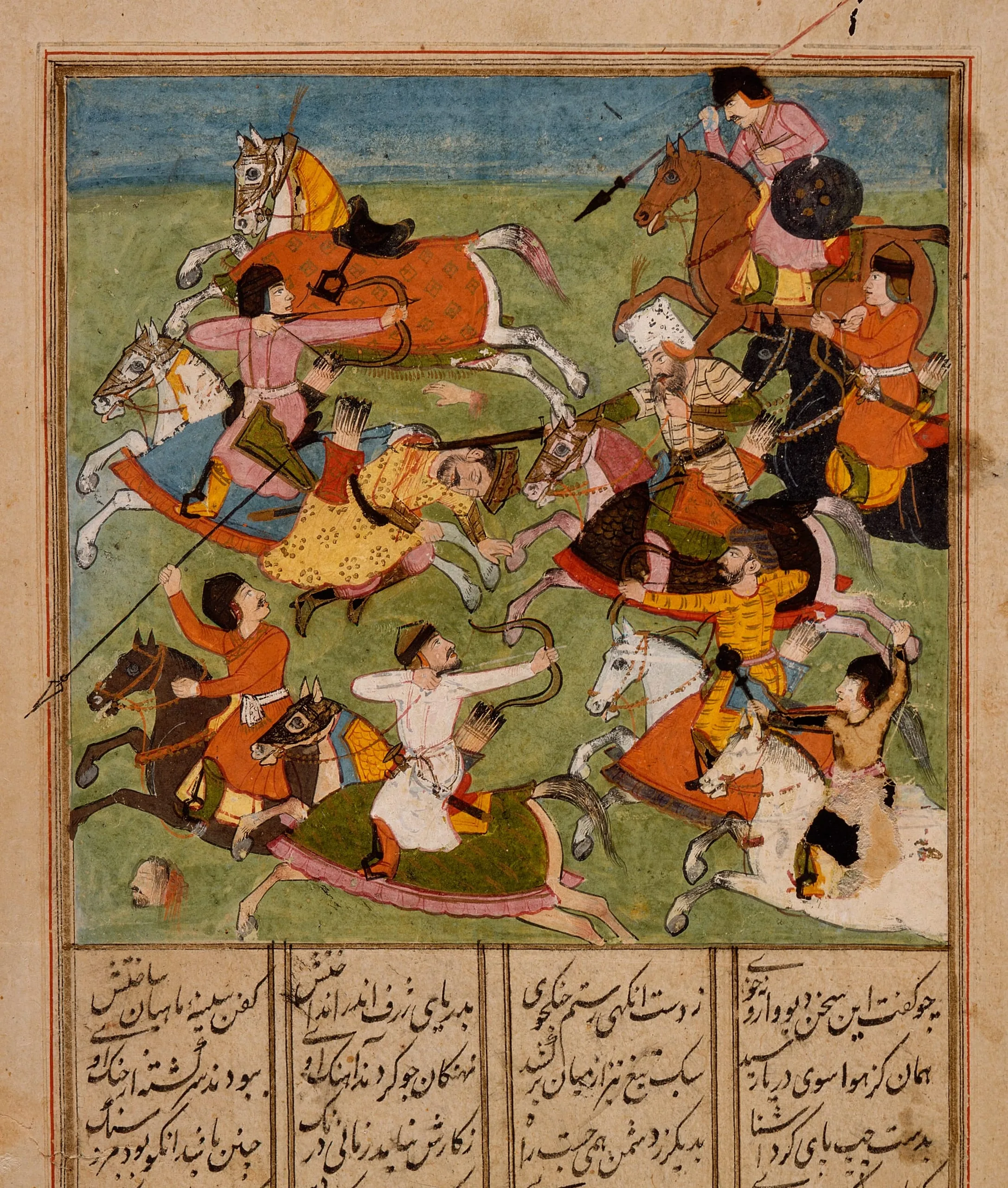
The Shahnama (Book of Kings) is an epic Persian poem composed by Firdausi (or Ferdowsi; circa 934-1020) in circa 977-1010. It narrates the legendary and historical past of the Persian Empire until the Arab Muslim conquest in the 7th century. Shahnama manuscripts were frequently produced throughout the Islamic world, including the Mughal Empire (see M.78.9.5).
This folio is from a Shahnama manuscript attributed to Delhi, early 17th century.
Rustam, the legendary Persian hero immortalized in the Shahnama, can be recognized in the center among the warriors on the right by his white leopard head-helmet and a tiger skin-jacket worn over his magical suit of body armor made of dragon skin (Babr-e Bayan). He rides his rose-colored stallion, Rakhsh. In this unidentified battle scene (the textual verses have yet to be translated), Rustam has used his sword to hack the shoulder of the opposing king, identifiable by his crown, which causes the dead king to fall off his now-riderless horse in the top left. The king’s fleeing troops fire arrows back at Rustam’s soldiers using the “Parthian shot,” in which archers on horseback at full gallop turn around in their saddle to shoot at a pursuing enemy. Made famous by the Parthians (Iran, 3rd century CBE–3rd century CE), this calvary tactic was also utilized by succeeding Central Asian and Muslim armed forces.
See also 39.12.72, 57.17.3, 57.17.4, 57.17.7, 57.17.10, M.71.49.3, M.73.5.609, M.75.52, M.78.9.5, M.81.12a-b, M.85.189, and M.90.160.1.