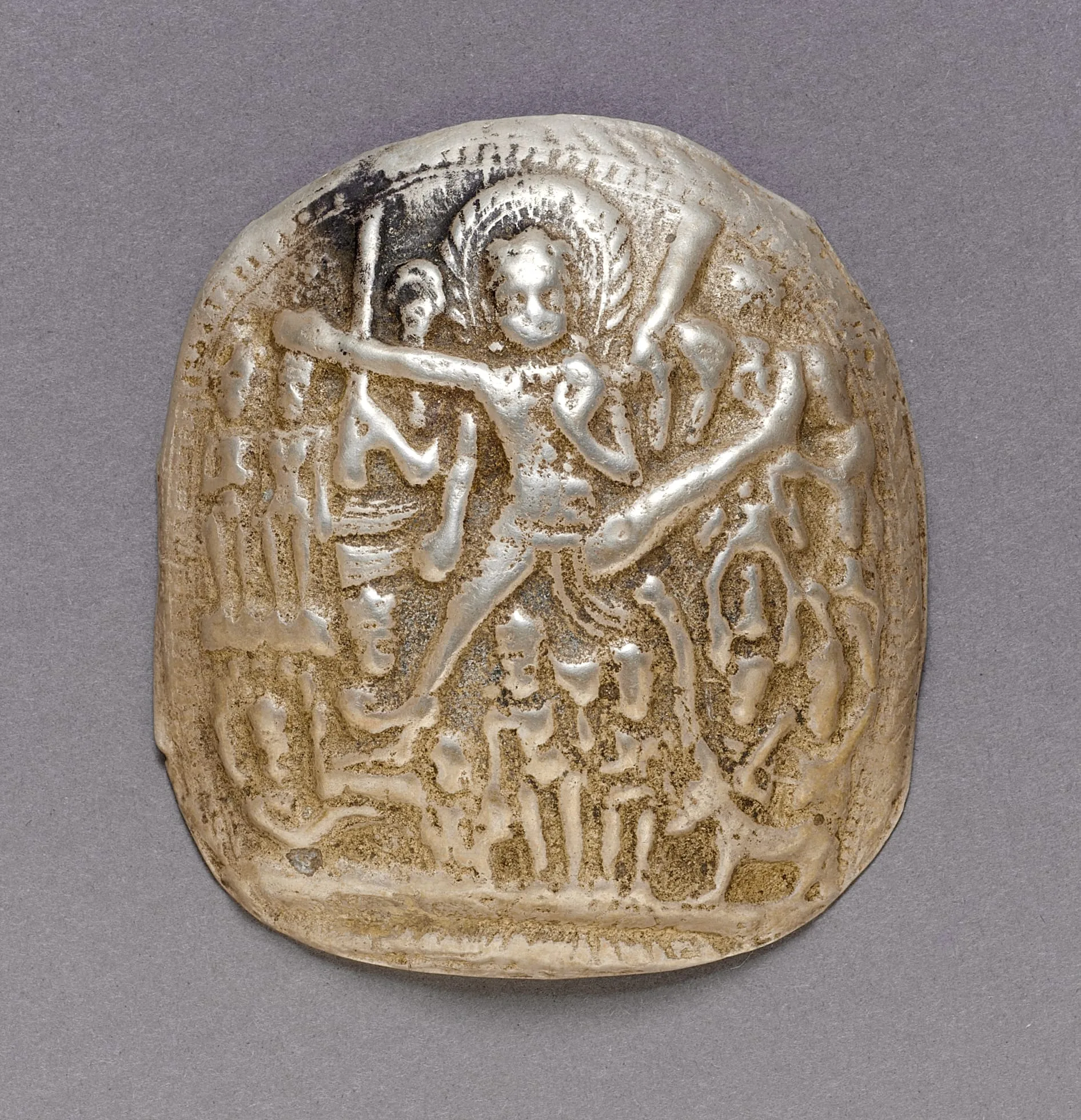
In his fifth incarnation (avatar), Vishnu, the Hindu God of Preservation, manifested as the dwarf Vamana to thwart the grandiose sacrifice of the demon king Bali who had defeated Indra, the King of the Gods, and assumed his throne in the heavens of the gods (Indraloka or Svarga). When Bali offered the lowly Vamana anything of his choosing, Vamana humbly asked for all the land he could cover in three steps. After Bali granted his request, Vamana instantly transformed himself in the colossal Trivikrama (The Taker of Three Steps). His first step encompassed the earth, his second step traversed the entire sky, and his third step enveloped the celestial regions. Bali was thus defeated and relegated to rule a minor domain. Here, Trivikrama stands with his left leg upraised and pointed to the heavens to represent his three cosmic strides. He is crowned, nimbate, and has eight arms holding multiple attributes.
Depictions of Trivikrama are common in Nepal, where they are typically known as Vishnu-Vikranta (Vishnu's Strides). Attributed to the 13th century, this repoussé silver medallion may have been inspired by one of the large relief sculptures of this theme, such as the 7th-century representation at the Changu Narayan Temple, Bhaktapur.
See also M.84.221.3 and M.84.58.1