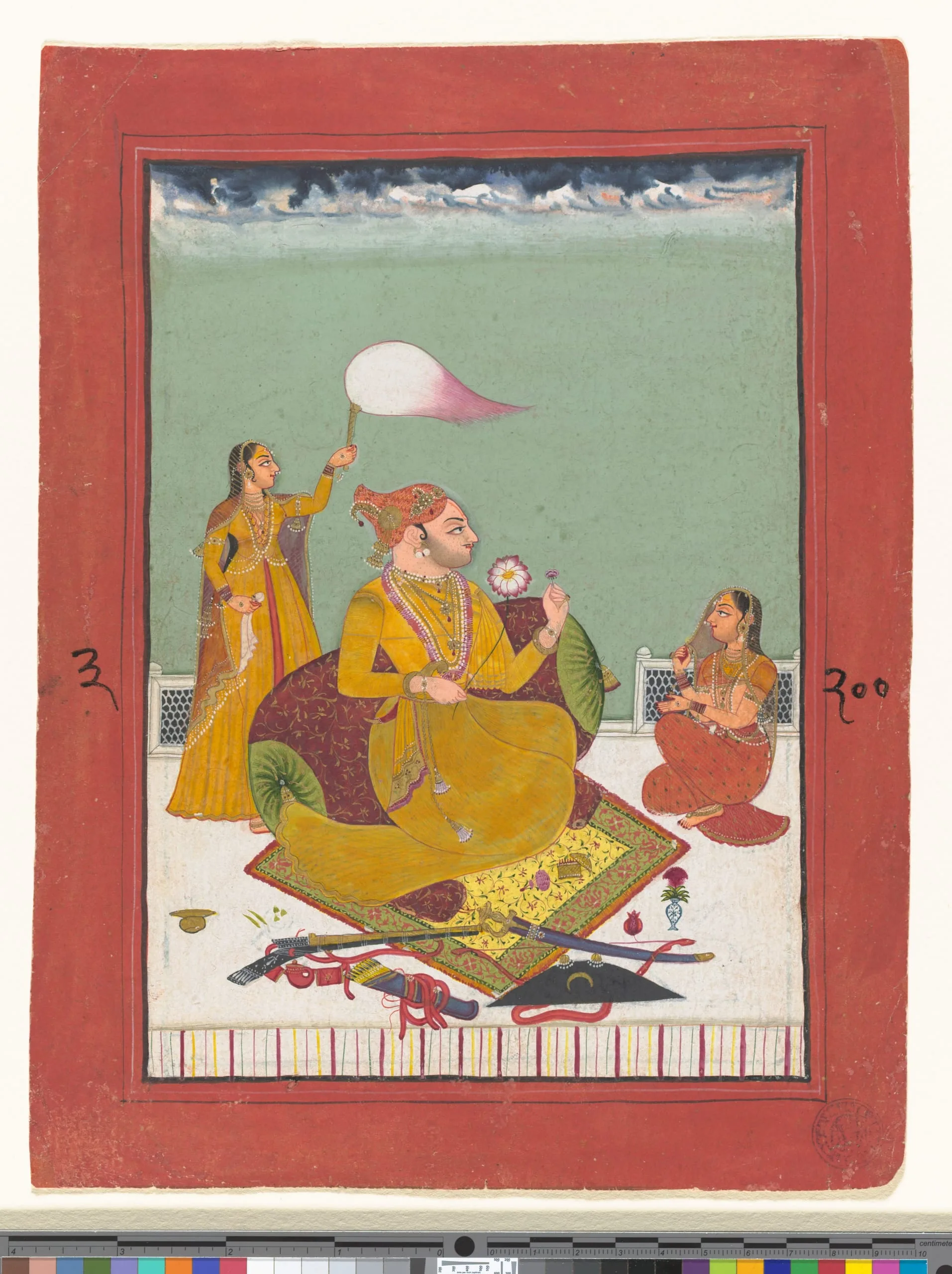
- Title
- Rao Raja Ajit Singh of Bundi (r. 1771-1773)
- Date Made
- circa 1775
- Medium
- Opaque watercolor, gold, and ink on paper
- Dimensions
- Sheet (Sheet): 10 1/8 x 8 in. (25.7175 x 20.32 cm)
Image (Image): 8 1/2 x 6 in. (21.59 x 15.24 cm)
Frame: 19 × 14 in. (48.26 × 35.56 cm)
- Accession Number
- AC1993.162.1
- Curatorial Notes
The devanagari inscription on the reverse of this painting identifies the subject as “Rao Raja Sri Ajit Singhji” of Bundi (r. 1771-1773). He was the nephew of Maharaja Dip Singh of Kaparan (see M.86.417.2). His brief rule was distinguished two months before his death in 1773 by his treacherous murder of Maharana Ari Singh II of Mewar (r. 1761-73), which is memorialized in a painting in the National Museum, New Delhi (47.110/2028).
Ajit Singh is depicted seated on a palace terrace with a female attendant behind him waiving an honorific fly whisk made with a white yak tail and, in front of him, a seated woman modestly veiling her face with her scarf. He has a pockmarked face and sectarian markings on his forehead. He wears an orange turban with a bejeweled plume in a turban brooch and, above his brow, the royal turban jewels of a jigha (similar to an aigrette) and a sarpati (horizontal tripartite ornament). Around his neck are golden necklaces with ruby pendants, strands of pearls, and a floral garland. He holds a lotus and a rose symbolic of his cultural refinement. Arranged beside him is his full princely regalia of a sword and shield; reflex bow and quiver of arrows; rifle with a powder primer flask and tinder pouch; golden betel box (pandan) and spittoon (ugaldan); and a blue-and-white ceramic flower vase. In the red border are the numerals “3” on the left and “200” on the right, and an indecipherable seal stamp in the lower right corner.