- Title
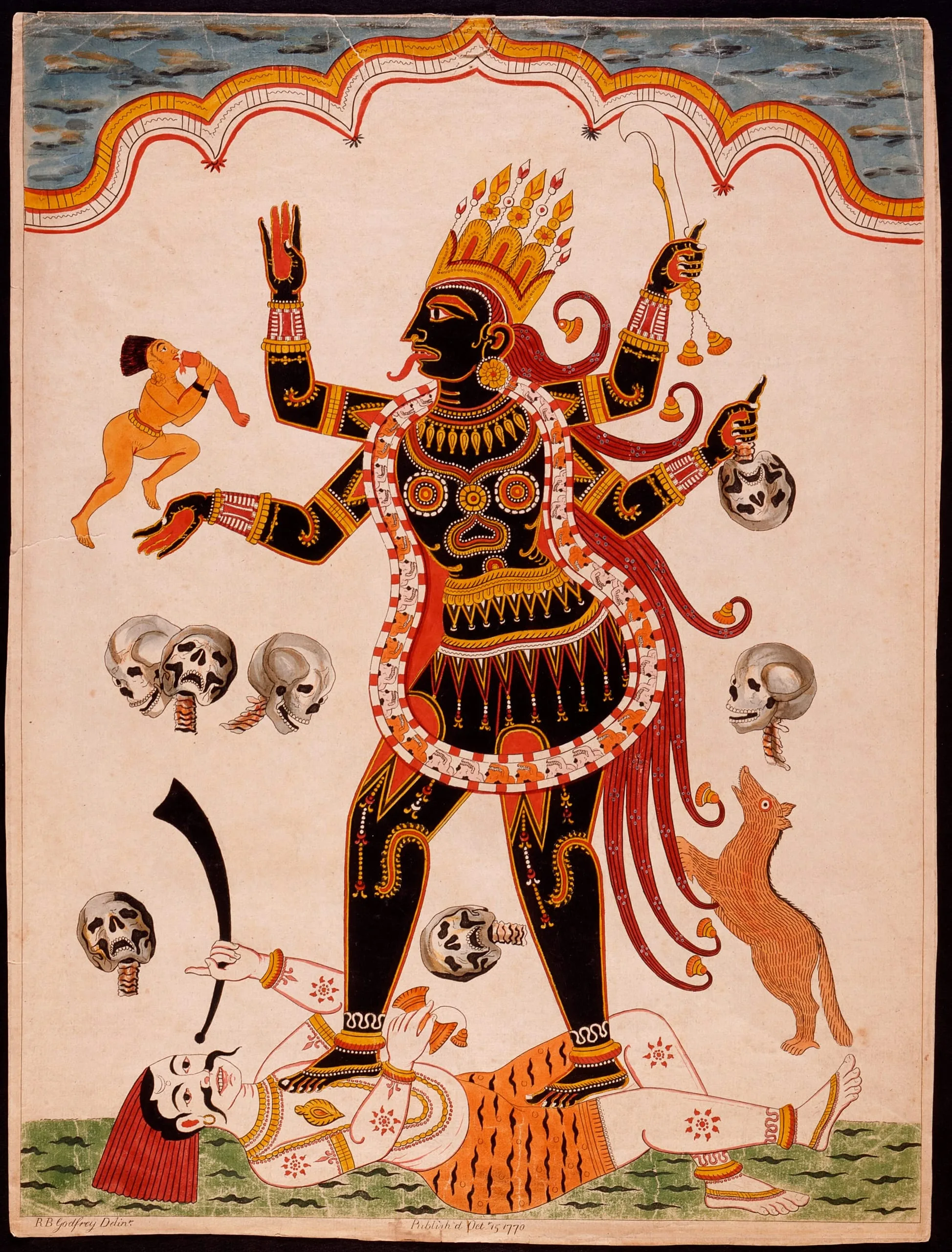
- The Hindu Goddess Kali
- Date Made
- 1770
- Medium
- Colored etching on paper
- Dimensions
- Sheet: 22 1/4 x 16 3/4 in. (56.52 x 42.55 cm); Image: 21 7/8 x 16 3/8 in. (55.56 x 41.59 cm)
- Accession Number
- AC1993.80.1
- Curatorial Notes
Although he has taken liberties with the decorative patterns on the bodies of Kali and the supine Shiva, and filled the scene with floating skulls, the English artist Richard B. Godfrey (b. 1728) has accurately portrayed the essential elements of Kali's and Shiva's iconography according to eastern Indian conventions. The image that Godfrey used as the inspiration for this print was most likely one of the forerunners of Kalighat paintings and ink drawings that were sold in the bazaars near the revered temple of the goddess Kali in the Kalighat area of southern Kolkata (formerly Calcutta) in the 19th- and early 20th-century. As this is the earliest work on paper that has come to light depicting Kali in a style closely related to that later developed by the Kalighat painters, this English print is thus an extremely important document for the study of the origins of Kalighat painting.
Little is known about the life of Godfrey or the circumstances behind the production of this work. We do know that it was used as the prototype for the plate of “Nareda or Callee” published in the Calcutta journal Asiatic Researches in 1788. In 1794, the same image, labeled "sufficiently savage and picturesque" was published in Thomas Maurice's (1754-1824) immensely popular Indian Antiquities, in which the artist has misunderstood the curtains at the top of the print and rendered them instead as clouds.
See also 37.28.17, M.83.48, and M.2011.5.