- Title
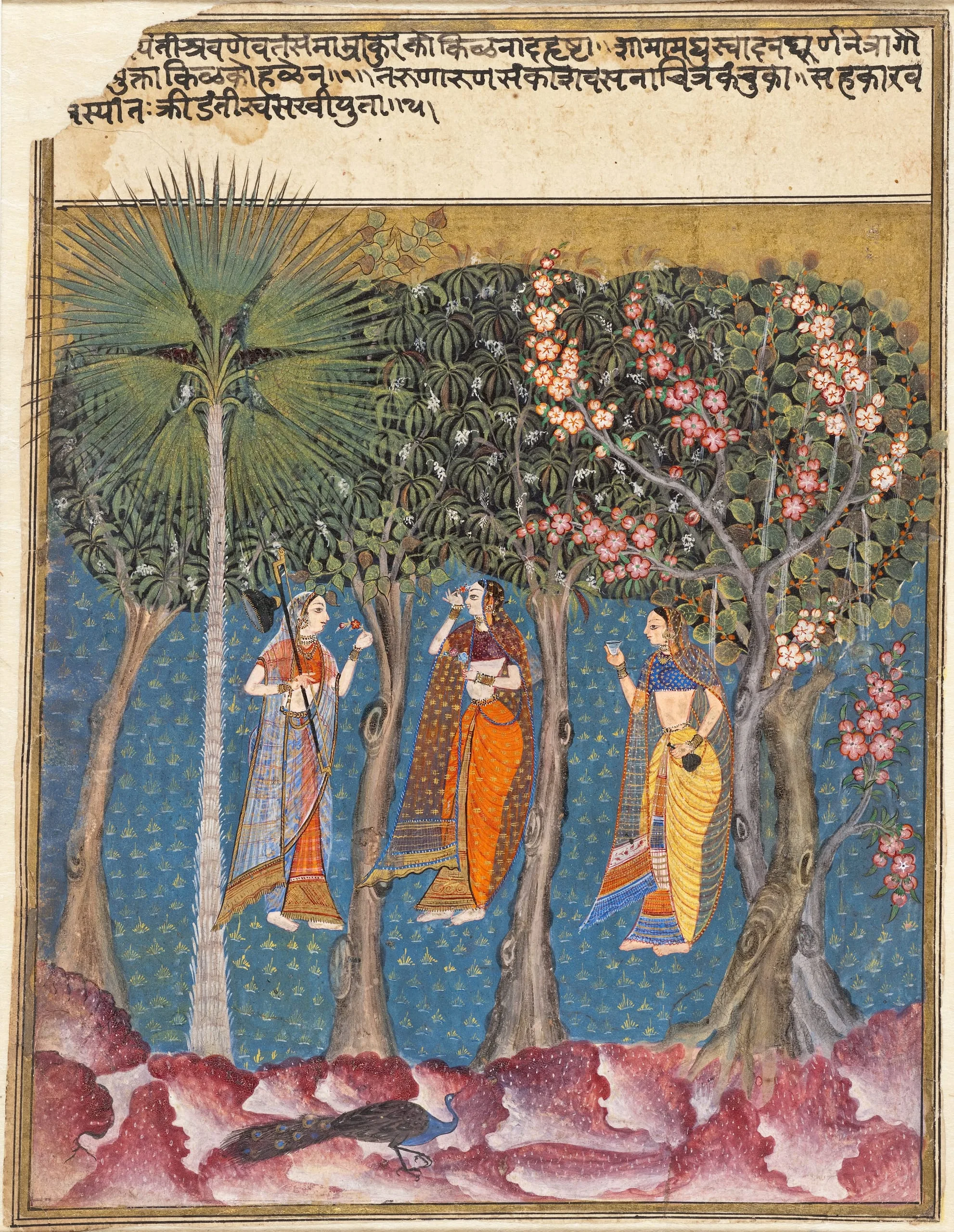
- Gauri Ragini, First Wife of Malkos Raga, Folio from a Ragamala (Garland of Melodies)
- Date Made
- late 16th century
- Medium
- Opaque watercolor, gold, and ink on paper
- Dimensions
- Image: 8 x 7 in. (20.32 x 17.78 cm); Sheet: 9 3/4 x 7 1/2 in. (24.77 x 19.05 cm)
- Accession Number
- M.90.141.2
- Curatorial Notes
Gauri Ragini is the first wife of Malkos Raga in the predominant system of ragamala classification generally known as the Rajasthani system. Early Deccani ragamalas, such as this exuberant example, typically accord to descriptions found in the Sangita Darpana (Mirror on Music) composed around 1625 by Damodara Mishra. Gauri Ragini is a soulful winter melody associated with the second quarter of the afternoon. It expresses the lamentation of a heroine over her unfaithful lover.
In the Rajasthani tradition, and in this early Deccani representation, the heroine is often visualized with a vina and holding sprigs of flowers while drinking wine and listening to music with companions and a peacock in the forest. Here, the exuberant landscape features a golden sky, a radiant fan palm, lush mango trees (Mangifera indica), bluish-gray ground with golden tufts of grass, and mulberry-colored stylized rocks forms along the bottom. The intertwined tree trunks on the right likely symbolize the heroine’s longing for love.
The Sanskrit text in the header reads,
She is putting on her ears ornaments of mango blossoms made beautiful by the voice of the cuckoo.
She has a shining complexion and has a sweet and delicate voice.
Such indeed is Gouri [or Gauri] spoken of by Kohala [a south Indian musical theoretician, author of the Sangita Meru].
(Translation by O. C. Gangoly.)
- Selected Bibliography
- Pal, Pratapaditya. Indian Painting, vol.1. Los Angeles: Los Angeles County Museum of Art, 1993.
- Los Angeles County Museum of Art Members' Calendar 1991. vol. 28-29, no. 12-1 (December, 1990-January, 1992).
- Zebrowski, Mark. Deccani Painting. Berkeley: University of California Press, 1983.
- Haidar, Navina Najat, and Marika Sardar. Sultans of Deccan India, 1500-1700: Opulence and Fantasy. New York: Metropolitan Museum of Art, 2015.