- Title
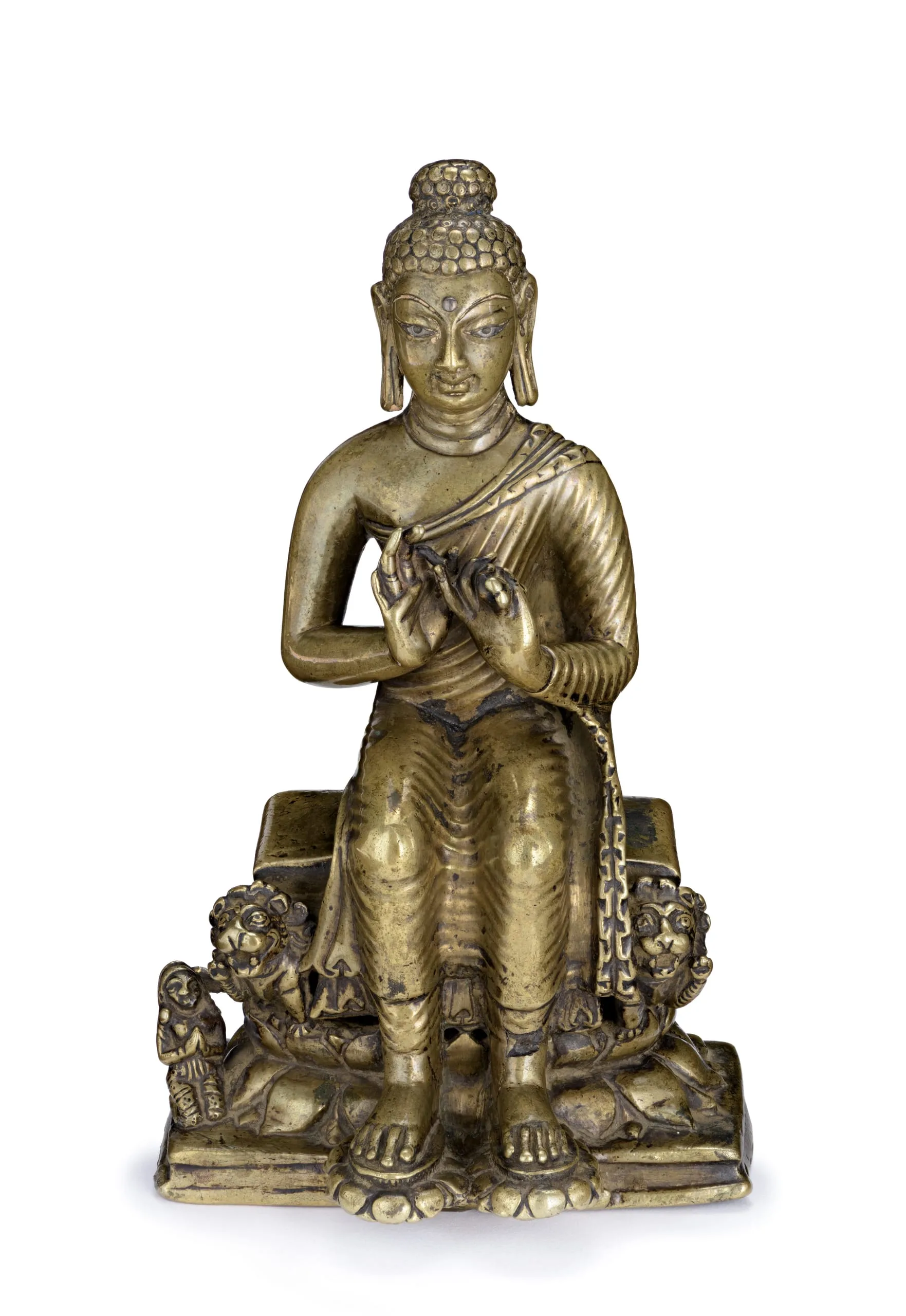
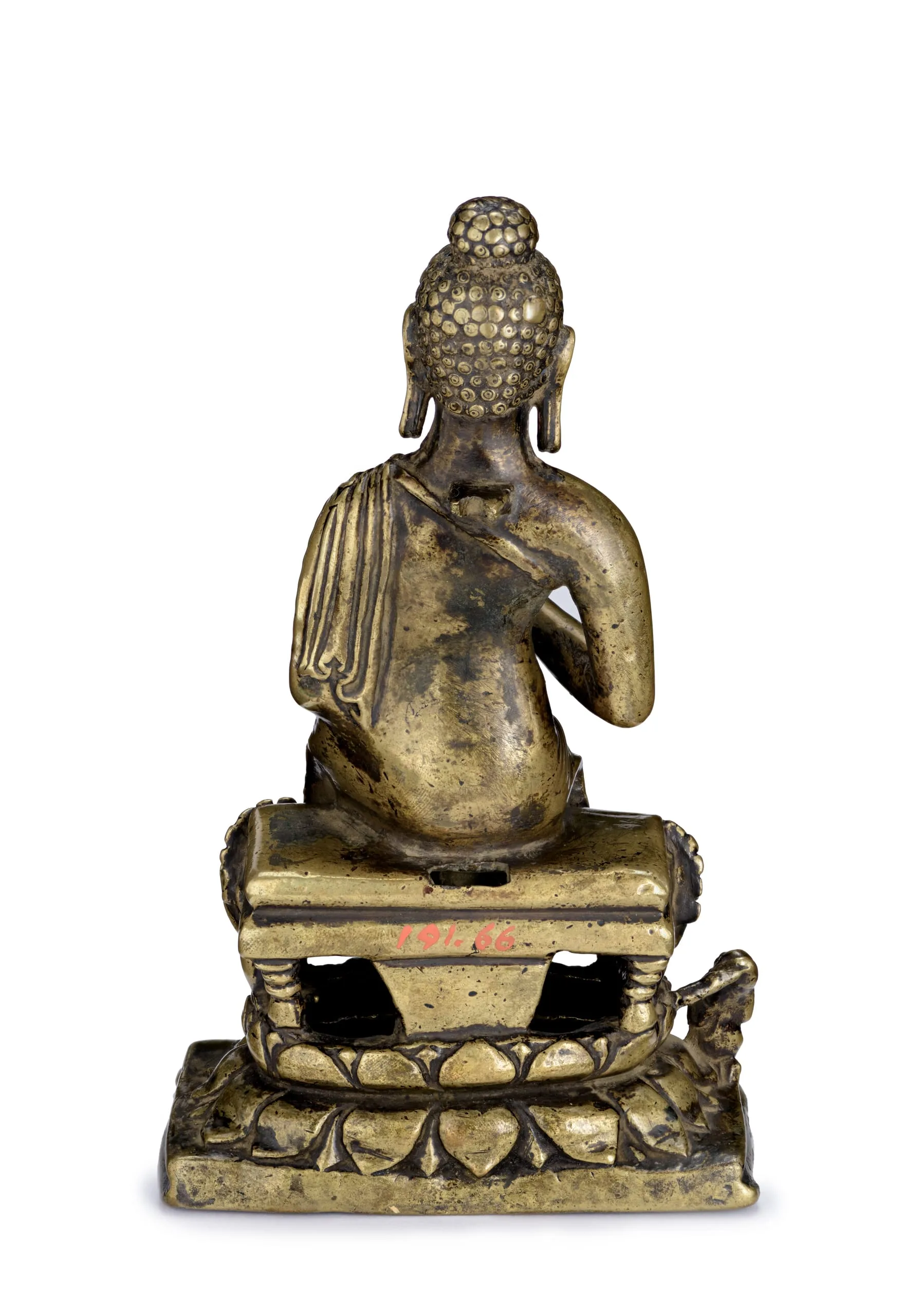
- Buddha Shakyamuni or the Bodhisattva Maitreya Seated in European Posture
- Date Made
- 9th century
- Medium
- Brass inlaid with silver
- Dimensions
- 7 1/8 x 4 3/16 in. (18.09 x 10.63 cm)
- Accession Number
- M.76.2.33
- Curatorial Notes
As a node along the silk route, Kashmir was a vital region for the transmission of the Buddha’s pleated heavy robes from the Gandharan region of Pakistan and Afghanistan to central Asia and the Western Himalayas. The Buddha represented here holds his hands in a teaching gesture, (dharmachakra mudra), and may possibly be identified as the historical Buddha Shakyamuni (traditionally dated to 563–483 BCE). However, the pose of the figure, whose feet are pendant in the so-called European posture and rest on lotuses (pralamba padasana), rather than being crossed in meditation (dhyana asana), is closely identified with the future Buddha, Maitreya. The image has the cranial protuberance (ushnisha) emblematic of his omniscience and the circular forehead marking (urna) indicating his enlightenment. He sits on a lion throne associated with royal imagery that emphasizes his spiritual sovereignty. The kneeling female with her hands held in the gesture of devotion (anjali mudra) is likely the pious donor of the sculpture.
- Selected Bibliography
- Pal, Pratapaditya. Indian Sculpture, vol.2. Los Angeles: Los Angeles County Museum of Art; University of California Press, 1988.
- Rosenfield, John. The Arts of India and Nepal: The Nasli and Alice Heeramaneck Collection. Boston: Museum of Fine Arts, Boston, 1966.
- Reedy, Chandra L. Himalayan Bronzes: Technology, Style and Choices. Newark: University of Delaware Press, 1997.
- Trabold, J. The Art of India, An Historical Profile. Northridge, CA: California State University Press, 1975.
- Glynn, Catherine. Aspects of Asian Art from the Los Angeles County Museum of Art. University of Redlands, 1972.
- Pal, Pratapaditya. The Sacred and Secular in Indian Art. Santa Barbara, CA: University of California, 1974.
- Little, Stephen, Tushara Bindu Gude, Karina Romero Blanco, Silvia Seligson, Marco Antonio Karam. Las Huellas de Buda. Ciudad de México : Instituto Nacional de Antropología e Historia, 2018.
- Little, Stephen, and Tushara Bindu Gude. Realms of the Dharma: Buddhist Art across Asia. Los Angeles: Los Angeles County Museum of Art, 2025.