- Title
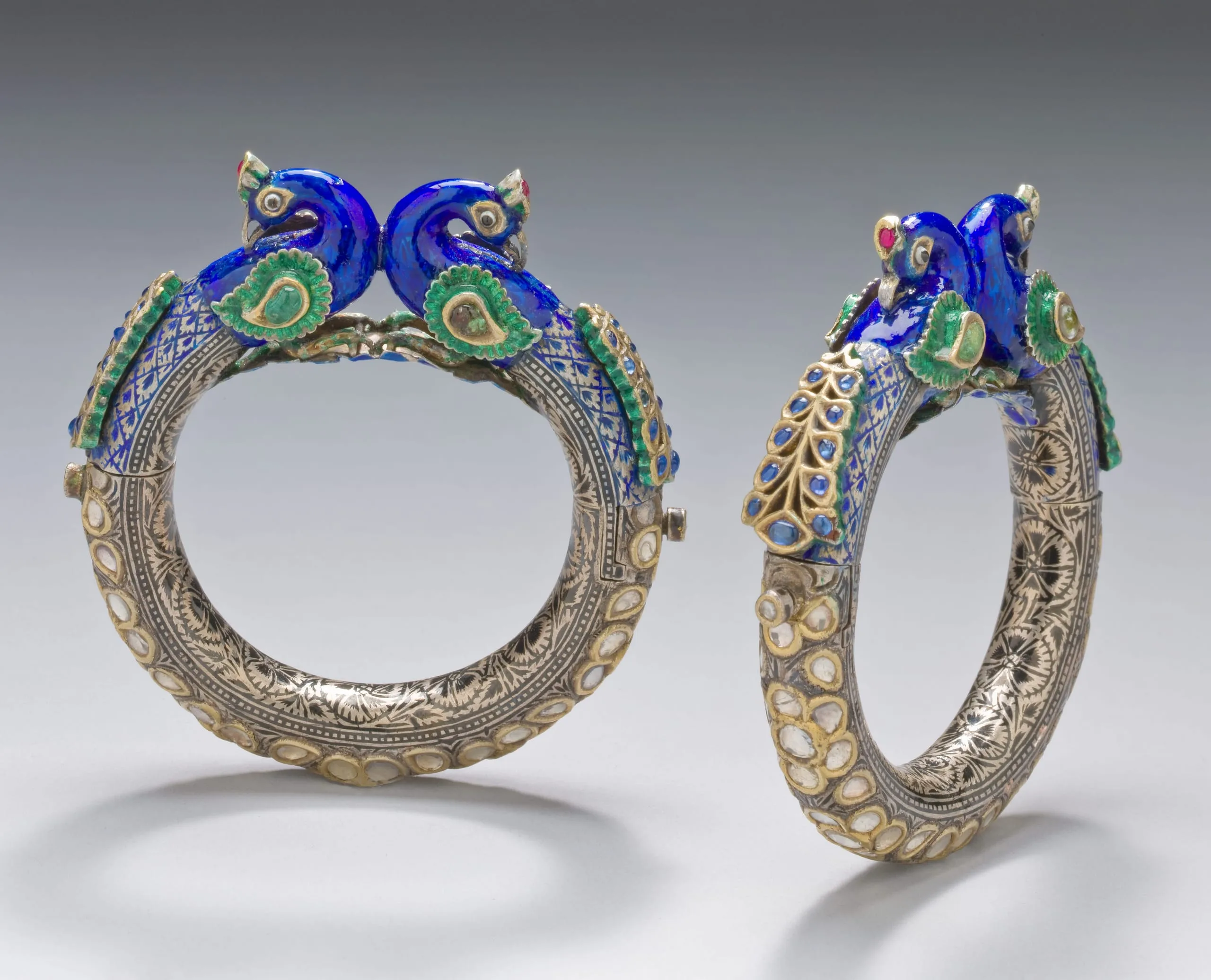
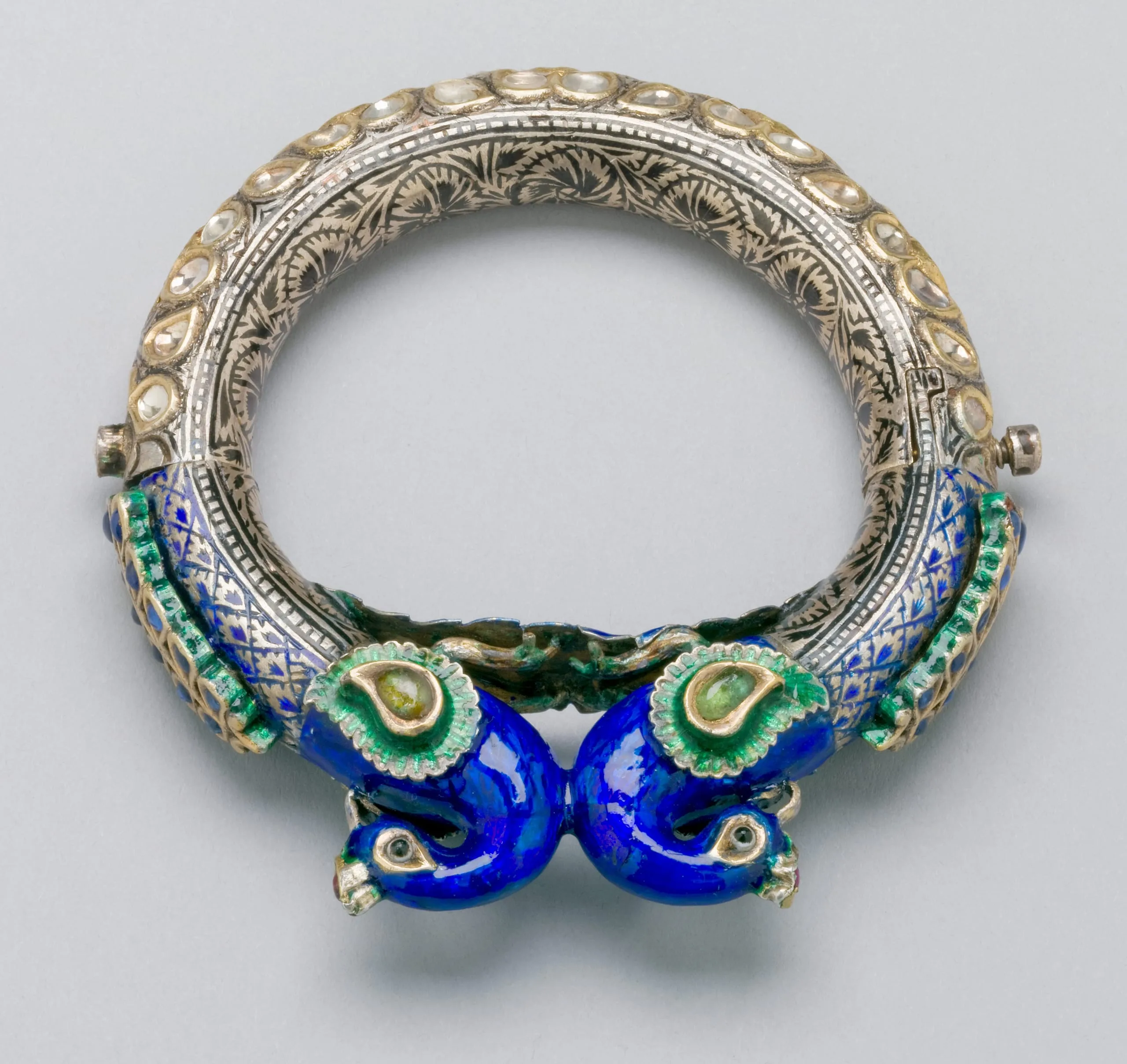
- Pair of Bracelets with Peacocks
- Date Made
- circa 1900
- Medium
- Enameled and partially gilded silver inlaid with emeralds, rubies, glass, and silicate minerals; paint
- Dimensions
- 3 1/2 x 3 3/8 x 5/8 in. (8.89 x 8.57 x 1.59 cm)
- Accession Number
- M.76.2.26a-b
- Curatorial Notes
These eye-catching bracelets have protome terminals in the form of confronting peacocks. They are hollow and made in two horizontal sections with a hinge on one side and a setscrew securing the opposite shank. The peacocks have bejeweled crests, feathers, and a long tail or train. The exterior radius on the top half is embellished with a foliated lattice pattern in translucent blue enamel. The exterior of the bottom half features clear stones set kundan-style in gilded silver. The interior on both halves is adroitly adorned with a stylized scrolling poppy vine in rare black enamel.
Animal-headed (tête-à-tête) penannular and pseudo-penannular bracelets and anklets have an ancient heritage in the Middle East and South Asia. Extant examples survive from at least as early as the 6th century BCE in Achaemenid Persia and by the 2nd century BCE in Taxila. They can be made of enameled and/or gilded silver, silver, silver wire, gold, or jade. In addition to peafowl, common animal terminals are elephants, tigers, lions, serpents, and makaras (mythical aquatic creatures). Elephant-headed and makara-headed bracelets were particularly prevalent in the distinctive pink enameling of Varanasi in the 19th century.
- Selected Bibliography
- Rosenfield, John. The Arts of India and Nepal: The Nasli and Alice Heeramaneck Collection. Boston: Museum of Fine Arts, Boston, 1966.