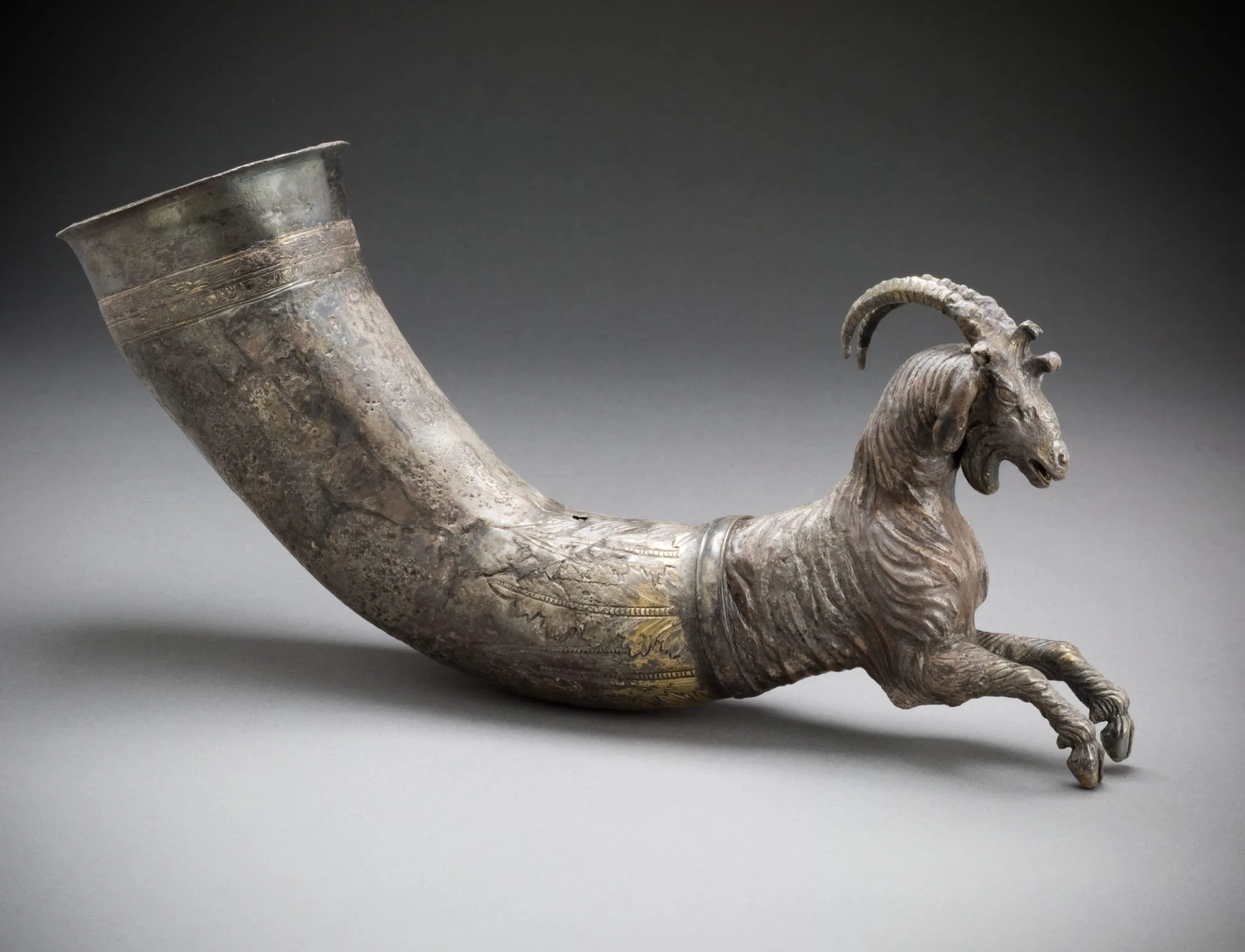
- Title
- Parthian Rhyton
- Date Made
- 150 B.C. - A.D. 225
- Medium
- Gilded silver
- Dimensions
- 6 × 14 1/2 × 3 3/4 in. (15.24 × 36.83 × 9.53 cm)
- Accession Number
- AC1992.284.1
- Curatorial Notes
Most likely derived from the custom of forming drinking cups from animal horn, the rhyton was a popular type of vessel in the ancient world, including Iran, where it first appears in ceramics by the second millennium BCE. Some of the most dazzling Persian examples, beginning in the second half of the first millennium BCE, were made of precious metal, with the forepart of an animal forming the protome, and a hole in the front, sometimes in the animal’s chest or mouth, from which the liquid could flow. This spectacular rhyton belongs to the period of the Parthian dynasty (150 BCE–225 CE) and reflects the long-standing tradition and great facility and sophistication of Persian artisans working in silver (see AC1992.152.76 and AC1992.152.82). Here, the protome is in the shape of a lively goat with raised front legs. The naturalism of the goat, with its carefully detailed horns and swirling fleece coat, further animates this hybrid vessel, while the gilding adds color and richness to what was undoubtedly a courtly object.
2025
- Selected Bibliography
- Mousavi, Ali. Ancient Near Eastern art at the Los Angeles County Museum of Art. Los Angeles: Los Angeles County Museum of Art, 2012.