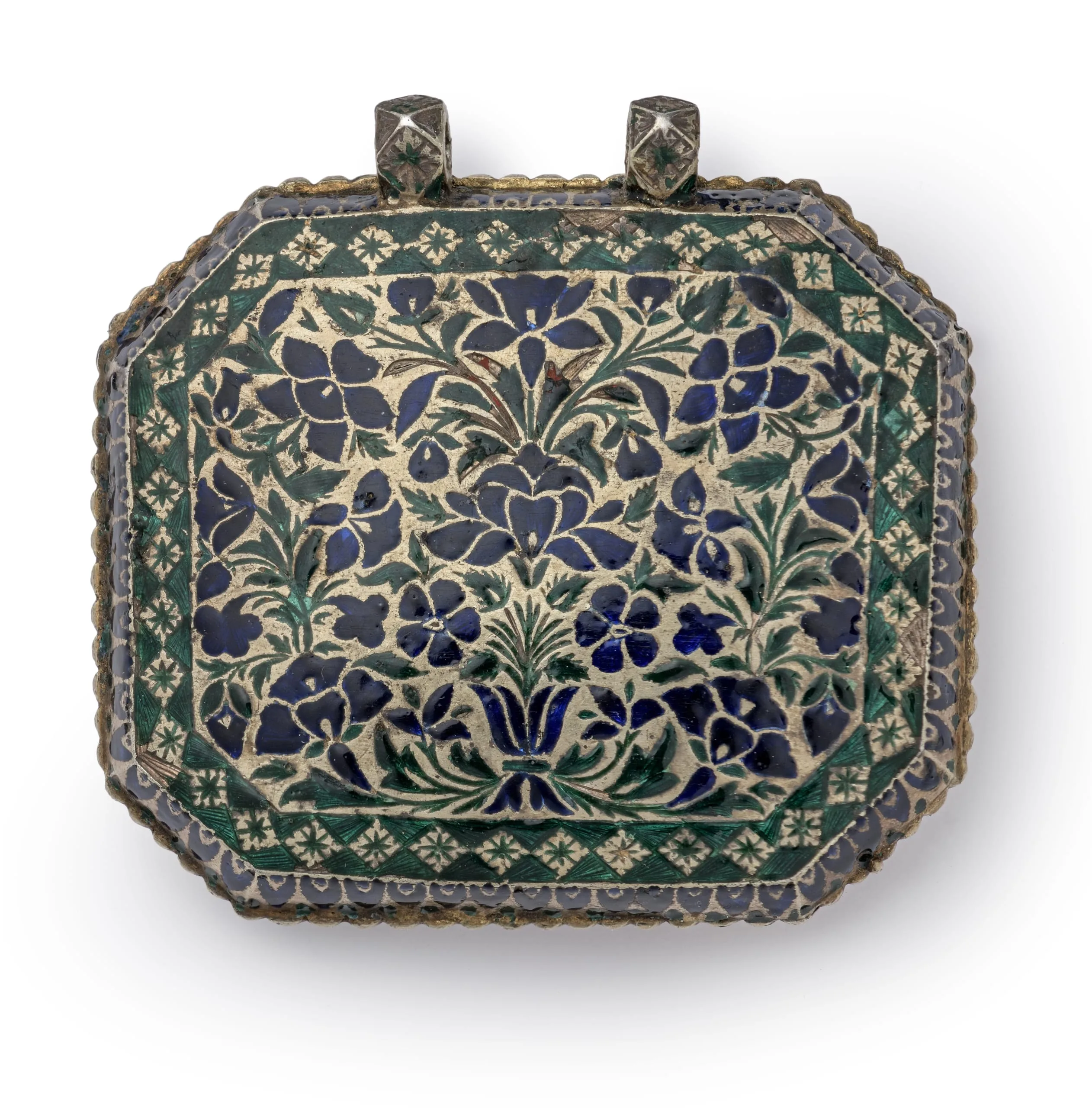
The amulet case is an elongated octagonal box of enameled and gilded silver. A small scroll of paper, likely inscribed, is inside the bottom compartment. The obverse, or top compartment, is a single turquoise slab set into a bezel. A verse from the Qur’an (40:44) is inscribed with red foil-backed glass set in gold channel settings: "I entrust my cause to Allah. Verily, Allah sees (all His) servants." (Translation by Z.A. Desai)
The LACMA amulet case epitomizes a jewelry tradition of ornate octagonal pendants and amulet cases that existed in Hyderabad and other sites in the Deccan. Bejeweled pendants worn by royalty and the nobility not only serve as bodily ornaments and to display personal wealth, but they can also be visual indicators of political status or a particular cultural or ethnic identity. Certain pendants or amulets are believed to provide the wearer with prophylactic protection from malevolent forces. Usually made of precious or apotropaic materials, they are empowered with inscribed sacred verses and/or astrological, numerical, or mystical symbols written on paper. In the Indo-Islamic tradition, protective amulets are often inscribed with the ninety-nine names of God (Allah) and Qur’anic verses. Hadith (the sayings of Muhammad) are believed to be the most efficacious.
The reverse, or bottom compartment, is gilded silver with an elaborate floral design in translucent dark blue and green enamel of a poppy-like tripartite flowering plant rising from a stylized vase with a splayed foliate foot. The strong verticality of the design and its prominent center motif parallels the flowering tree used to adorn a type of protective jade amulet known as a haldili (Arabic: condition; Persian: heart), which was worn for its ostensible protection against heart palpitations.