- Title
- The Bodhisattva Maitreya
- Date Made
- circa 1000
- Medium
- Leaded brass inlaid with silver; traces of paint
- Dimensions
- 8 1/4 x 4 5/8 x 1 7/8 in. (20.95 x 11.74 x 4.76 cm)
- Accession Number
- M.76.2.34
- Curatorial Notes
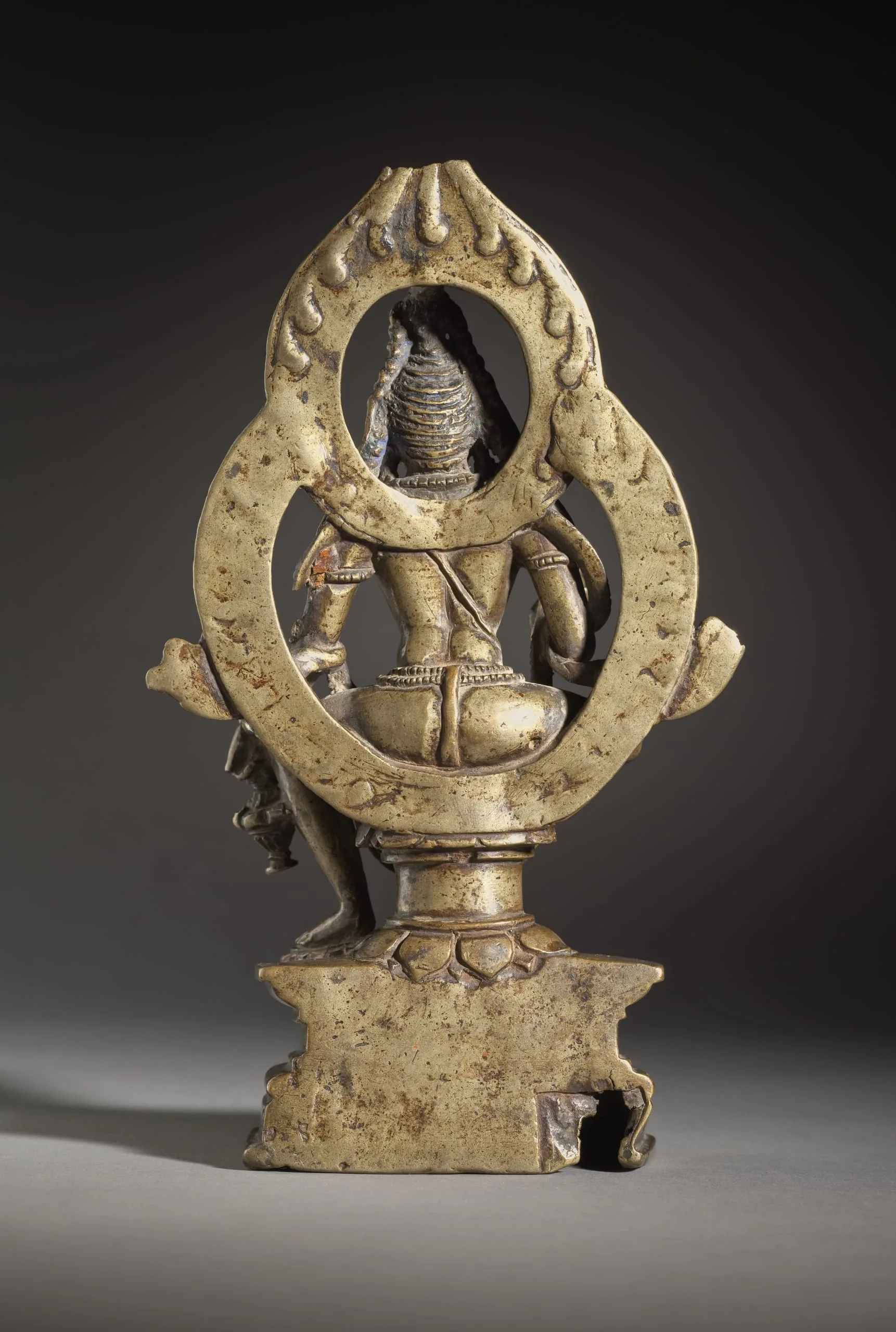
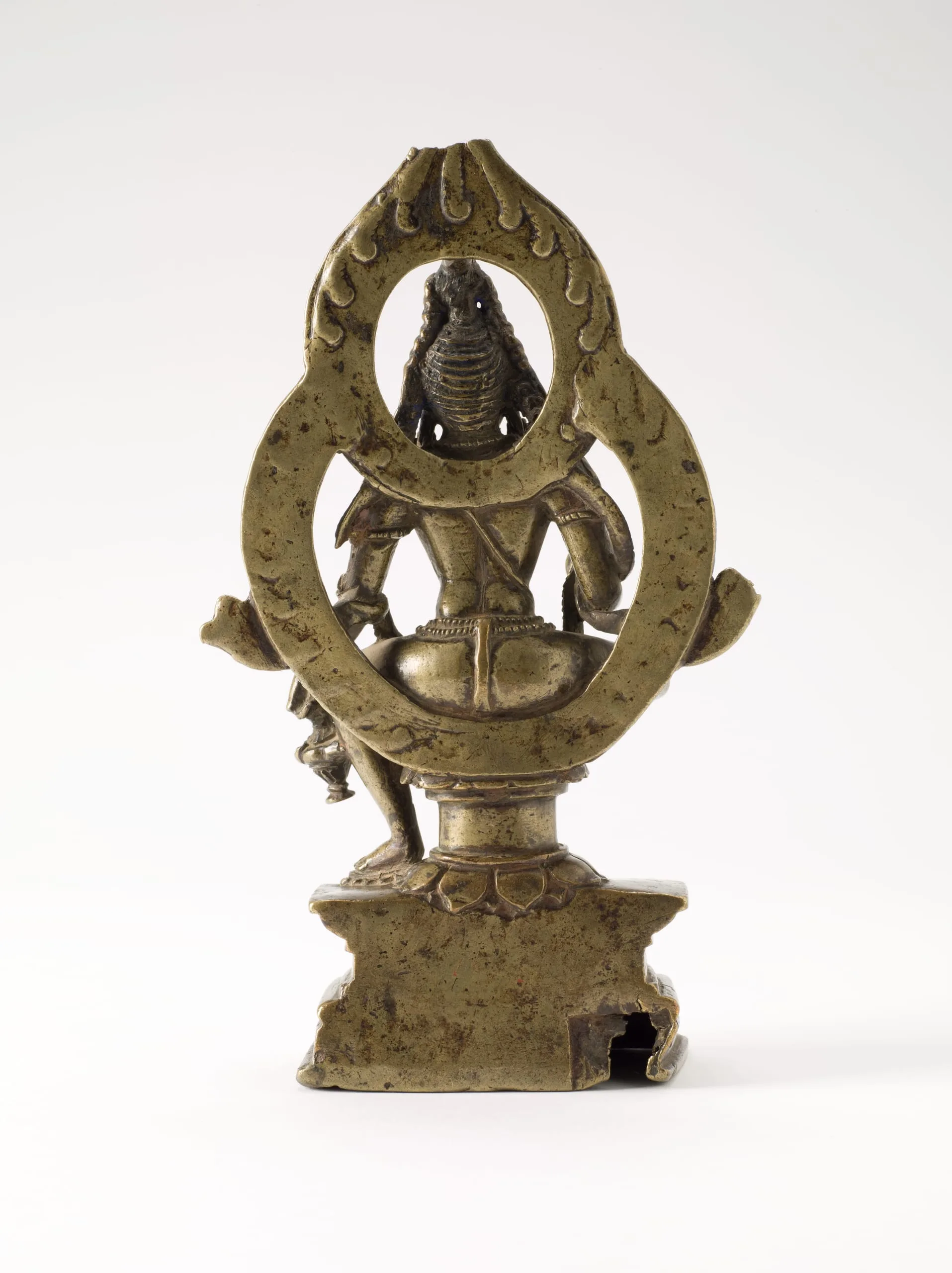
Maitreya, the Buddha of the Future, is here represented as a bodhisattva. He has an ascetic’s piled hair that is graced by a small stupa (funerary mound), thus confirming his identification as Maitreya. He wears abundant jewelry and has a long forest garland (vanamala) draped over his shoulders that hangs below his knees. He sits on a tall lotus base and pedestal in a variant of the relaxed posture (lalit asana) with his left leg pendant instead of the more customary right leg. Behind him are a separate nimbus and aureole (prabhavali), both executed with a flaming border. He holds a rosary in his right hand and a fluted water pot in his left hand.
At some point, this sculpture was evidently in worship in Tibet. There are traces of blue paint in his hair and gold paint on his face, both Tibetan stylistic features. A short Tibetan inscription is also etched into the front of the base. It reads, rgya (Indian) and klad or glad (both meaning head or primary) or possibly gling referring to a (sacred) place perhaps in India. (Linrothe 2014, pp. 66 and 104, note 133)
- Selected Bibliography
- Pal, Pratapaditya. Indian Sculpture, vol.2. Los Angeles: Los Angeles County Museum of Art; University of California Press, 1988.
- Rosenfield, John. The Arts of India and Nepal: The Nasli and Alice Heeramaneck Collection. Boston: Museum of Fine Arts, Boston, 1966.
- Reedy, Chandra L. Himalayan Bronzes: Technology, Style and Choices. Newark: University of Delaware Press, 1997.
- Pal, Pratapaditya. The Sacred and Secular in Indian Art. Santa Barbara, CA: University of California, 1974.
- Linrothe, Robert N. "Kashmir and 'Collecting Paradise'." Orientations 46, no.1 (2015): 60-67.
- Linrothe, Rob. Collecting Paradise: Buddhist Art of Kashmir and its Legacies. New York: Rubin Museum of Art, 2014.
- Little, Stephen, and Tushara Bindu Gude. Realms of the Dharma: Buddhist Art across Asia. Los Angeles: Los Angeles County Museum of Art, 2025.