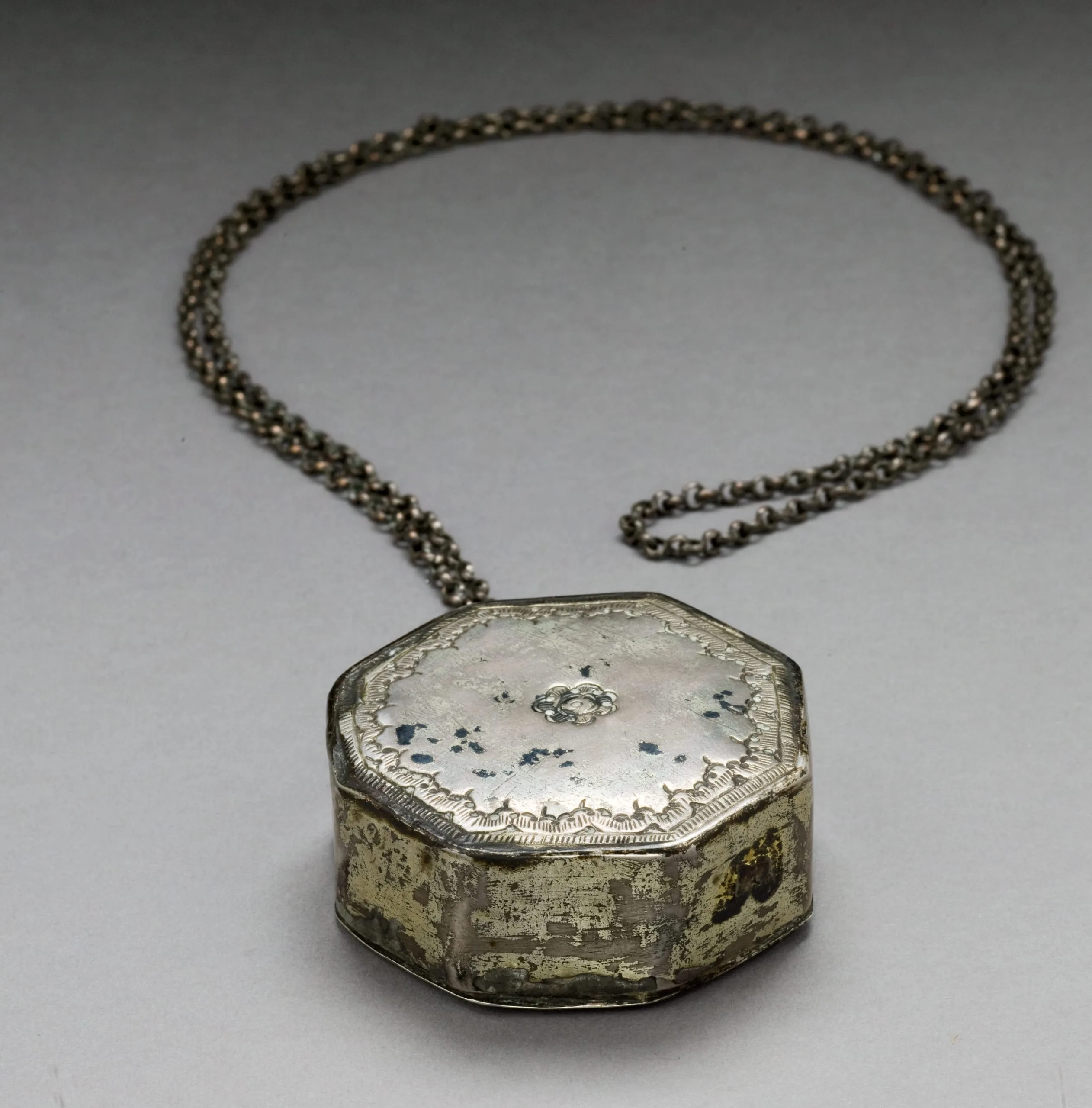
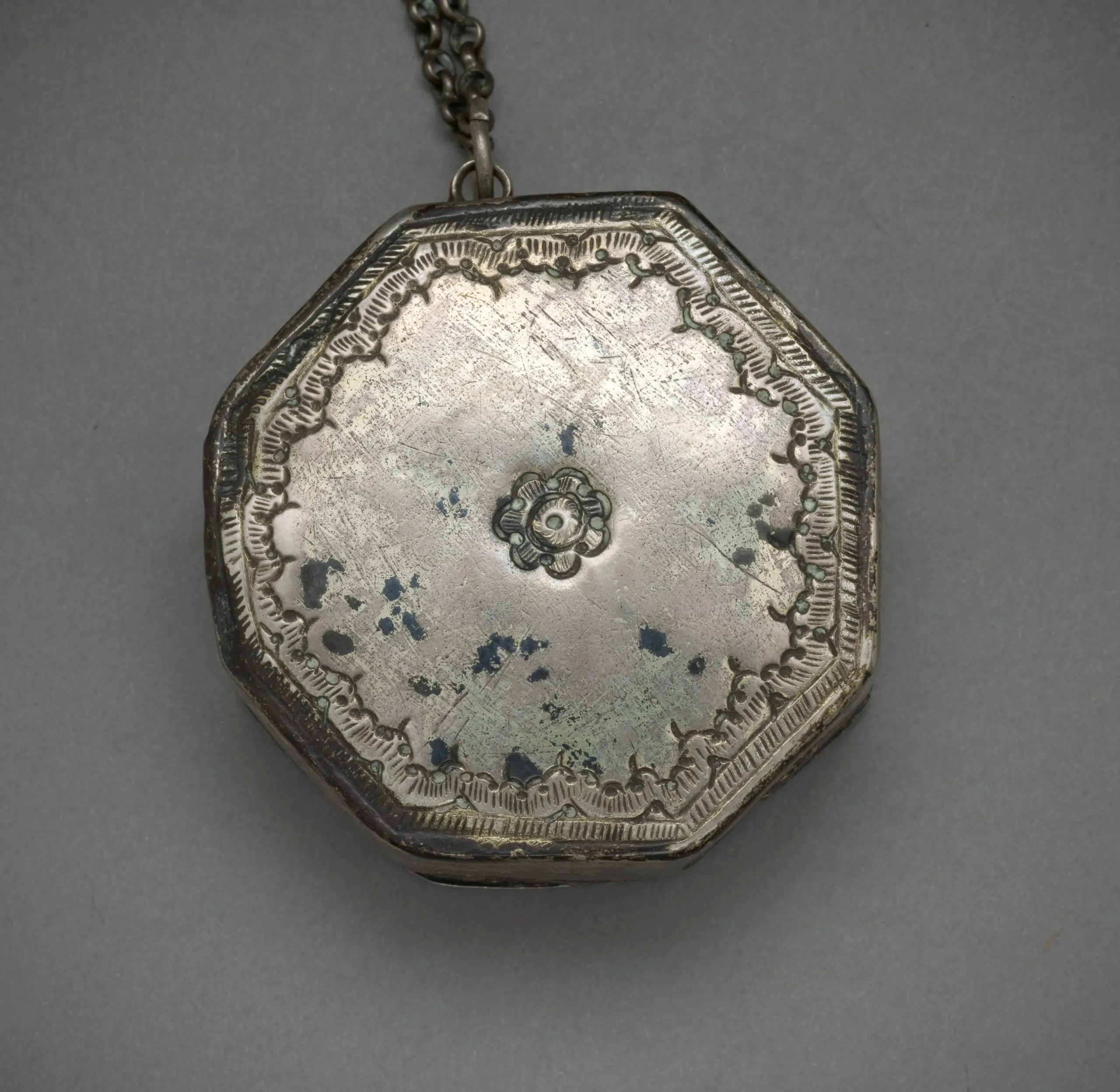
Despite its diminutive size, miniature octagonal Qur'ans, often preserved in silver cases such as this, carried powerful meanings to their users as amulets. They are similar in shape to other talismanic pendants and could be worn around the neck hanging close to a believer’s heart. Fittingly, the long chain of this silver case also allowed the Qur'an to be easily attached to a battle standard during war, which is where this type of codex garnered its best-known name as the sancak or “banner” Qur'an.
Miniature Qur'ans gained popularity across the Ottoman empire during the early modern period, also appearing in India, Iran, and sub-Saharan Africa with production continuing into the twentieth century. Owners of numerous backgrounds possessed these works, sometimes commissioning lavish cases befitting their status. Since this case uses a simple incised design, wherein a scalloped border frames a small rosette, the owner likely came from a humbler origin than the court. Even so, the artist(s) took care to add illumination that hearkened to trends in wider luxury book production of the period.
They not only offered a visual manifestation of faith, miniature Qur'ans also were believed to hold apotropaic abilities, affording protection against evil or ill-will. Qur'ans of this size served as intimate objects whose protective potential relied on their proximity to the human body, not unlike talismanic shirts that could also feature parts or all of the Qur'an. In both contexts, the calligraphed divine word imparted magical potency to the amulet. One early-modern traveler related that some urban buyers never removed these amulets, even when bathing. Therefore, while an owner could use this object for devotional purposes, perhaps even heightened by the concentration needed to read such a small text, they could also benefit its protective presence in daily life. Part of their appeal also stemmed from the marvelous craftsmanship that enabled these Qur'ans to reach such reduced sizes.